FXGuide.com spoke to Richard Bluff, Production Visual Effects Supervisor for Disney+’s The Mandalorian, to discuss the advances in ILM StageCraft 2.0 that were used for the new bigger LED stage built for the second season. The team pioneered new techniques that could have a profound effect on how such stages are conceived moving forward.
“When we were doing season one, we spent months and months discussing how big that stage should be,” he explained. “With the success we were having, we felt as though this season we could be less conservative and we could try different things, different shapes. So, one of the things that we wanted to do was, was to have a different shape and bigger stage such that we can have a longer walk and talks.” Naturally as the stage grew in hardware size it also dramatically increasing the size of the technical task in driving even more visible pixels. For the 2nd season, ILM moved to an in-house real-time renderer, dubbed Helios and it also broke with the notion of how the stage could be filmed. For many filmmakers, the new LED stages are thought of as a circular stage or volume within which to film with in-camera 3D real-time backgrounds captured in camera. While this remains true, ILM and the production team also extended the concept to tracking the camera inside and outside the volume.
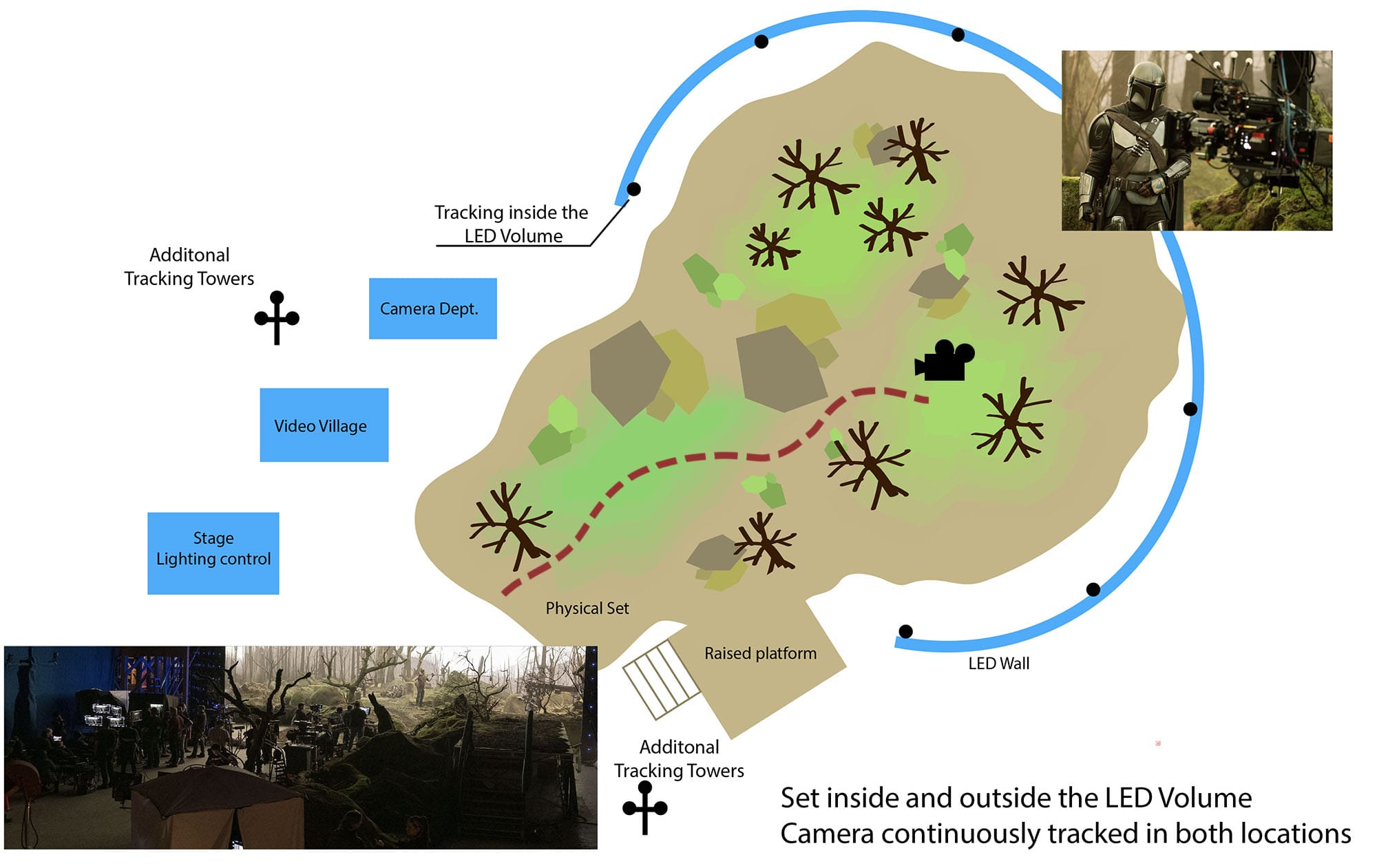
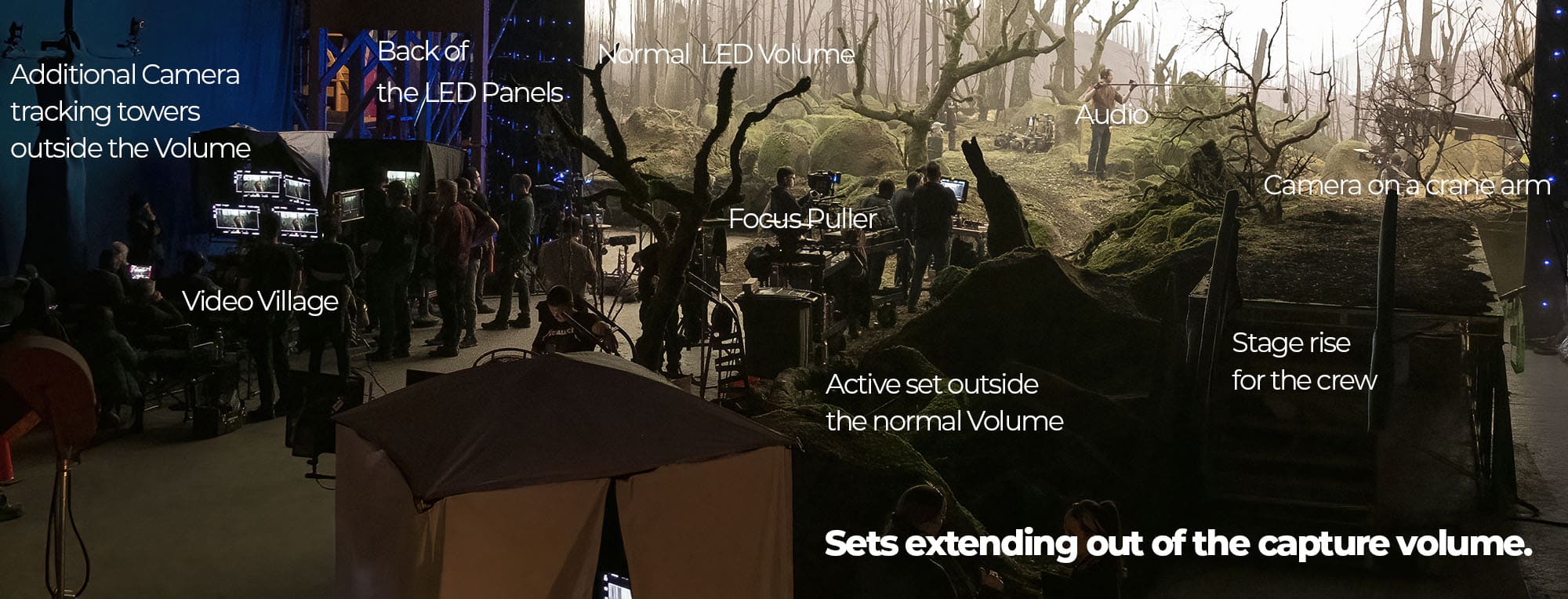
For key scenes, such as in episode 5 of season 2, the production extended a practical set out of the volume into the sound stage beyond it. In the episode The Jedi, written and directed by Dave Filoni, the Mandalorian tracks down Ahsoka Tano (Rosario Dawson), outside the city of Calodan on the deforested planet of Corvus. The entire episode is set outdoors, but filming inside on the volume allowed Filoni to control the lighting. When Mando is walking to first find Ahsoka, he walks through a burnt forest until he comes upon an open clearing. Unlike season one, the physical sets for this long continuous walk were built starting outside the volume. The set design was done so as to hide as much of the back (technical) side of the LED walls as possible, but the motion capture volume was extended into the normally technical areas of the stage so that the camera could be tracked moving continuously from outside the LED walls into the middle of the volume. Given the nature of the lens, any sections of the LED stage seen at the back of this long dolly shot, would be visually correct, but the lighting on the actors outside the LED volume was all traditional lighting. In-camera, the movement, and lighting appear seamless as the camera moves in one take from a traditional sound stage into a LED capture volume.
This is significant as it points to how ILM is innovating to produce multiple volumes and yet one integrated solution. ILM is opening the door to multiple connected volumes, multiple vertical volumes. One can image new and vast shots that travel from different rooms or spaces, with dynamic LED volumes via connected practical corridors, trenches or openings. This dynamic real-time world facilitated by possibly moving sets allowing for action sequences that could never before be designed for sound stage in-camera filming.Mando inside the heart of the set – seen above
ILM has developed a very strong relationship with all of the other departments such as production design, art department, or standby props (set decorations). “We scan what they source and what they build or paint,” points out Bluff. All props and on-stage elements are brought into UE4, which is used by all the departments in pre-viz, such as the virtual art department which also leverages VR for scouting and heads of department reviews. The final content can be created in Unreal, Houdini, 3DS Max or any number of other DCC packages, and then, for the shoot days, all of it gets seamlessly read into ILM’s Helios real-time renderer for accurate display on the LED walls. Collaboration is central to the StageCraft ILM pipeline.
Boba Fett’s ship, for example, flies vertically and lands horizontally but the audience has never seen how this managed to work. In The Mandalorian the interior of the ship is shown to be a type of gimbal, allowing the ship to rotate while the crew area remains seated correctly. In the behind-the-scenes Disney Gallery series, Jon Favreau commented that “Nobody’s ever seen what goes on inside that ship when it rotates. We’ve only seen the outside, so that was one of the inspirations for doing it on the stage, taking advantage of what the stage can do.”




This is significant as it points to how ILM is innovating to produce multiple volumes and yet one integrated solution. ILM is opening the door to multiple connected volumes, multiple vertical volumes. One can image new and vast shots that travel from different rooms or spaces, with dynamic LED volumes via connected practical corridors, trenches or openings. This dynamic real-time world facilitated by possibly moving sets allowing for action sequences that could never before be designed for sound stage in-camera filming.