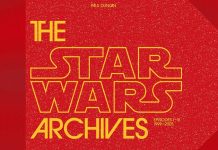
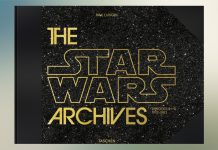
Ziro.hu interview Paul Duncan, the author of the excellent Star Wars Archives Episodes I – VI published by Taschen. He talks about his first day at Skywalker Ranch, the origins of the modern myth and what he learnt from his meetings with George Lucas.
Z. S.: How did you become a film historian? What are the questions that you seek answers to when you process a topic?
P. D.: I used to watch science fiction movies on television when I was a child: The Incredible Shrinking Man, Invasion of the Body Snatchers, Forbidden Planet, The Day of the Triffids, King Kong… These were all monumental films when I was growing up. When I was 13, I saw Star Wars, was fascinated by it and started to pick up magazines like Starlog and Starburst that showed how these films were made. I remember leaving school at lunchtime and finding that in the local bookstore there was a Making of Alien book with images by Moebius and H.R. Giger. I begged my parents for these things and then I started to make my own little magazines. I used to say, “I like that image,” “I like that article,” and began assembling my own fanzines. I also love comics and I combined everything into one magazine called Arken Sword, which became ARK. I published it for 10 years and it grew so it was distributed around the world. I interviewed comics artists and writers like Moebius, Jack Kirby, Will Eisner, Alan Moore, Ron Smith, Dave Gibbons, David Lloyd, Alan Davis, and many more, doing long interviews about their careers and how they made comics.
Cover of ARK 33 (1990) by Brendan McCarthy
From when I was 15 to now, everything I do is about stuff that I’m personally interested in. I want to know: how did they do that? And why did they do that? My day job was technical authoring; I wrote technical documents and “how-to” manuals for computer software and equipment. As a freelancer, I would travel around and when I got home, I worked through the night on my magazines. I became interested in noir writers from the ‘30s, ‘40s, and ‘50s, like Jim Thompson, Cornell Woolrich, Frederick Brown, and Gerald Kersh, so I started a magazine called Crime Time. For that, I interviewed novelists like James Ellroy and Patricia Cornwell. And then I started my own series of books about films, called Pocket Essentials. I love Hitchcock and Kubrick and Scorsese. This gave me an excuse to watch all the movies and then write about them. That work led me to being noticed by Benedikt Taschen at Taschen, the publishing company, for whom I’ve made film books for almost 20 years. I’m still a freelancer, working on projects where and when I can.
My work has always been about trying to find out what actually happened rather than what somebody said happened. And luckily enough, for the past 20 years, I’ve been able to get access to original materials and to the people. Although I work on these books with very talented colleagues, I spend a lot of time on my own, doing the text and image research, writing, and selecting the images for the layouts.
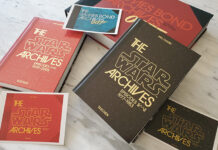
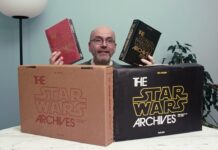
Paul Duncan writer with all six kilograms of The Star Wars Archives Episodes I-III 1999-2005
Was there any difference between Star Wars and the topics of your previous books e.g., James Bond, Chaplin or Ingmar Bergman?
I always go in with a completely blank slate. I never know what I’m going to do. I dive into the pool without knowing how to swim. I don’t know how deep it is. And I don’t know whether I’m going to get to the other side. It’s exciting and scary at the same time because the pressure is on me to produce, assemble, find a story—something that’s marketable—and also something that is meaningful for me. Because who wants to spend two years of their life doing something they’re not interested in? I have to be engaged by it.
How did you start your research?
On the very first day of the research in the Star Wars archives, where they have all the models that they used for concept and design, I just photographed everything in order to collect as much material as I could. In the end, not a single image of them was used in the book, but it gave me an introduction to the working processes used in the movies. Then I turned to the artwork drawers. For most drawers, they know what’s in them. But there were drawers, especially for the prequels, where they’d literally taken the drawers of Iain McCaig, Ryan Church, Erik Tiemens and Derek Thompson after the movies wrapped, and just put them into the archives and never sorted through them. The very first drawer I opened was Erik Tiemens’. There was this artwork about the rough storyline “seven battles on seven planets” for the original beginning of Episode III and I thought, “This is going in the book. That’s two pages done. Just 598 to go.” But I didn’t know how that was going to fit into the story.
Erik Tiemens’ rough sketches for Act I of Episode III from The Star Wars Archives Eps I-III
Was it always clear that you make two books?
No. The original plan was to include all six episodes in one book. I started looking through the materials and I felt there are two books here and I don’t want to choose between the materials. I’m an editor, so I’m supposed to reduce this to size, but don’t make me do this. I then had to talk to both Lucasfilm and to Taschen to persuade them both that it would be a good idea to make two books. Luckily, they both said yes. Then I knew that I could split up the research and use more material for both trilogies.
What was the point when you realized that digital transformation will be the main arranging topic of the prequel book?
It was after I’d done the first book on Episodes IV to VI. I knew that I wanted to do it that way but I didn’t know how I was going to cover it because quite frankly, it meant a lot of scary research into a very big field. Luckily, I picked up a book called Droidmaker and the first book on ILM (Industrial Light & Magic: The Art of Special Effects). That was the beginning. When I first talked to George the project was still at the stage where it was going to be one book for all six movies. But after it had been split, I sent a letter to George.
I wrote that I think we should do a book about the onset of digital technology and the fact that he was behind a lot of that development in terms of pushing it forward.
And I’m not just talking about CG. I’m talking about the editing, the camera, the production process—many things now used every day in movie production. We are doing this interview via Skype face to face. They were doing that as George was either on set or at the Ranch editing. They would do that with the VFX people at ILM and he could review their material. The technology is not just what you can see on the screen, but it’s everything behind it. And once I realized how wide-ranging that was, I wrote this letter to George and he said exactly the same thing, that that’s where you should drive it. And then he gave me a list of people that I should talk to.
Who were on that list?
Doug Chiang, Erik Tiemens, Ryan Church, Rick McCallum, John Knoll and Dennis Muren, among others. On my next visit to the Presidio in San Francisco, when Lucasfilm and ILM are based, I met all of them. One day I had an interview with Rick, and George was there too and it was basically three hours of George talking, and Rick adding information—it was fun to see them reliving everything. Afterwards, I went with Rick to do a separate interview.
These conversations led to the other aspect of the second book. In Episodes IV, V and VI I felt there were a few people like Ben Burtt, John Barry, Dennis Muren, John Dykstra, John Williams and others at ILM et cetera who really got Star Wars. These were people who understood it and gave 110, 120, 250% commitment to George. But in Episodes I-III Rick McCallum had brought together such a fantastic team—like Fred Myers and Mike Blanchard on the technical side, and everyone from the camera people to the VFX and costume/makeup/model making, every aspect of filmmaking, and you felt that everybody in the team was behind George on these. George was giving them the opportunity to go for it, the freedom to explore their own ideas. I think this aspect is really underrated about those movies.
George wasn’t remaking Episodes IV, V and VI. He was making something completely new in the same galaxy.
I noticed the story when George instructed the concept artists to make a design and after a few rounds, he pulled out a reference that he always had in mind.
He wants to see where people will go and then he will pick up what he likes. It’s an iterative process. But it’s also an iterative process for George in the writing—he’s working in the same way. He’s seen what they’re doing and that feeds back into the story and into the visuals because he’s also got to visualize it for himself. Sometimes he will have an idea but he wants the artists to reach it on their own. They find their path to the same place. Sometimes they go off a completely different way and he decides “well, that is the better way.” He’s completely open and free. And I think that’s very underestimated in terms of the creative process. There is this idea outside the film and television industry that you start with a fixed idea and then you carry out that vision to the end. In other words, there is no development or change. But my understanding of the creative process, from my investigations in multiple areas of expertise and creativity, is that people may have an idea at the beginning but the idea at the end is often different. This is because between then and now they’ve developed as people, as individuals. They have new influences, new ideas and they know more about the subject at the end of the process than they did at the beginning. And what George did as part of these processes, especially on Episodes I to III, is that he opened up that creative process so that you can change and develop as you go through the three movies in order to make the best version of it. If at the end it just takes a day of blue screen work or another VFX effect or a slightly different cut that will give the movie a better meaning then let’s go with it.