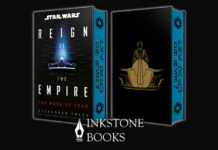
Alexander Freed, author of the Star Wars: Alphabet Squadron trilogy of books, answers your burning questions about the characters in the books and writing the story.
Spoiler warning: This article discusses plot points and details of Star Wars: Alphabet Squadron: Victory’s Price and the entire Alphabet Squadron trilogy.
StarWars.com: Alphabet Squadron’s story concludes in Victory’s Price. Yrica Quell was believed by her squadron to be dead, but they later learn not only that she lives, but she has returned to serve in Shadow Wing, the squadron’s Imperial opposite. How do her Alphabet pilots react to this betrayal? How does Yrica live with this herself?
Alexander Freed: How do the pilots react? “Not well” is the easy answer. Some view it as an outrage or an insult, while others wonder if they carry some responsibility or feel the need to set things right. Only Hera has the presence of mind to view it in military terms instead of as a personal matter — though her relationship with Quell matters to her more than she’s eager to admit.
How does Quell live with the decision? If there’s one thing we know about her from Alphabet Squadron and Shadow Fall, it’s that she can stick with a questionable decision much longer than most people, for better or worse. But she has a new set of emotional tools thanks to Shadow Fall, and she has reasons for what she’s done. She has a job to do in Shadow Wing, and she knows there’s no going back.
StarWars.com: The novel ends with the Battle of Jakku. What was it like to bring Alphabet Squadron and Shadow Wing into the final battle between the Empire and the Rebel Alliance?
Alexander Freed: Going to Jakku was something we’d discussed from the planning stages of the trilogy. With a story centered around the final days of the war, it only felt right to be there at the last battle. But Jakku had already been lovingly detailed in other sources (the Aftermath trilogy, Lost Stars, and Battlefront II among them) and finding a new angle on it — something that wouldn’t feel like a repeat — was tricky. Much like finding a fresh story in the Battle of Hoth or at Endor. It’s doable, but you need to weave through the known events, adding to the pattern without disrupting what’s there.
From a tactical standpoint, Shadow Wing’s role in the battle involves bringing all its new experiences to bear — Shadow Wing has learned to fight like rebels even as the rebels have learned to fight like a New Republic. Emotionally, though, this is the final confrontation between Alphabet and Shadow Wing; in the shadow of a cataclysmic event, they find that they’re uniquely bonded, even as they try to kill each other.
StarWars.com: The title of the novel, Victory’s Price, is right on target for this part of the lives of these characters. Why did you choose to write about the cost of war, and surviving it, as a major theme of this book?
Alexander Freed: “The cost of war, and surviving it” is as good a way as any to describe the central theme of the trilogy. In large part it appeals to me because it’s not something Star Wars often has a chance to showcase — we see a lot of war stories, to be sure, but for the most part we see the key victory that turns the tide and then leave the aftermath to the imagination.
The Alphabet books seemed like an opportunity to talk about what it means to go from a rebel underdog to an agent of a galactic government; to go from dreaming of being a hero to facing the looming realities of civilian life; to go from fighting Imperials to potentially living alongside them after the enemy has finally surrendered. Victory’s Price brings all these themes to a head. I can only hope I did them justice, especially knowing their relevance to our real world.
StarWars.com: The objective of Soran Keize is to allow for better reconciliation of former Imperials into the New Republic by making it more difficult to know the extent of their actions for the Empire. What is important about the need for striking a balance between holding people accountable versus allowing many millions of people to be able to integrate into the larger galactic society?
Alexander Freed: The New Republic is in a difficult position. The Empire spent decades performing horrific acts, and justice has its value. But the Imperial bureaucracy, military included, was massive, and many worlds surely retain loyalty to the old order. So how does New Republic leadership proceed? How do you create a functioning, unified society after a conflict of such profundity?
There are many, many examples from the real world to draw from, and they don’t all reveal the same lessons. The American Reconstruction, Germany’s post-World War II denazification, the de-Ba’athification of Iraq, and the efforts of post-apartheid South Africa may all spring to mind for American readers — each different in its causes, intents, and ultimate ends, each with its own varieties of success or failure. I don’t pretend to have any special insight into the subject. I’m not a scholar of politics or culture. But it’s a weighty one and worth exploring in fiction.
StarWars.com: In our previous conversation, you noted that Chass na Chadic is realizing that she might just survive the war and has to deal with sorting out a future. What is it like for her to see her future self on the other side of the war?
Alexander Freed: By Victory’s Price, Chass has a notion of what civilian life might look like for her. Where she used to fear homelessness, joblessness, and despair, now she has an answer — the Children of the Empty Sun. But life in a cult, though it provides some seductively easy solutions, also has its own downsides. The challenge for Chass is that she sees no third way between her cult and martyrdom, and time is running out.
StarWars.com: We learn a lot more about Kairos and her people in Victory’s Price, and how she cannot return to them. What is it like for her to be only able to move forward on an uncertain path?
Alexander Freed: Kairos begins the novel less certain of herself — more vulnerable, physically and emotionally — than she’s ever been. It’s maybe for this reason that she clings to what she does know for sure: her bond to Caern Adan and IT-O, and through them to Yrica Quell. And while she does eventually get the confrontation with Quell she’s looking for, that doesn’t leave her with all that much more clarity. She’ll need to find that another way.


Read the interview in full here.