As Halloween approaches, Lucasfilm heads into the unknown by looking back on fifty years of productions to dig up the horror genre elements from the company’s storytelling.
Co-written and directed by George Lucas, Lucasfilm’s first production American Graffiti (1973) is known to audiences as a colorful, funny, coming-of-age story infused with vibrant automobiles and energetic rock-n-roll music. It’s perhaps too easy to forget, however, that in the midst of this raucous comedy is a dark, eerie moment of suspense.
Having driven outside of their small town to find a romantic spot, teens Debbie (Candy Clark) and Terry (Charles Martin Smith) are left stranded when their car is stolen. Forced to walk through the countryside in the middle of the night, the ever-talkative Debbie shares tales of the infamous “Goat Killer,” a supposed gruesome murderer who is the stuff of nefarious legend for local teens. A nervous Terry, however, is in no mood to discuss the topic under their present circumstances.
In contrast to the rest of the movie, the scene is devoid of music. Instead, an ominous sound effect tone slowly builds in intensity as Debbie and Terry run for the bushes after hearing a mysterious noise. Convinced the Goat Killer is nearby, the pair hide away as the ominous tone grows louder, almost sounding like a beating heart, and punctuated with distant sounds of a goat’s calling. Is a teen car flick about to become a teen thriller? It’s all tongue-in-cheek, of course, as they’re soon met by their friend Steve (Ron Howard), who had also been left stranded out in the country.
This scene, as much as any other, defines Lucasfilm’s historical relationship to cinematic horror techniques. The company hasn’t fully embraced the genre in a feature film, but has certainly borrowed elements of its style, even trying horror-esque stories in television and games. Over the years, these have been applied in obvious and not-so-obvious ways.
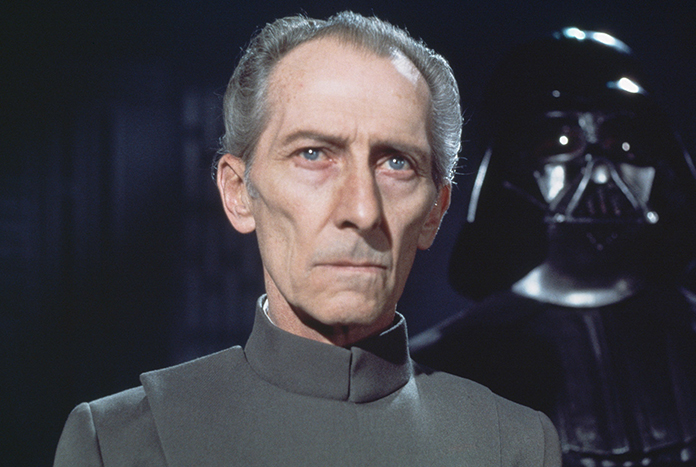
Sometimes the horror-esque in a Lucasfilm story is merely associative. In Star Wars: A New Hope (1977), audiences meet Darth Vader early in the story, but arguably the more intimidating presence in the film is Grand Moff Tarkin (Peter Cushing), a cold, ruthless villain with a refined, almost classical sensibility. Audiences in 1977 knew Peter Cushing for his roles in the United Kingdom’s celebrated horror films made by Hammer Film Productions. To most, Cushing was Doctor Van Helsing or Victor Frankenstein in some of the most iconic horror-fantasy movies of the era.
It came full-circle in the Star Wars prequel trilogy when George Lucas cast Christopher Lee as another ruthless villain, Count Dooku. Among many iconic roles, Lee was perhaps best known as another count, the villainous Dracula, in many Hammer films (where he played opposite Cushing). Though not explicit influences on Star Wars, the Hammer films shared important stylistic similarities with the saga. To varying degrees, Hammer and Star Wars films are “genre pictures,” which emphasize their thematic elements with distinct stylistic traits. Both include atmospheric locales, melodramatic plots, thrilling actions, accentuated production designs that feel like moving illustrations, as well as exaggerated acting performances that heighten the sense of fantasy-reality in these make-believe worlds.
George Lucas applied his interest in genre pictures to other Lucasfilm productions, not least of all in the Indiana Jones franchise. Among the familiar qualities of these stories is the macabre. Indy’s (Harrison Ford) adventures are full of encounters with mummies, skeletons, and countless creepy crawlies of one kind or another. His close brushes with death include witnessing more than one gruesome end of an antagonist, from René Belloq’s opening of the Ark of Covenant in Raiders of the Lost Ark (1981) to Walter Donovan’s poor choice of a Holy Grail in Indiana Jones and the Last Crusade (1989).
Indiana Jones and the Temple of Doom (1984) might qualify as Lucasfilm’s most horror-esque story. Deep within the caverns below Pankot Palace, the Thuggee place Indy under a trance known as the “black sleep,” enlisting the hero to unwillfully join their rituals of human sacrifice. The horrific elements of Doom’s settingmirror Indy’s inner crisis of temptation. Will he give in to the alluring riches of “fortune and glory,” or let it go to save the innocent children kidnapped from their village? It’s only thanks to the heroism of his young companion Short Round (Ke Huy Quan) – a veritable light in the dark – that Indy is able to choose the latter path.
“Masks of Evil,” an episode from The Adventures of Young Indiana Jones (1992-96), is almost like a Hammer horror story in its own right, taking Indy (Sean Patrick Flanery) and a small group on a journey to Transylvania during World War I. There they discover a medieval castle inhabited by a Romanian general whom some believe to be the reincarnated Vlad the Impaler, the true-life inspiration for the Dracula legend. (In an unusual twist for the Young Indy series, this story adapts both real history and popular legend, even including supernatural elements.) Indiana Jones and the Kingdom of the Crystal Skull (2008) takes its lead from 1950s horror-infused science fiction movies like Earth vs. the Flying Saucers (1956). In particular, composer John Williams devised a brooding, ominous theme for the MacGuffin that feels right out of a vintage B-movie.
Genre-borrowing abounds in many other stories. Radioland Murders (1994) is a fast-paced whodunit set in a 1930s radio studio where a mysterious, disembodied voice forebodes the death of multiple cast and crew members. Jim Henson’s Labyrinth (1986) is a modern fairy tale, full of dark and threatening obstacles for its central heroine, Sarah (Jennifer Connolly). For the Lucasfilm Games classic Maniac Mansion (1987), creators Ron Gilbert and Gary Winnick were inspired by horror flicks like Stephen King’s Creepshow (1982) and The Fly (1986) when devising their story of a group of a teenagers exploring a creepy house full of bizarre, sometimes violent denizens. That was only the beginning of fun-filled, horror-inspired Lucasfilm Games adventures, from the pirate ghosts of The Secret of Monkey Island (1990) to lesser-known adventures like early console games Zombies Ate My Neighbors (1993) and Ghoul Patrol (1994).
Read more at Lucasfilm.com — if you dare!