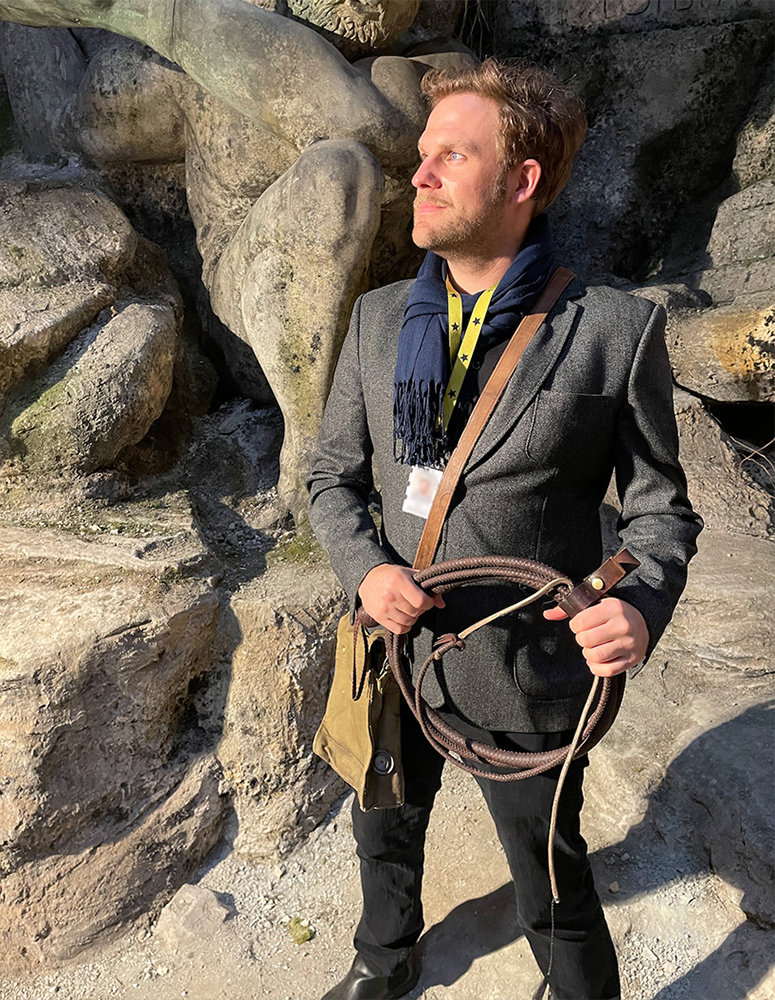
Lucasfilm’s lead video content creative Ian Bucknole has directed the new and exclusive documentaries available on the Indiana Jones and the Dial of Destiny 4k Ultra HD, Blu-ray, and DVD, available now from Amazon.com and Amazon.co.uk, and streaming on Disney+.
Harrison Ford’s first arrival in costume on the set of Indiana Jones and the Dial of Destiny (2023) came as a surprise to many crew members. Lucasfilm’s lead video content creative Ian Bucknole was there as the behind-the-scenes filmmaker, and recalls how “they were shooting the train sequence during World War Two when the locomotive is at the station. Toby Jones and Mads Mikkelsen were there. It felt like a warm-up. We’re making an Indy movie but the man’s not here yet. I had a chance to get my bearings. Then I whirled around, and there was Harrison Ford in his costume! He had just come onto set for a costume review. You could hear a pin drop. Indy was there. That’s when it all hit home. It’s hard to communicate. It’s like, what if the Santa Claus at the mall in his costume was actually the real Santa!” [laughs]
Having led the behind-the-scenes crew onset during production of Dial of Destiny, Bucknole then directed the new documentaries about the making of the film which are exclusively available on its 4K Ultra HD, Blu-ray, and DVD release. Along with the feature-length Disney+ production, Timeless Heroes: Indiana Jones & Harrison Ford (for which Bucknole was a producer), this bevy of rich material is the output of Lucasfilm Video Production (LVP), the company’s in-house documentary team.
For Bucknole, the chance to join Dial of Destiny as behind-the-scenes filmmaker was the fulfillment of his lifelong passion for Indiana Jones. “I grew up in Cornwall, which is a Celtic region of England,” he explains. “It has its own language and is very steeped in history and literature and has a vibrant arts and film community. Growing up with VHS, I was just in love with the character. There was this crossover with my dad, who was a miner. He’d dig for treasure underground. The most starstruck I ever was as a child was meeting Harrison Ford’s waxwork at Madame Tussaud’s. I was probably eight-years-old, and my mum took my sister and I to London, which was the big city.”
Having experienced Indiana Jones and the Temple of Doom (1984) first, his discovery of Raiders of the Lost Ark (1981) was a sort of a cinematic epiphany for the budding young filmmaker. “There’s something about the simplicity of its opening,” Bucknole explains. “The geography and pacing is so subtle yet deliberate. Between Douglas Slocombe’s cinematography and Michael Kahn’s editing, there’s some real magic there. There’s something deceptively simple about Raiders. Steven Spielberg’s direction is very lean. He’d made some big studio movies before, and this one has some momentum that really translates to the filmmaking. He’s in an indie filmmaking mode. It feels like something you can almost replicate and makes you want to try, but it’s the genius of Spielberg that makes it accessible. It was ultimately the reason why I wanted to join Lucasfilm.”
During the equivalent of his high school years, Bucknole took inspiration from an English teacher who organized a media club and encouraged the students to make short films. That led to film school at the University of Westminster where he reveled in the opportunity to learn diverse formats from traditional film to newly-emerging digital tapes. As Bucknole started his career making independent short films and music videos, he landed the opportunity to visit Lucasfilm headquarters in San Francisco through a connection with an employee via some mutual friends.
“As if by magic, events coalesced, and I was able to meet Trish Brunner, who’s the fantastic director at LVP,” Bucknole recalls. “It just so happened that where I was in my career and the kinds of things I was making synced up with what they might be doing in documentary. But I wasn’t a documentary guy. Around that time, there were changes happening across the industry where they were looking to bring more of a cinematic style and feeling to behind-the-scenes documentaries. I try to treat behind-the-scenes the same way you’d treat a traditional narrative shoot, from shot composition to lens or camera choices.”
Joining the LVP crew around the time of Star Wars: The Force Awakens (2015), Bucknole’s experience only gained in momentum as he moved between an array of projects. “Everyone in LVP is a massive movie buff and wants to bring their A-game, just because of the amazing material and people we get to work with,” Bucknole says. “I love my role because I get to wear a lot of hats. Sometimes I’m just a camera operator, other times I’m writing or helping with marketing-style material. Other times I’m directing.”
As the years passed with dozens of exciting Star Wars projects, Indiana Jones inched closer into the limelight. “With any big tentpole movie, we know these take a while for everything to fall into place,” Bucknole explains. “And specifically with Indy, we know that they never made one in any kind of rush. They made them because the story was right. There was a hope that it was finally going to happen.”
As Dial of Destiny ramped up its pre-production, Bucknole floated the possibility of his covering the shoot. “There’s no hiding our love for Indy,” he says. “You just have to walk past our workspaces where there are posters and toys and replica props. I always wore that on my sleeve. I hadn’t done a huge amount of on-set behind-the-scenes coverage up to that time, but I had worked very closely with all of our behind-the-scenes filmmakers on different projects, and I had a sense of what I wanted to do. It was a huge swing to ask to do this. I had my office job here at Lucasfilm, and everyone graciously allowed me the opportunity to go. I just had to be a part of Indy. It was a ‘pinch-me’ moment when [vice president of marketing and franchise creative] Anna Yeager called me with the news.”
Returning to his native England where production was centered at Pinewood Studios, Bucknole led a relatively small behind-the-scenes crew. “This movie was made during the pandemic, so it was impractical to have a large team,” he explains. “We had a larger crew who came in to help with interviews, but our brilliant director of photography Callum Johnston and I were the ones shooting everything else. We both worked with the main unit, and then Callum worked with the second unit in Morocco doing the tuk-tuk chase, which happened at the same time as the main unit’s shoot in Sicily. Callum got incredible footage of all of those stunts, which was important because the stunt team was really fearless and did amazing work.
“It was also great to partner with Callum because he could cover scenes that were being shot while I went and checked in with the prop department or something like that,” Bucknole continues. “Often changes to something like the dial were still going on while shooting had begun. We were able to capture the evolution of those designs and speak to the great people on the props team.”
Another member of Bucknole’s crew was Annishah Razaq, a trainee from the British Film Institute. “Annishah did a fantastic job and she’s gone on to work on other exciting projects like Game of Thrones,” Bucknole says. “If there were days when you were a bit tired, you’d see how enthusiastic she was, and you’d remember to be present and enjoy it like her.”
That enthusiasm seemed to be contagious amongst all of the crew. “I can’t stress enough how excited and thrilled people were to work on an Indiana Jones movie,” says Bucknole. “It doesn’t come along very often. There was a multi-generational appeal. Everyone knew it was a big deal, from people on their first movie to those who’d been in the industry for 40 years. People were turning down opportunities to work on other huge blockbuster franchises just for the chance to get to work on Indy.”
Bucknole stresses that the central appeal of working on an Indy movie was its leading actor. “On any shoot, the person who’s at the top of the call sheet really has a huge influence on the mood of the crew and the way a set runs,” he explains. “Harrison’s generosity and professionalism permeated throughout the entire crew. It’s not lost on him how much these stories mean to people because they also mean so much to him. Because he’s probably worked on more movies than anyone else who is there, he understands everyone’s jobs. It wasn’t unusual to see him helping the crew between takes. One of my favorite shots we got is when he’s helping put little wedges under a dolly track for the camera crew.”
Of course, Bucknole was to have his own interactions with Ford, who from the start lived up to his reputation. “I knew that at some point I would need to introduce myself to Harrison,” the filmmaker recalls. “It’s a conversation you rehearse a thousand times in your head. It turned out that I didn’t have to, because he introduced himself to me! He knew what I was there to do. Some actors don’t like the distraction of a behind-the-scenes camera, which I respect, but Harrison didn’t seem bothered at all. We were working on the scene when Indy is hanging inside the castle, and there was a moment where he just turned to me and said, ‘Oh, I haven’t met you yet.’ And because I’m British, I immediately self-deprecate and say, ‘Well you have been very busy.’ And he says, ‘Well you’ve been very busy too.’ He put me at ease.”
The reverence of the crew for Harrison Ford extended to the other cast members as well, not least of all Ford’s original co-star. “Karen Allen is a remarkable person and Marion is right there alongside Indy,” Bucknole notes. “Karen said herself that she’s the woman you want to watch your back. You wouldn’t have believed that so much time had passed since she and Harrison had shared the screen together. They had so much generosity and trust in each other. It’s all there on the screen. I had the chance to interview them together after that scene, and I think it might be one of the only times they’ve been interviewed together onset.”
Daily interactions with cast and crew combined with the generally overwhelming experience of being a part of a massive production. “At one point, the 007 Stage at Pinewood Studios was about 80% filled with the Archimedes tomb set and all of those caverns,” Bucknole recalls. “And then just to the side was the subway where he rides the horse with the train. There was a real working train and the horse running down the track, and if you just poked your head around the corner, there was the tomb! It was very easy to get confused. [laughs]”
Read more at Lucasfilm.com. Listen to our thoughts on Indiana Jones and the Dial of Destiny and the UK premiere on RADIO 1138.