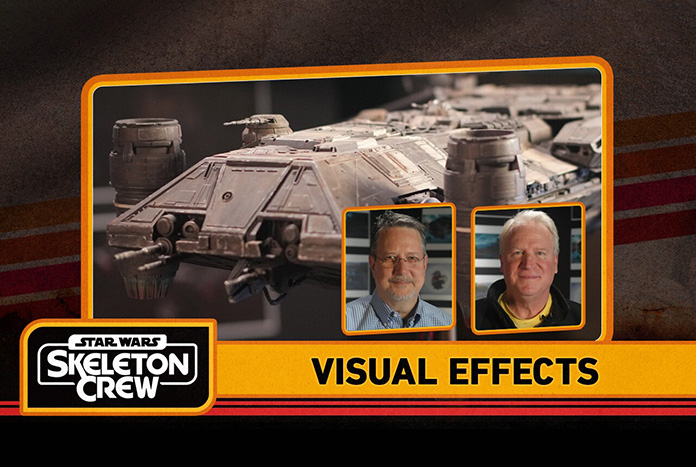
Brandon Wainerdi, writing at StarWars.com, talks to visual effects supervisor John Knoll and model supervisor John Goodson about their masterful merging of practical and digital techniques in Star Wars: Skeleton Crew.
Knoll is a familiar name for many fans, whether for his contributions to Star Wars as one of the visual effects “supes” for the prequel trilogy, as well as a writer for Rogue One: A Star Wars Story or other cutting-edge technology (Knoll co-created Adobe Photoshop alongside his brother). Meanwhile, Goodson has handcrafted the models for many of the iconic ships of the saga, including the podracers and Republic Cruiser in Star Wars: The Phantom Menace, eventually making the jump to the digital realm.
More than most, they are both highly aware that the visual effects landscape is constantly and radically evolving, a practice being led by Industrial Light & Magic (ILM) across numerous blockbuster projects. And a series like Star Wars: Skeleton Crew gives Knoll and Goodson the opportunity to take what they’ve learned in their cumulative careers, as well as the storied history of the effects company, and mix it all together.
Sign Me Up
What made Knoll, a veteran of a dozen Star Wars projects, want to join the Skeleton Crew’s, well, crew? “It was described to me as The Goonies in space,” Knoll explains. “The filmmakers wanted to evoke the sense of magic from Steven Spielberg’s 1980s movies, placed into the galaxy of Star Wars.” And, as someone who contributed Academy-Award-winning work on the first three Pirates of the Caribbean films, the idea of “space pirates” was just too good to pass up.
With that Amblin inspiration in mind, there was a significant opportunity for Knoll and the ILM team to step back into the cinematic feeling the company had helped define decades prior. “There’s certainly a nostalgia for wanting to craft things that have that tactile feel, in the use of makeup, miniatures, motion control, and matte painting,” says Knoll. “This show is a wonderful amalgam of the newest of new technology with the oldest of old.”
Knoll, who started his career as a model maker and effects cameraman, is perhaps the perfect person to bridge these two worlds. “The old school techniques are still something I have a great fondness for…It’s just a lot of fun to dig into some things that I haven’t really dabbled with for some time.”
Model Behavior
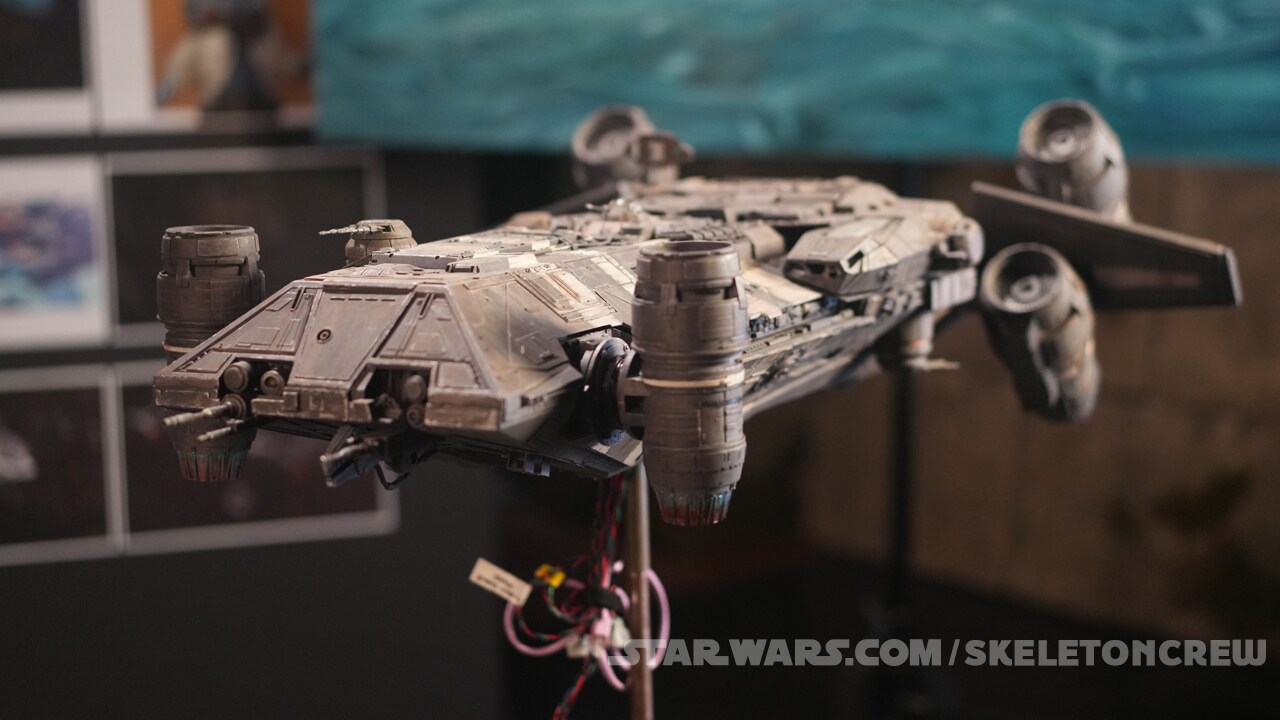
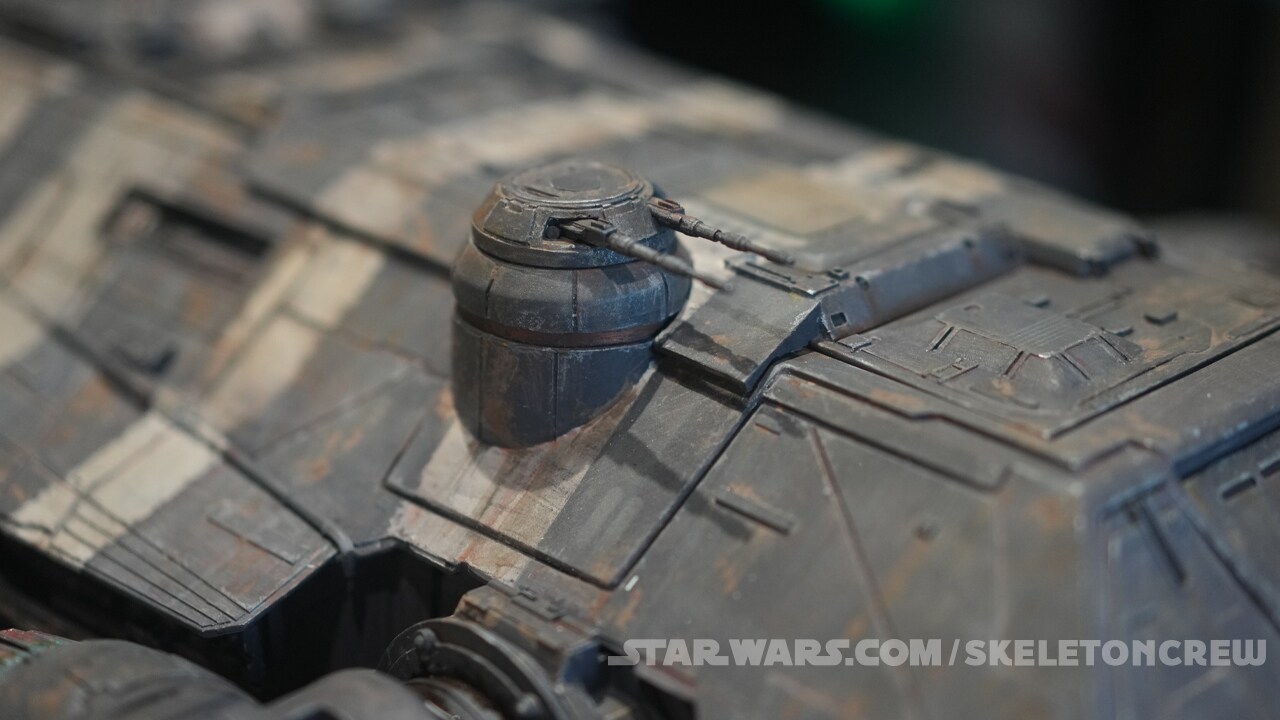
Over the past few years, Goodson has built numerous physical models for recent Star Wars tales, including the Razor Crest and Moff Gideon’s Light Cruiser in Star Wars: The Mandalorian and the rotating T-6 Jedi Shuttle in Star Wars: Ahsoka. He returned to Skeleton Crew to put the same care into crafting the Onyx Cinder, the hero ship for the series. As Knoll puts it, “Miniatures have a quality that’s hard to describe. There’s something immediately tangible about them. When you’re looking at them, there’s no question you’re looking at a real, physical object.” Goodson agrees, adding, “It helps drive the overall look, and then further refines it. You get a better look overall between the computer graphics and the practical.”
In addition to a beautiful sculpt, the model also needs internal electronics and mechanics that interface with the rest of the technological set-up. In order to make sure everything is symbiotic, Knoll and Goodson work with Dan Patrascu, a machinist and fellow model maker. “Dan built the chassis and everything that’s inside of it, and mounted the motors,” says Goodson. “We generally refer to ourselves as ‘Three Garage Productions’ because all three of us are working in our garages to do this stuff.”
After that garage work is done, the miniature sets the visual bar for its digital counterpart. “When we first started shooting the Cinder miniature, we had already built a CG model of the ship,” remembers Knoll. “But, once we had photographed the model, we went and retooled the digital version to match it more exactly, because the model’s paint job is just too gorgeous. It truly elevates all work.”
Then it’s time to hit the record button. The motion control camera, a technique near-perfected by the original Star Wars and its Dykstraflex technology, is the other piece of the puzzle. “It can be more expensive than equivalent computer graphics,” notes Knoll. “So the way to make it affordable is just to do it as a guerilla operation working out of our garages. I donated a bunch of evenings to build up this hardware, which is pretty cost effective if you build it yourself with bits and pieces from online stores.”
“I don’t think you understand how much [Knoll] enjoys building these,” Goodson adds. “I get texts at like eleven o’clock at night saying, ‘Look at this! It’s a new type of LED readout!’ He gets such a huge thrill out of putting it together, and it’s the real human part of it all.”
“I also didn’t want to lose this technology to time,” says Knoll. “I’m not going to be around forever, and I want there to be some continuity of knowledge. Lindsay Oikawa operated the motion control system for us on this shoot, and I think she’s learned enough that she could do a shoot on her own.” The legend continues.
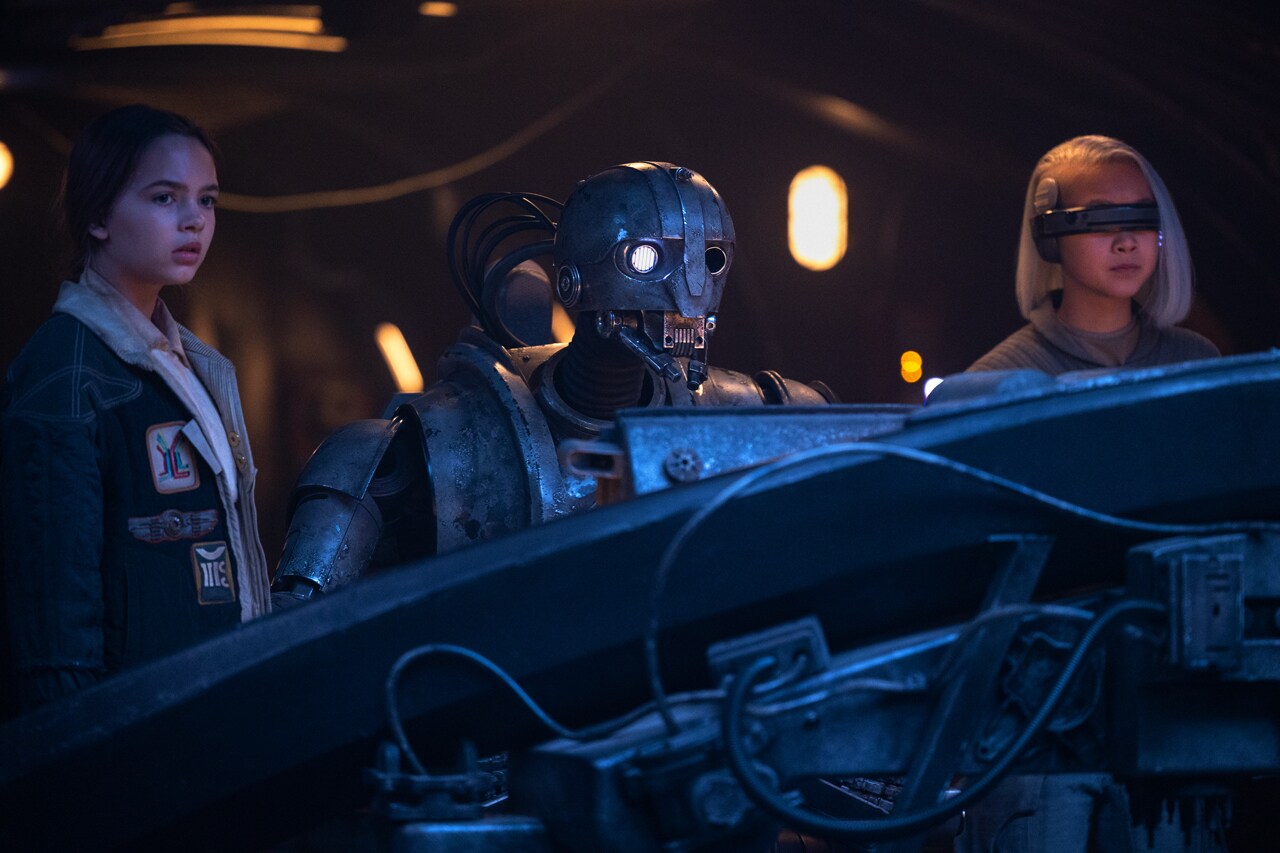
Head to StarWars.com to read the interviews in full, and stream the first seven episodes of Star Wars: Skeleton Crew on Disney+ now.