Devan Coggan, writing at StarWars.com, talks to ILM’s John Goodson, Hal Hickel and John Knoll about how they married old-school modelmaking and cutting-edge digital technology to bring Din Djarin’s iconic Razor Crest to life in The Mandalorian and Grogu.
Bringing back the Razor Crest meant that the film’s visual effects team also wanted to bring back physical modelmaking, a classic technique that was also used in The Mandalorian Disney+ series. In addition to building a highly detailed digital asset for the ship, the Industrial Light & Magic team painstakingly built models of the ship, using a motion-control rig to shoot the miniatures. It’s exactly how the original trilogy crew filmed X-wings or the Millennium Falcon in Star Wars: A New Hope, using the pioneering camera system known as the “Dykstraflex.”
“It was such an old school Star Wars thing,” animation supervisor Hal Hickel says of working on The Mandalorian and Grogu. “I was just absolutely in nerd heaven.”
Here, members of the film’s visual effects team from Industrial Light & Magic (ILM) reveal how they made the Razor Crest fly, marrying historic techniques with cutting-edge digital tech.
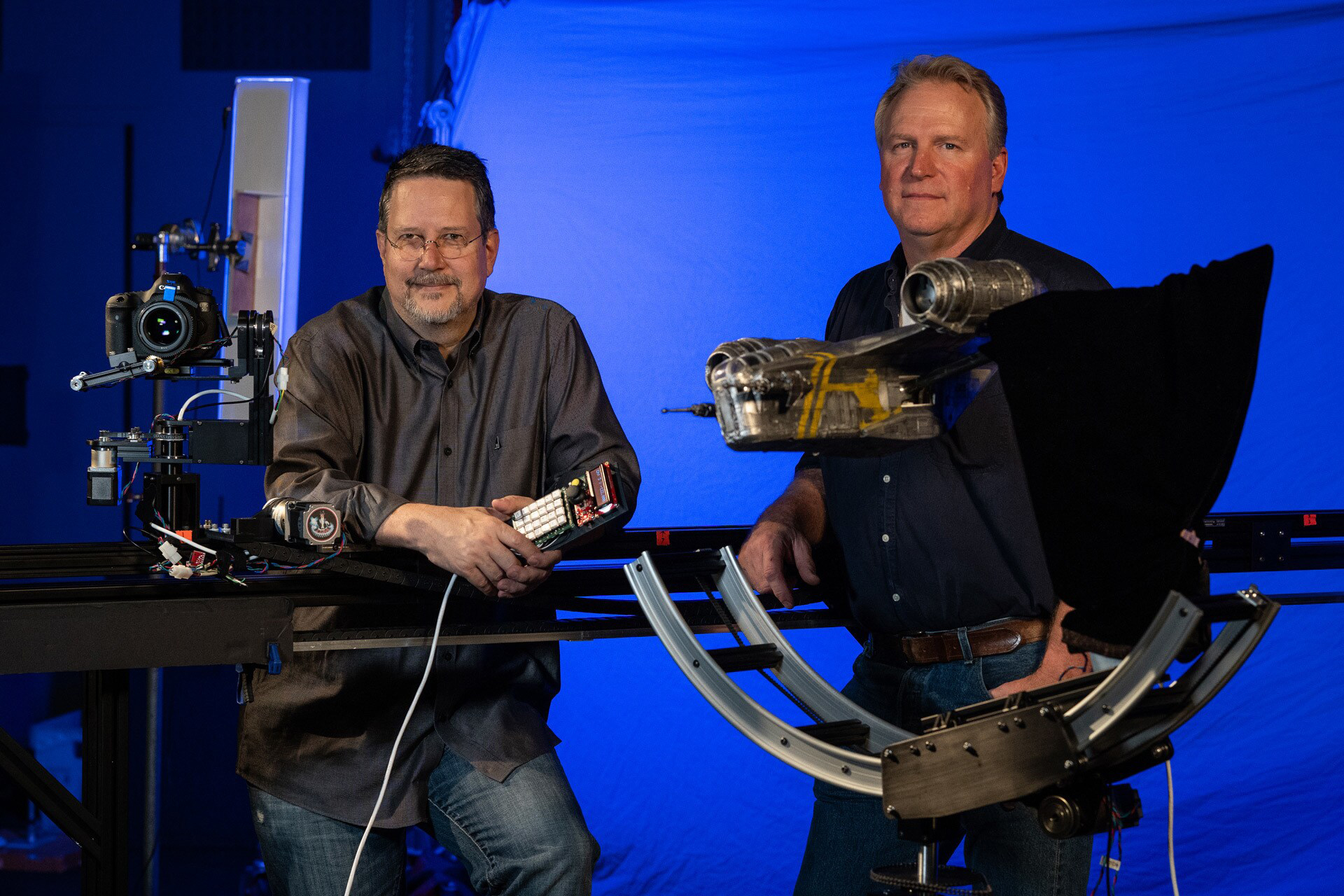
Image: John Knoll and John Goodson with the original Razor Crest model from The Mandalorian Season 1.
Model Behaviour
In development of TheMandalorian series, the Razor Crest was intended to be solely depicted with a digital model. But early on, director Jon Favreau suggested building a small, physical model of the ship to use as a lighting reference. (The Razor Crest’s shiny exterior makes it particularly difficult to light — more on that in a minute.) Once the model was built, the ILM team began wondering: Why not shoot the model for real, the way it was done on the original Star Wars?
“Way back on Season 1, we had a good-looking CG version of the ship, but in some ways, the finish and the actual look of the metal felt a little conventional somehow,” Hickel explains. “Jon wanted to keep exploring. So, we thought, ‘Well, let’s build a simple metallic version and put it outside in a bunch of different lighting environments to see what it tells us about reflectivity.’ That led to: ‘Well, let’s make it more than a lighting model. Let’s make it a nice-looking model.’ And then: ‘Let’s actually shoot it.’”
John Goodson constructed the original Razor Crest model, which was about 24 inches long. Production Visual Effects Supervisor and ILM Executive Creative Director John Knoll then designed and built a motion-control rig for the camera, allowing him to film in gorgeous detail.
“It was a really shoestring guerilla operation,” Knoll remembers of filming the model for The Mandalorian Season 1. “We had John Goodson working out of his garage and building the model, and I was working out of my garage, putting together a camera system to shoot it.”
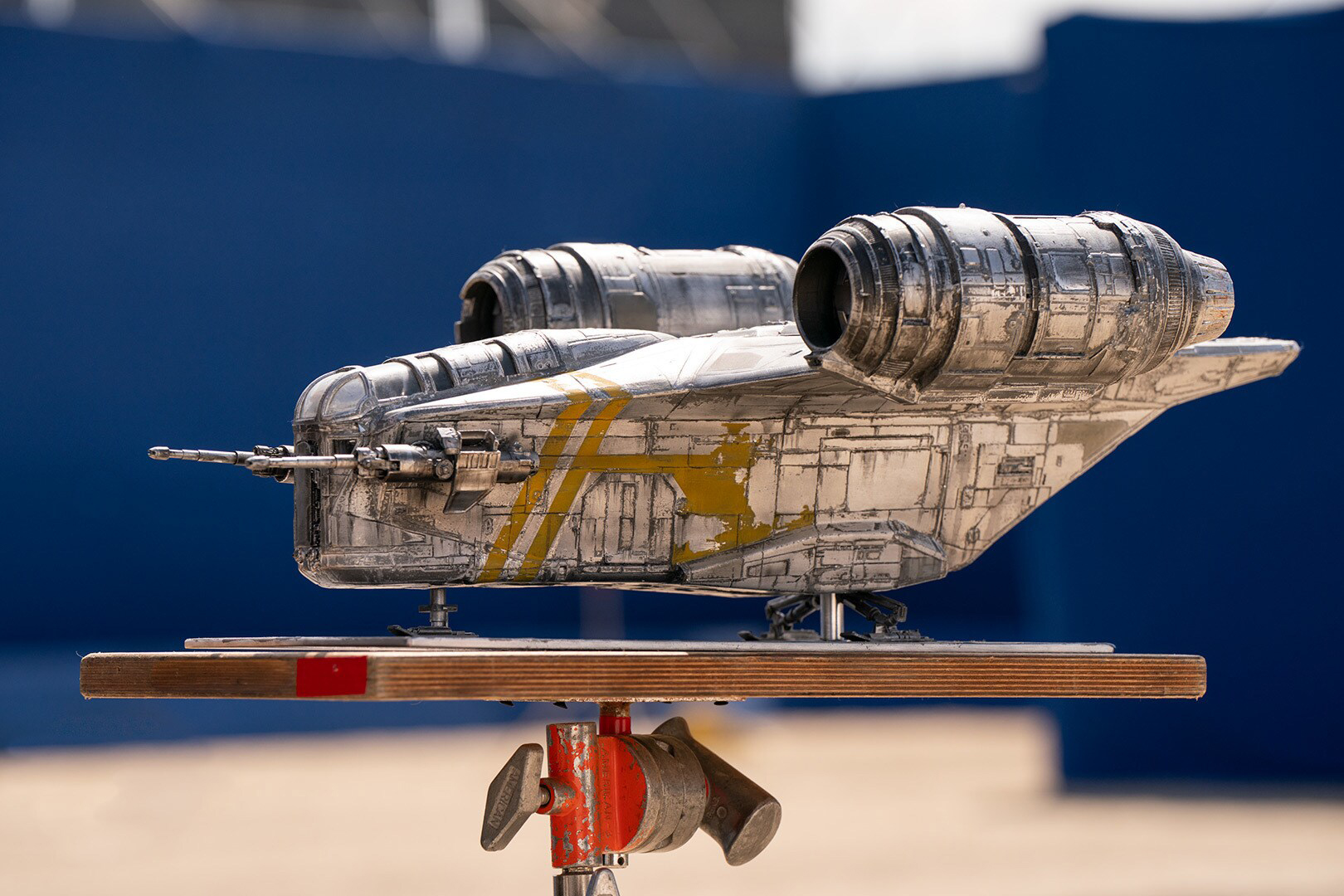
The original version was a success, but for The Mandalorian and Grogu, Knoll wanted to up the scale — literally. In addition to building a new version of the 24-inch model, the team also built a much larger 48-inch version. Each served a different purpose: The smaller model made it easier to shoot fast fly-bys through space, but the bigger version allowed for detailed closeups.
The 48-inch version was also built with removable ramps and landing gear, allowing Knoll to photograph the ship both in flight and on the ground.
“I didn’t want to just do shots of it that were flying shots,” Knoll explains. “When we first see the Razor Crest, when Mando is introduced to this new model, we come around the corner, and there it is parked at Adelphi Base. I wanted to be able to do shots like that with the 48-inch model.”
Each miniature shot required meticulous preparation. Before Knoll and the team could shoot a single frame, animators would mock up each shot digitally, mapping out every miniscule camera move and every light source.
“We would effectively create a 3D scene that would replicate what we’d photograph in reality,” Visual Effects Supervisor Jeff Capogreco explains. “We’d put the same constraints so the animators couldn’t over-crank the motion or do things that wouldn’t allow the miniature to effectively work.”
“For me, the challenge is always to make sure that the shot design has the kind of old-school vibe that Favreau likes,” Hickel adds. “[I did] a deep dive into why the spaceship shots in the original trilogy look the way they do. Design-wise, the way the ships move through the frame or the stars move, it’s a very particular look. If you look at Star Trek movies from that era, for instance, it’s a totally different aesthet
After each shot was mapped out digitally, Knoll could use that computer graphics blueprint to film the actual miniatures. Later, ILM artists would clean up the footage digitally, adding star fields, planets, and other key environmental details. In all, Knoll estimates that he completed about 36 different shots with the models, ranging from soaring space scenes to closeups at Adelphi Base.
Image: The 24-inch model of the Razor Crest for Star Wars: The Mandalorian and Grogu.
Shiny and Chrome
Because the Razor Crest seen in The Mandalorian and Grogu is a new model, it differs from the original in several key ways. It’s the Star Wars equivalent of a retro car, one that rolled right off the assembly line and has been kept perfectly preserved in a garage.
“It’s meant to be clean and new, and it hasn’t been hot rodded the way Mando has customized it — like what Han Solo did with the Millennium Falcon,” Knoll explains. “This [new ship] is more in factory condition. The paint on the yellow stripe is fully intact. The finish on it is cleaner, so it’s a more shiny, bare metal finish — not quite as oxidized and aged as the one from Season 1.”
The shiny finish of the Razor Crest echoes the shiny beskar armor that Mando wears — but it also provided challenges for the crew. While shooting the miniatures, Knoll had to ensure that every reflection was perfect, monitoring how the light glinted off the body.
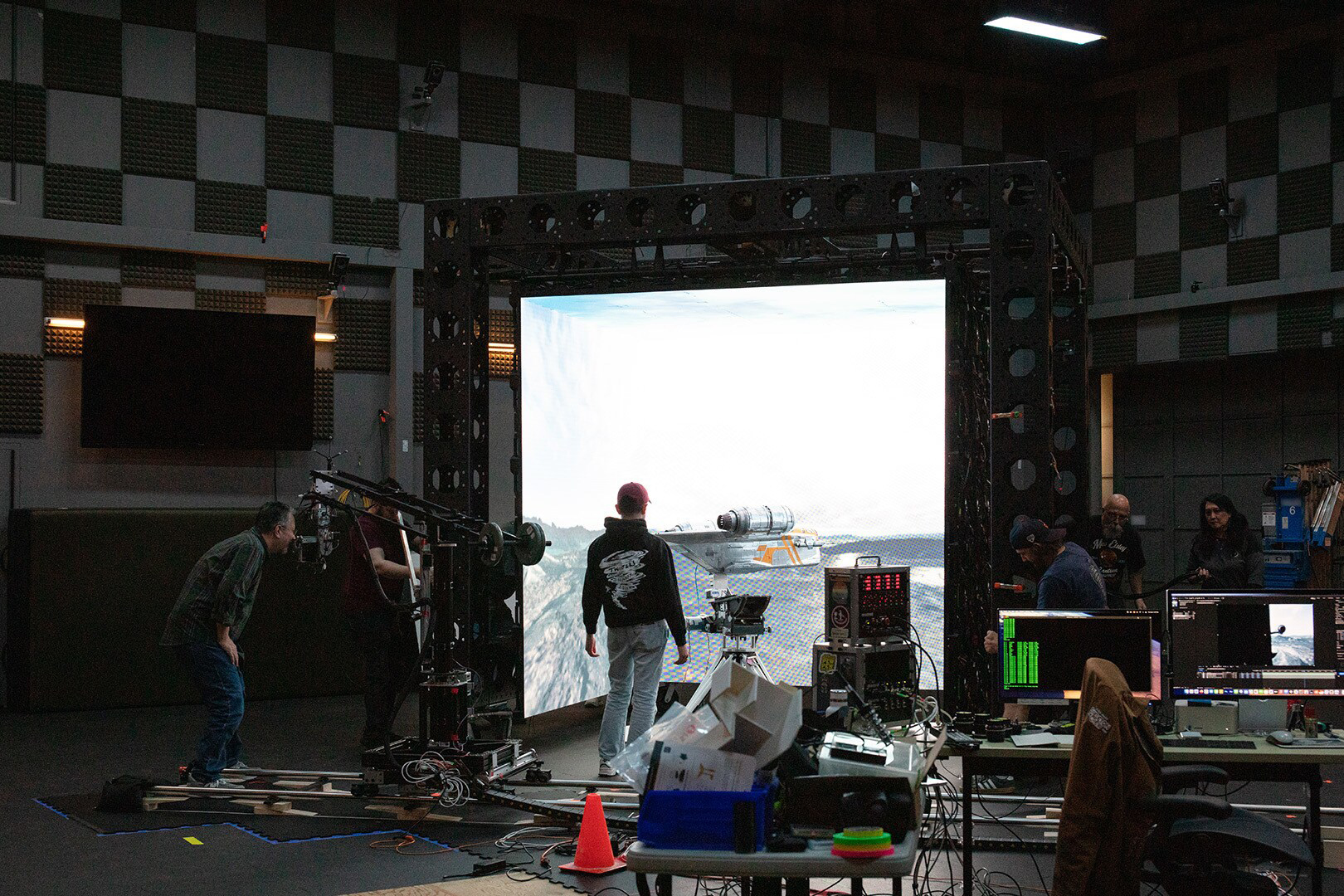
Image: The Razor Crest model filmed inside “the gazebo.”
“Lighting is really tricky when it’s something that’s shiny,” Hickel adds. “You basically have to light it the way they light cars in TV commercials with big, broad panels of lights. You get a nice broad reflection that shows all the detail. You have to play with it because it’s all sort of make-believe. When the ship’s in space, theoretically there’s just a single light source out there somewhere, like a sun, but we do all kinds of tricks to get a nice rim light on one edge and a big swath of light on the other side. If it’s near a planet, you want whatever the general color of that planet is washing over it, whether it’s bluish or reddish or whatever. That reflectivity presents opportunities but also a lot of challenges.”
In an attempt to perfect the reflections on The Mandalorian series, Knoll invented something he nicknamed “the gazebo,” a partially enclosed space made of foam boards. The miniature would be situated inside, and Knoll could project atmospheric images onto the walls of the gazebo, giving the Razor Crest more accurate reflections. “It sort of worked,” Knoll admits. “It was hard to really calibrate the color on that.”
Read the article in full here and see The Mandalorian and Grogu in cinemas now.