Jay Stobie, writing at ILM.com, sits down with ILM visual effects supervisor Daniele Bigi about ILM’s contributions to The Fantastic Four: First Steps, the blockbuster film that brought Marvel’s First Family into the Marvel Cinematic Universe.
Marvel Studios’ The Fantastic Four: First Steps (2025) transports audiences to the Marvel Cinematic Universe’s Earth-828, where Reed Richards (Pedro Pascal), Sue Storm (Vanessa Kirby), Johnny Storm (Joseph Quinn), and Ben Grimm (Ebon Moss-Bachrach) must prevent Galactus (Ralph Ineson) and his herald Shalla-Bal (Julia Garner) from destroying their entire planet. Directed by Matt Shakman, whose acclaimed credits include helming episodes of the long-running comedy series It’s Always Sunny in Philadelphia (2005-Present) and the mystical Disney+ hit WandaVision (2021), The Fantastic Four leans into a retro-futuristic aesthetic that blends 1960s-inspired designs with out-of-this-world technologies.
With this innovative endeavor in mind, the filmmakers called upon Industrial Light & Magic and its accompanying half-century of visual effects expertise to help execute Shakman’s vision, with a particular focus on The Thing, Galactus, the climactic third act battle in New York City, and more. Daniele Bigi (Ready Player One [2018], Star Wars: The Rise of Skywalker [2019], Eternals [2021]), who served as the ILM visual effects supervisor on The Fantastic Four, sat down with ILM.com to discuss the company’s numerous contributions to the project, from devising a fresh approach for portraying The Thing’s rocky features to constructing Earth-828’s distinctive New York City skyline.
An ILM Overview
As the ILM visual effects supervisor on The Fantastic Four, Bigi spearheaded ILM’s involvement on the project from the company’s London studio, working closely with invaluable colleagues like ILM animation supervisor Kiel Figgins and ILM senior visual effects producer Claudia Lecaros. “In this case, ILM didn’t split the work between multiple ILM facilities, so my team ended up keeping all the asset and shot work in London. We were assigned the major task of handling the third act of the movie, which centered on the final battle between the Fantastic Four and Galactus,” Bigi tells ILM.com. “Although it’s divided into multiple sequences, the third act is a continuous narrative from Galactus’s arrival on Earth through the end of the film. It was a fascinating and important piece of work to deal with.”
ILM’s assignment included devising an innovative look for Ben Grimm’s iconic alter ego, The Thing. “We did all of the initial development with [production visual effects supervisor] Scott Stokdyk and [visual effects producer] Lisa Marra from Marvel, in collaboration with [head of visual development] Ryan Meinerding. Ryan provided us with the concept for The Thing, which is what we based our work on,” Bigi relays. As the leading vendor for The Thing, ILM developed the entire character and then distributed the asset to the film’s other visual effects vendors for their own sequences.
“After the initial development of The Thing, we were assigned another prominent character to build. Since ILM had several shots in which Mister Fantastic stretched his body and used his ability in an extreme way during the final battle, ILM ended up leading the look development of Reed Richards, too,” Bigi explains. In January 2025, ILM’s success with these character creations prompted Matt Shakman to task Bigi’s team with crafting the Fantastic Four’s immense nemesis, Galactus.
“Another big component to ILM’s work was the development of New York City, which was an imaginary version of it based on Marvel concept art,” Bigi continues. “Roughly 90% of the New York City shots were done in computer graphics by ILM. It’s a 1960s futuristic New York, and while certain aspects appear exactly like our New York, there are many buildings and stylistic elements that reflect both 1960s and futuristic designs. A large section of the city, including Times Square, was ingested from Sony Pictures Imageworks, whom ILM collaborated closely to combine different city blocks into a unified layout with a matching style, color palette, and overall look.” Most of the city set-up was handled by environment supervisor Stacie Hawdon and CG supervisor Tobias Keip at ILM’s London studio. In total, Bigi estimates that ILM contributed between 350 and 380 shots to The Fantastic Four.
Thinking the Thing Through
“At ILM, we aimed to deliver on Matt Shakman’s vision by dramatically changing what had been done with The Thing in the past. We sought to create the most believable, realistic performance that would respect Jack Kirby’s original design, from the size of the rocks to the very specific rock formation of The Thing’s brow,” Bigi shares. Animating facial expressions for a character whose face is composed of rock proved to be a considerable challenge. “We explored different options, but I always wanted to keep the rocks as rigid as possible. If we started to squash and stretch them, The Thing would resemble what was done in the past with plastic material and foam prosthetics.”
Leaning into The Thing’s bouldery frame, Bigi’s team created small, undefined gaps between the rocks. “Depending on the expression, we could move the rocks in these minuscule spaces. Additionally, we allowed the rocks to gently stretch in areas that were invisible to the camera, giving us larger gaps that let us keep the rest of the rocks completely rigid.” ILM employed another sophisticated technique for The Thing’s face and body, running an effects simulation on the rocks rather than dealing with geometric skinning. Bigi praises FX and creature technical director Maybrit Bulla, who used Houdini to create a custom setup to control the collision between the rocks. “We used our blend shape technology to move the underlying surface, but there are rocks on top of it that are actually colliding. They push each other and land in a natural position. In some shots, we had to guide the simulation in an artistic manner to avoid having rocks go into unwanted territory and seem weird or strange. The process is something new that we developed for this movie.”
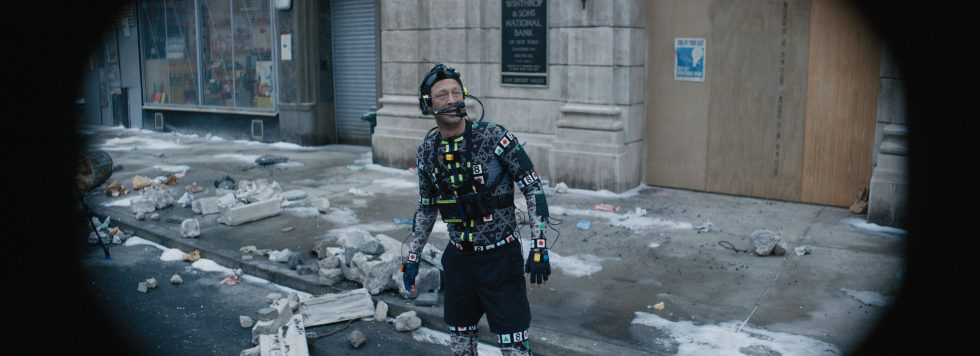
When it came to actor Ebon Moss-Bachrach’s performance capture for The Thing, ILM referenced the work-in-progress geometry data from Digital Domain (another effects vendor on the film). “The data was useful for the initial stages and the blocking animation, but when we started to go into the minutiae with Scott Stokdyk and Matt Shakman, we ultimately worked on our own system and reanimated the character for our final animation,” Bigi details, crediting CG supervisor Marco Carboni for developing a workflow to quickly ingest data from Digital Domain and transfer it to ILM’s proprietary facial rig.



Read the story in full at ILM.com.
Images: ILM & Marvel