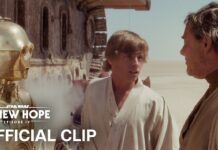
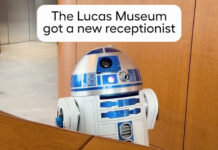
Ben Burtt, the iconic sound designer and voice of R2-D2, Chewbacca and WALL-E, will receive Locarno’s Vision Award for “extending the horizons of cinema,” discusses how he revolutionized sound for Star Wars, and explains the origin of the “Wilhelm Scream.”
Ben Burtt created the sound of my childhood. He gets that a lot.
“Yeah, I hear that often,” says the legendary sound designer, creator of the lightsabre swish and Darth Vader’s electronic wheezing, the voice of R2-D2, Chewbacca and, for a younger generation, that of Pixar’s WALL-E. “I guess I altered the DNA of a lot of young people.”
Burtt, a 12-time Oscar nominee, and four-time winner — he earned Special Achievement Awards for his work on Star Wars and Raiders of the Los Ark, and Oscars for E.T. The Extra-Terrestrial and Indiana Jones and the Last Crusade — is being honored by the Locarno Film Festival at its 2024 edition with the Vision Award Ticinomoda, a prize dedicated to creatives whose work has extended the horizons of cinema.
“It might seem odd, giving the Vision Award to someone who is a sound designer and sound editor,” admits Locarno artistic director Giona A. Nazzaro, “but Burtt is such an influence. It’s incredible what this gentleman has done and how influential his work has been.”
In a wide-ranging conversation with The Hollywood Reporter, Burtt reflects on the turning points in his career, his lasting impact on the art of cinema sound and whether he really did name the Wilhelm Scream.
Congratulations on the Locarno honor. It seems impossible to sum up a career as eventful as yours, but maybe we could start way back before the beginning. How did you grow up and how did you even get into filmmaking?
I come from Syracuse, New York. My father was a chemistry professor at Syracuse University. My mother also taught there. It was a very middle-class Leave It to Beaver, June Cleaver, kind of existence. A very stable childhood. I had a lot of hobbies. As a child, I loved make-believe, dressing up as a spaceman, a robot for Halloween, that sort of thing. And I loved movies. At the encouragement of my father, I started making movies with his 8mm movie camera, when I was about 10 years old. Stop-motion animation. That was unusual in those days. I started making movies in my backyard with my friends, superhero movies, war movies. That kind of thing. Very similar to Steven Spielberg if you know his little movie [The Fabelmans]. It was very much the same story.
But I never considered moviemaking as a career. It was just one of my hobbies. I went to college and got my degree in physics. But all during the summer, I was making films — Super 8 movies with my friends. I won a couple of national awards in contests for films and for one of them, Pauline Kael was a judge and I actually got invited to New York to meet her. She said: “You don’t need to go to film school, you’re ready: Just become a director.” But I wasn’t that confident. I finished my degree in physics. But in my last year of school, there was a real turning point. Arthur C. Clarke came to my campus to give a talk on science. He was the author of 2001 of course, and that had just come out. The talk was on science, not on the movies, but I ended up being his escort on campus for a day and I started asking him questions about how they did 2001. He went up to the blackboard and did all kinds of drawings, explaining motion control, matte painting, and in-camera effects. I realized: Here is a fellow who is a scientist, but who also exists in the worlds of science fiction and movie making.
I thought, if he can do it, maybe I can take my interest in science, and also go into the movies. I went home and made kind of my own mini-version of 2001, building my own equipment. That film got me some scholarship money to go to film school. I applied to USC and was accepted.
What were you and George Lucas going for in the sound design of the first film?
Well, at the time, most science fiction films contained sound effects and ambiance that were electronic in nature. Things sort of derived from Forbidden Planet, you know, that wonderful electronic score and sound effects that were made for that film. George felt that was a cliche by this point, so he didn’t want to have a synthetic or electronic score or electronic effects of any kind. He described it to me as an organic soundtrack, which meant, let’s go out in the real world and gather acoustic sounds, be they motors, animals or jet planes. Let’s fashion the world of Star Wars out of these real sounds. The idea being that people would inherently recognize the reality of those sounds, the naturalness of them.
When the Millennium Falcon’s doors open, it should sound mechanical, it might squeak, it might be rusty. Because I came from a background in physics and I loved 2001, I initially thought: Well, there’s no sound in space, and I told George that. He was kind of puzzled but he said. “Well, we’re going to have sound and music in space.” He wasn’t shy about creating a world where you hear everything in space. And thank heavens, I guess, because that gave me a career.
We were building more on Flash Gordon and those serials, but creating a more naturalistic science fiction-fantasy environment where the robots are beat up and dented and dirty, where the world wasn’t pristine and clean like you might have found in other science fiction at the time, with people wearing immaculate, beautiful, well-ironed costumes in bright colors.
My job became making appointments to go to factories, airports, any place where there might be something interesting to record, with a recorder slung over my shoulder. Also recording animals. George wanted the Wookiee Chewbacca to be made out of animal sounds — maybe dogs, maybe bears. [In the end, Burtt used a combination of bear sounds with a few walruses, lions and badgers thrown in.] I fashioned the Chewbacca “language” before shooting, so they could see how the actor would work in a costume and the limitations of the prosthetic mask and so on.
Along the way, I created the lightsaber sound [combining the hum of the USC’s film projector machines with the buzz of a cathode ray TV set, recording with a swinging microphone to mimic movement] but the real challenge was R2-D2. Because people evaluate dialogue differently than other sounds, they really focus on speech. I mean R2-D2 has scenes with Alec Guinness, just the two of them talking. So his “acting” has to be up there. It took a long time and really didn’t come together until near the end of post-production.
With Pixar and WALL-E, what was the particular challenge, sound-wise, given you had already created an iconic robot language with R2-D2?
Andrew Stanton had been developing the idea for a while and he had maybe a 10-minute reel of storyboards cut together with some music on top of it. He would refer to the film, as “R2-D2: The Movie.” So Jim Morris at Pixar, formerly of Lucasfilm, said “Why don’t you just talk to Ben Burtt? He did the original R2-D2.” Andrew had the idea that WALL-E and EVE wouldn’t say much except their names but they would have to have a lot of expressive vocals to tell you their state of mind, if they were angry, if they were frustrated or affectionate. The original concept for WALL-E was to have no English dialogue at all. Even the Earthlings we encountered on the spaceship were supposed to have evolved to speak a language that was just gibberish for us.
I started working with the idea of making something like R2-D2 but not R2, to have more buzz and make him sound like a synthetic voice generator. So I tried different voice experiments and eventually came up with a voice synthesis program, which didn’t work very well for voice synthesis. But the artifacts it created — the electronic noise, the flaws, the things that you would normally reject if you wanted a perfect human voice — those appealed to me. But it wasn’t good enough for what I had in mind. So I did a similar thing as with R2-D2. I combined my voice with the machine.
I was in the studio every day experimenting, so it was easier to use myself, I didn’t have to schedule a formal session. It was the same with EVE [voiced by Elissa Knight]: She was an employee at Pixar, so it was convenient. We could work on the script, word by word, without much formality. We’d just work on it, taking about four or five months to find different ways of trying out the voices and the sound effects when WALL-E moves his hands, his arms, eyes, his wheel treads, trying to make them indicate different moods, from agitated to relaxed.
I generated a series of sounds that went to the animator, who would design movements and body language based on those sounds. The video would come back and I would alter my sounds to fit better with the animation. It would go back and forth until we ended up with almost a two-minute audition scene for each character in the film. It was the WALL-E audition that convinced everyone, including Steve Jobs, that we could make a movie about a robot and make him seem alive and have a soul, without using language. That was what got the green light for the movie on full blast. It took a lot of time to create the whole soundscape because I wasn’t working from a library of pre-existing materials.
But you still use stock sounds sometimes, right? I mean, you are the man credited with naming the Wilhelm Scream, a stock sound of a man screaming when falling.
I knew it! I knew this question was coming.
Well, it is attributed to you, and you have used it in many of your films…
Well, I do this as it was an in-joke to myself and a few friends that got out of control and escaped into the world. I never intended that. If you Google me, the first thing it says is: “Ben Burtt, creator of the Wilhelm Scream.” I say to my wife: “Is that what I’m known for?” It was a joke I made once and now I can never live it down.
It was a scream I first heard as a child. I recorded it off the television. It was in many of the Warner Bros. films in the 1950s and ’60s. It was a stock scream in their library, and it had been used in a lot of Westerns. For cowboys getting shot with arrows or whatever. It was just one of the many sounds I had. I had charted the provenance of lots of the iconic sounds from the movies I listened to growing up because I was interested in where things came from and how they were made. The stock thunder or the gunshots in Paramount movies sounded different than the ones in Warner Brothers. I always wanted to know: ‘How did they get the arrows in Robin Hood to sound like that?’ Those things obsessed me.
Anyway, when I got to USC, there was another student there named Richard Anderson, who also became a sound editor [on Raiders of the Lost Ark, and Poltergeist among others]. I told him about the scream. Him and a third person, named Rick Mitchell [who worked on Die Hard and Hoffa], who’s no longer with us. We just joked about it. We included a Wilhelm in a film we did for school and all laughed about it. The naming came out of our discussion. I don’t remember whether I said it or Richard said it, but we began referring to it as the Wilhelm squawk. And then we just called it the Wilhelm. When we’d do a student film, we’d stick it in there, taking it from my recording of the TV show. Later, when I became an actual sound editor and we were mixing at Warner Bros. on the first Star Wars movie, I went to their sound library and spoke to the librarian. They didn’t know what a Wilhelm was, because it wasn’t called that, of course, but I was able to find it. So in Star Wars, I stuck it in for a stormtrooper falling into a trench when he gets shot. It was just for my own pleasure. Nobody asked for it. Nobody noticed it. That was it. The next time might have been for More American Graffiti. I stuck it in. After that, I started seeing how far I could go with it. Richard Anderson had gone back to L.A. and he was working on other films, and he started putting it in his movies. We played this game of one-upmanship for 25 years, just the two of us knowing what we were doing.
He would put it in a Quentin Tarantino film and call me up and challenge me to find it. I put it in an Indiana Jones movie. It was a private joke. Nobody said a thing. It wasn’t until the Internet came along, it must have been around 2000 or so when people could collectively talk about trivia and DVDs were on hand so you could study these movies. Suddenly everybody was hearing the same scream on all these Lucas films, and on a few others, and began wondering what it was. Somehow the word got out. I didn’t mention it. But then it escaped onto the Internet and became, what do you call it, a meme? Is that what it is? I don’t know. Now it’s everywhere. I just heard it in a commercial on TV yesterday. An insurance commercial. It’s just crazy. I stopped putting it in. But even when I stopped, my crew would put it in because they felt it had to be there. I couldn’t stop them. I created a monster.
Read the in-depth interview in full at the link below.