Ahead of the two-episode premiere of The Acolyte, costume designer Jennifer Bryan spoke to StarWars.com to talk about the inspiration behind some of the characters designs, and the details that will entertain costume aficionados and cosplayers alike!
At a glance, costume designer Jennifer Bryan knew the Jedi robes and Mae’s assassin garments needed to work in harmony — essentially two sides of the same coin, — while simultaneously ushering in a new era of design for the series set during the High Republic, about 100 years prior to Star Wars: The Phantom Menace. To achieve that delicate balance, Bryan and her team looked to real-world warriors and previous Star Wars costumes, then remixed the individual elements for something brand new. Among her inspirations were Trisha Biggar’s prequel costumes, which Bryan studied up close during a visit to Skywalker Ranch’s archives. “On this amazing planet that we live on now, I see a lot of things that I put together and put in the galaxy of Star Wars,” Bryan tells StarWars.com. “It’s different, but somehow I like to think that you sense the origins of the elements that I put together in The Acolyte.”
Mae
Mae (Amandla Stenberg), the assassin at the heart of the series, is a warrior constantly on the move. Bryan and her team took great care to reflect that in Mae’s costume, which mixes chainmail, bamboo, and a patchwork quilt of a purple cloak into a look that feels both salvaged and utilitarian. “The first time that you see Mae, she’s walking into this town and she is mysteriously clothed,” Bryan says. “She’s been on the run, so everything is kind of pieced together…it’s got holes and some tatters because she’s been through a lot. She’s on a mission.”
Consciously created to appear as the polar opposite of the pristine Jedi robes of the period, Mae’s cloak in particular was handcrafted from numerous swatches of artisan cottons and gauzes, strategically stitched together then dyed a uniform purple, a nod to her past. “I use purple because it’s a memory color for her,” Bryan says. “The cloak is many, many segments of fabric arranged and patched together to make a whole cloak. And I think it gives a sense to this kind of vagabond character as she’s on her journey to kill these Jedi.”
Mae’s belt is also a riff on the Jedi uniform, but this one conceals a deadly secret. “At first it may look decorative to you,” Bryan says, but the eyelets lining the front of the belt are actually the handles of four of her throwing knives, a clever way to conceal her daggers close at hand. “They are in her boot, too,” Bryan says. “She has an unending supply.”
Nods to our own Earth-bound warriors can be found peppered throughout Mae’s costume. “I looked at great warrior tribes and cultures of the past, all the way back from Asia minor, East Africa, North Africa, and the Roman and Byzantine Empires. It needs to look like it’s put together from these different historical eras of warriors, but not specific to any one culture. For Mae, I drew on samurai. That’s where you see the bamboo strips across the top,” Bryan says, which were molded from real bamboo stalks and cast in a flexible silicone rubber. “For the pewter metal section, you would think of a Byzantine [knight] or a Roman gladiator’s plate armor. The chainmail is not something that you frequently see in the Star Wars galaxy, but it’s historically important because warriors and gladiators used that material for protection. And then everything else is kind of put together with elements that she found along the way.”
Master Indira
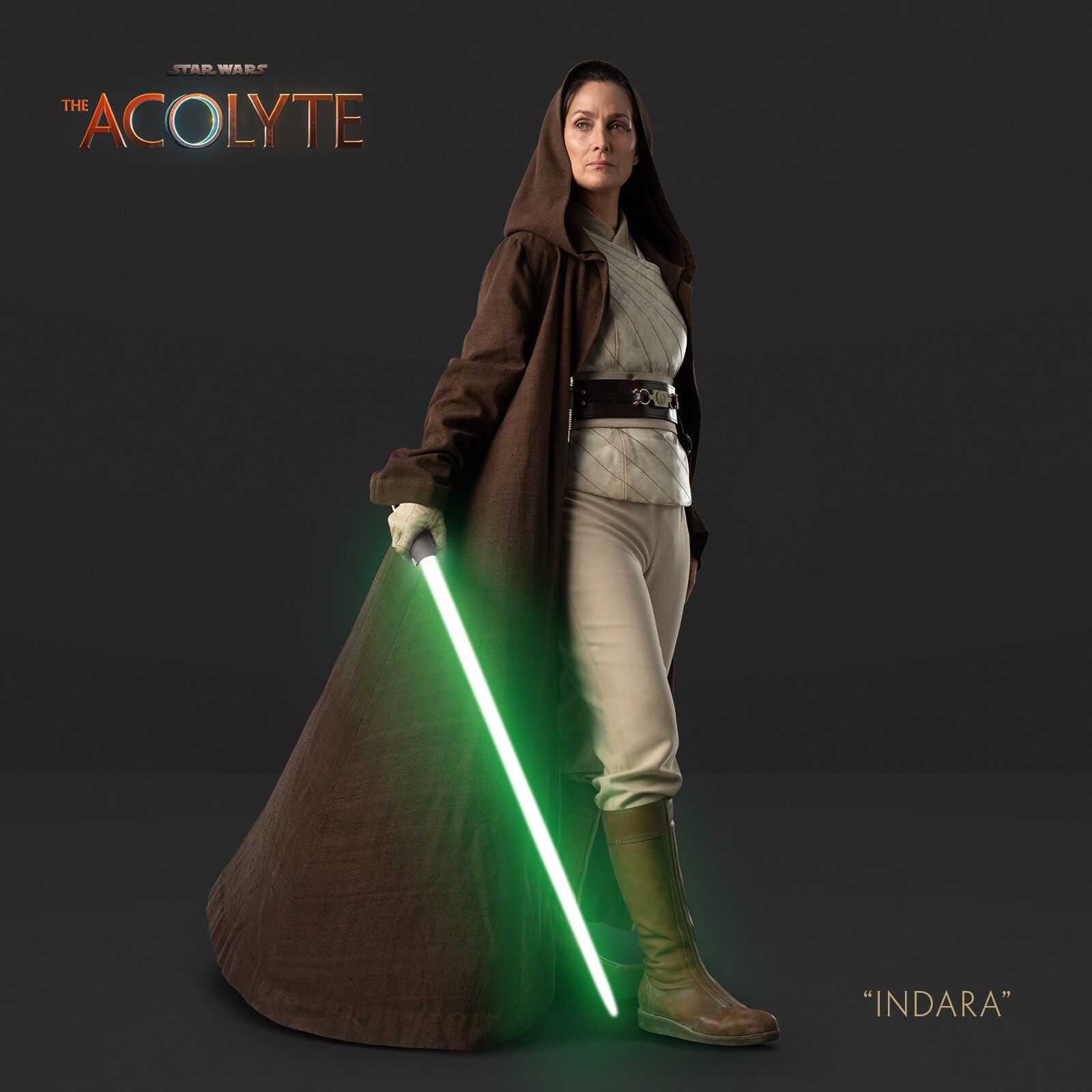
As the first Jedi Master viewers meet in the series, Master Indara (Carrie-Anne Moss) wears the classic brown hooded robes that introduced Obi-Wan Kenobi in Star Wars: A New Hope and became the go-to Jedi garment. “Knowing that Master Indara was going to be the first Jedi that you saw in The Acolyte, I really wanted to still keep that essence of how we’ve seen them, that significant and memorable brown mission cloak,” Bryan says. “How she’s hooded — I think it was a really great shot. Anyone who is a Star Wars fan, which for me is everybody on the planet, knows that that is a Jedi.”
Beyond the classic guardians of peace seen in previous Star Wars films, Bryan drew inspiration from Princess Leia Organa, using the same ivory color for Indara’s costume beneath the cloak as a nod to Leia’s long white gown in the original trilogy. Knowing that Moss was in for some high-flying stunts, her tunics and other layers are built with action and fight choreography in mind. “In designing costumes, not only does it need to look good, it has to function in filmmaking,” Bryan says. “It has to fit the choreography and the fighting and the lightsaber work.”
Building upon the layers of her Jedi mission attire, Bryan and her team constructed a leather doublet, a vest-like garment. With topstitching that mimicked the fine pleating of her under tunic, the doublet was styled from stiff material to provide additional support for the actor. “It gave her some upward posture and had to accommodate the choreography that we had to do,” Bryan says. “When you’re looking at Master Indara, take note of her boots and take note of the micro pleating.”




Master Sol
In stark contrast, when we first meet Master Sol (Lee Jung-jae), he’s dressed in his white temple robes, teaching a class of younglings on Coruscant. “Master Sol is your classic Jedi,” Bryan says. To usher his costume into this new era of the Jedi Order in its prime, Bryan and her team used new fabrics to layer his ensemble. “It still is Jedi, but a mix. We do have the traditional surplice neckline,” Bryan says, crisscrossing at the front of the garment, held in place with a Jedi belt, etched with the symbol of the era, and the clip to hold his lightsaber. For Bryan, it was essential to seek out fabrics that felt they could withstand the test of time, garments that would be issued to a Master and worn for years to come. “I layered his tunics and tabards,” she says. “I used new materials, new fabrics with different textures and weaves that are just a little bit more rugged and heavy.”
Even the color palette is a fresh spin on the browns and creams of the prequel era. “The colors are a fresh take on Jedi on Coruscant,” Bryan says. “The over jackets and tabards were done in a sort of a turmeric or mustard color, and I did variations within that. So when you see them as a group, you’ll see different tones. It’s basically to differentiate characters and give a little bit of hierarchy within the Jedi costumes.”
Jecki Lon
Some Jedi Padawans of the era, like Sol’s Padawan Jecki Lon (Dafne Keen), wear colorful sashes beneath their belts to signify their status as students. The pop of color, first seen in the Star Wars: The High Republic books and comics, stands out in addition to a classic Jedi tabard style that conforms more closely to costumes of the past. The hair and makeup department worked to craft a Padawan braid for the half Theelin, half human’s short blond locks.
“You’ll notice that she’s wearing her green under sash, which goes beneath her leather belt,” Bryan says, a color that mirrors the vibrant hue of her lightsaber blade. “For the green under sash, I used the wool felt fabric because it gives her some structure. And in terms of just plain practicality, it is going to stay firm and really stand out against the leather belt.”
Read the article in full at StarWars.com, and stream the first two episodes of The Acolyte on Disney+ from June 4th in the US and June 5th in Europe and the UK.