Clayton Sandell, writing at ILM.com, looks at how Industrial Light & Magic brought creative commotion to the creatures and New York cityscape of A Quiet Place: Day One.
Surviving the extra-terrestrial terror of A Quiet Place: Day One (2024) depends on the critical ability to stay absolutely silent.
Setting the third installment of the acclaimed film series in noisy New York City, however, brought an entirely new level of fear to the post-apocalyptic horror world first introduced to audiences in John Krasinski’s A Quiet Place (2018), while simultaneously presenting a welcome challenge for the visual effects team at Industrial Light & Magic.
ILM visual effects supervisor Malcolm Humphreys says early discussions with director Michael Sarnoski focused on how to bring unique and unexpected aspects to the frightening alien invaders that use a preternatural sense of hearing to stalk their human prey.
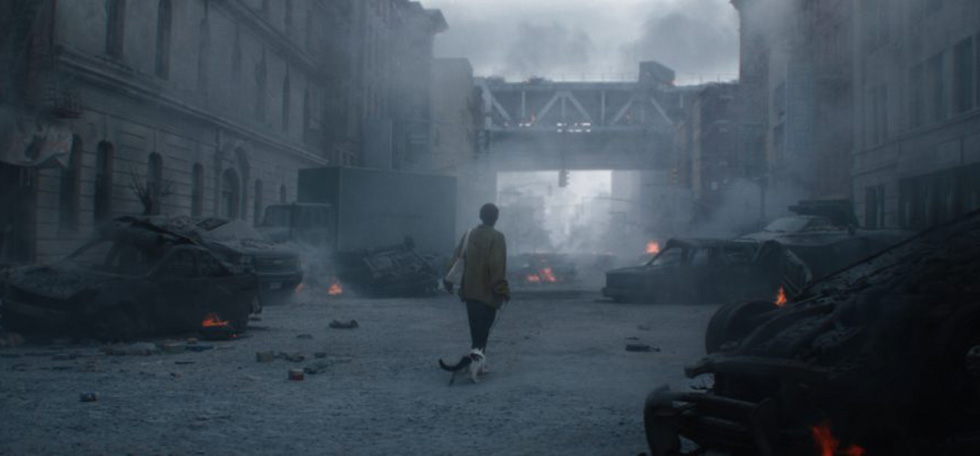
Among the thousands of New Yorkers running for their lives is Sam, a terminally-ill cancer patient played by Academy Award-winner Lupita Nyong’o. Trying to escape the city as the monsters close in, Sam and her cat Frodo eventually encounter Eric, an English law student portrayed by Joseph Quinn. Sam is determined to get a slice of her favorite pizza before she dies.
“He wanted to make a narrative about how two different people deal with this situation in a big city,” Humphreys says of Sarnoski. “So this was an interesting take about trying to make something about two strangers that meet while all this chaos is happening.”
A visual effects veteran of films including Ant-Man and the Wasp: Quantumania (2023), The Batman(2022), and Star Wars: The Rise of Skywalker (2019), Humphreys and his team helped guide Sarnoski and cinematographer Pat Scola through the complex process of making a film that required a large number of visual effects sequences. Sarnoski and Scola previously collaborated on the award-winning film Pig (2021) starring Nicolas Cage.
“Part of the job at ILM is just understanding the story and where we want to go, and just trying to build a bespoke solution depending on the different types of shots we’re doing,” Humphreys tells ILM.com.
One challenge, Humphreys says, was determining how the creatures with hypersensitive hearing might move and behave in a city environment like New York.
“In the previous films, they’re either just stealthing on a single character or they’re sort of doing a snatch-and-grab,” explains Humphreys. “So Michael was very keen on expanding that a little bit more. For example, ‘how do they act with each other?’”
During a nighttime sequence set at a construction site, the creatures behave almost like a family gathering for dinner, ripping apart and devouring a fungus-encrusted pod for food. Behind the scenes, the ILM team came to refer to the monsters by the name “Happy.”
“They’re not very happy creatures, so calling them ‘Happy’ is kind of fun,” Humphreys says. “There’s a really big mom that’s all caked in white, and then you’ve got the little baby happies. The little ones have slightly bigger heads. They’re smoother.”
When Eric accidentally makes a noise, a nearby creature is alerted and exposes its slimy, pulsating inner ear to listen more closely. It’s a tense, relatively long shot that Humphreys says is also one of the film’s most complex.
“There’s an immense amount of detail that the modelers, the texture artists, and the effects artists have done,” he says. “There’s the eardrum that’s fluctuating. You’re actually hearing Eric’s heartbeat, and we’re pulsing the eardrum and the heartbeat together.
“You want to get an emotional reaction from the audience, so we want to sit on this shot for quite a while,” Humphreys continues. “I really, really love this shot.”
Humphreys credits animation supervisor Michael Lum with helping develop the right movement for the creatures as they do things audiences have never seen before, like scrambling up and over Manhattan buildings.
“All of the creatures are hand-animated,” Humphreys reveals. “There’s no crowd system or anything like that. They’re all handcrafted, which is amazing.”
Building out New York City was another major aspect of ILM’s work on A Quiet Place: Day One that may not be apparent to many audiences, and that’s exactly the goal.
The areas of New York that appear in the film— including the Lower East Side, Chinatown, Midtown, and Harlem—were realized as a massive partial backlot set built at Warner Bros. Studios Leavesden near London. Production designer Simon Bowles and his team built two intersecting streets that could be modified and dressed into new locations as Sam, Eric, and Frodo make their way through the city.
Most of the backlot structures, however, were only built two stories tall, requiring ILM artists to digitally extend the height of buildings, lengthen streets, and fill in backgrounds.
“We did an immense amount of data capture,” Humphreys explains, a process that required 14 days in New York so the team could scan and photograph more than a hundred real buildings in high resolution. “We go through a whole process of building out those facades so that they can be used on many, many shots.
“For certain bits, we’ve changed quite significantly what you see in the backlot set,” Humphreys reports. “There’s a huge amount of augmentation and replacement.”
While Frodo the cat is entirely practical (played by two different feline stars, Schnitzel and Nico), a scene requiring the animal to weave through a frantic crowd running from the aliens required extensive digital artistry from ILM.
“Michael was adamant that he wanted to use the real cats,” Humphreys recalls. “There was a little bit of, ‘how are we going to do a shot like this? We can’t have a whole lot of people trampling over a cat.’”
The solution was to photograph just the cat’s performance separately at first, then add people and additional elements later.
“That shot is actually an amalgamation of hundreds of layers of different crowd people, and really timing and trying to build that shot up so that as an audience member, you get the sense of the chaos, but you also see Frodo enough for him to register,” Humphreys adds.
The film’s finale has Sam, Eric and Frodo desperately trying to reach a boat on the East River filled with survivors making their escape from New York. The sequence is built from several different locations, including part of an airfield dressed as a deserted FDR Drive, a pier along the Thames river, a moored boat, and a water tank at Pinewood Studios.

Read the article in full here.