Mark Newbold, writing at ILM.com, talks to ILM Visual Effects Supervisor David Vickery about Jurassic World Rebirth, talking dinosaurs and collaborating with Gareth Edwards.
Jurassic World Rebirth (2025) has grabbed global audiences by the hand and pulled them back into the savage world of the Jurassic film series, three years after Jurassic World: Dominion(2022) completed the second Jurassic trilogy. Rebirth has also changed the direction of the franchise, focusing on the genetic heritage of the incredible dinosaur creations.
Taking place on the fictional island of Île Saint-Hubert in the Atlantic Ocean, Rebirth shows the terrifying cost of unchecked genetic manipulation as we meet familiar creatures, including the armored Ankylosaurus, the chicken-sized Compsognathus, the crested, acid-spitting Dilophosaurus, the aquatic Mosasaurus, the F-16-sized Quetzalcoatlus, and, of course, Tyrannosaurus rex (albeit a much beefier one than the classic Rexy).
Along with these classic creatures are new franchise stars Scarlett Johansson as Zora Bennett, Mahershala Ali as Duncan Kincaid, Jonathan Bailey as Dr. Henry Loomis, and Rupert Friend as Martin Krebs. Together, they encounter distinctly unfamiliar dinosaurs, including the enormous Distortus rex, the towering Titanosaurus, and the horrifying Mutadon. It’s a one-way trip for anyone visiting the island – but in the capable hands of director Gareth Edwards (Rogue One: A Star Wars Story [2016] and The Creator [2023]) and visual effects supervisor David Vickery(Jurassic World: Fallen Kingdom [2018], Jurassic World: Dominion, and Mission: Impossible – Rogue Nation [2015]), it’s exactly what was needed for a pulse-pounding adventure in the grand Jurassic style.
ILM.com had the chance to sit down with David Vickery to discuss the visual effects of Jurassic World Rebirth. We started by looking at how the visual effects field is viewed today compared to a decade ago, when Jurassic World (2015) broke box office records and made the world stare in awe at dinosaurs all over again.
“The visual effects industry has grown in many ways,” says Vickery. “There’s a lot more trust placed in us than there used to be, even 10 years ago. Back then, visual effects were seen as something of a necessary evil – but now we find ourselves much more readily accepted as a department on set. Nowadays, other departments – whether it’s hair, makeup, costumes, special effects, stunts – rely on visual effects to guide how to film something because they know how vital it is that the visual effects work properly at the end of the process. They want to make sure what they’re doing is conducive to how we’re going to work, and it always used to be the other way around, so that’s been a refreshing change.”
On the surface, the art of visual effects may appear to be made up of equal parts skill, ingenuity, knowledge, and creativity, but the field also requires a healthy dose of collaboration, as Vickery explains.
“Over the years, I’ve found myself not trying to figure out how to do visual effects but rather figure out how not to do visual effects, and, as best I can, enable people on set to get what they need. You rely on the expertise of the crew. The camera operators and special effects technicians might have been in the industry for 30 years, and at ILM, we’ve got a bunch of talented artists that are generalists by nature, so that level of trust in visual effects has definitely grown.
“There’s a narrative in the press about how everything is done in-camera,” Vickery adds. “Well, yeah, everything is shot in camera because you can’t ‘shoot’ visual effects. What you’re trying to capture is as many practical things on set as you can because you can’t go back and get it in post-production.”
A veteran of three Jurassic adventures (three and a half if you include the 2019 short, Battle at Big Rock, directed by Colin Trevorrow), Vickery has worked with three directors (Trevorrow, J.A. Bayona on Fallen Kingdom, and Edwards), and that means differing styles and methods in bringing the dinosaurs to life.
“I find it interesting, the experiences I have with crews, directors, and producers who want to make their films in different ways,” he explains. “Colin relied heavily on animatronics for his films [Jurassic World and Jurassic World Dominion]. Gareth is much more comfortable with visual effects and wanted a consistency in his aesthetic by relying on effects for all the creatures and dinosaurs. On top of that, there’s a layer of what’s fashionable in movies at the moment. For a while, it was very ‘in’ to be shooting on green screen, or it was fashionable to use animatronics, and that’s what the public wanted to see. Now there’s a desire to see things filmed on location, and there’s an acceptance of visual effects, so filmmakers respond to that in the way they make their films. It’s interesting to see the evolution in how things are done.”
The style and flair shown by Gareth Edwards in his previous films – and his obvious affection for giants, as evidenced by Godzilla (2014) and Monsters (2010) – led producer Frank Marshall and executive producer Steven Spielberg to offer him Rebirth’s directorial seat in early 2024. And with that came a rare skill set for a major franchise film: a vast working knowledge and understanding of visual effects.
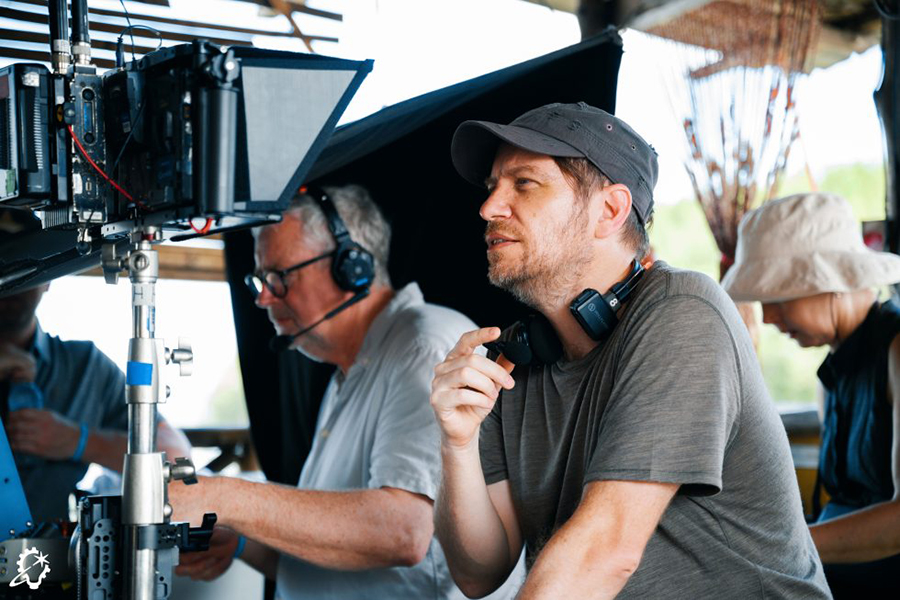
“Gareth’s a very distinctive filmmaker,” explains Vickery. “He comes from a visual effects background, so he truly understands how things work. He’s the type of filmmaker that creatively evolves his thought process as a project develops, so he’s totally happy to change his approach and defer some decision-making to later down the line. Visual effects is a great opportunity for him to do that, but he also likes reacting to natural things that happen on the day.”
Along with his knowledge of effects, Edwards is also known for his guerilla filmmaking style, something Vickery would learn more about from an Oscar-winning special effects supervisor.
“We worked with Neil Corbould [special effects supervisor for 2000’s Gladiator and Edwards’s The Creator, among others] on Rebirth,” Vickery says, “and I spoke to Neil beforehand because I was trying to find out what Gareth is like, and he said Gareth shoots really long takes. I’d heard of 20-minute or 30-minute takes on Rogue One, but how do you plan for that? How do you rig special effects knowing that Gareth’s going to roll for 20 minutes? Neil said they put a load of stuff out there – loads of mortars, loads of pots, loads of bangs, loads of fires and squibs, and they fired them off. They gave him something to work with, and Gareth reacted to that. Gareth wants to be in the real world, to react to what’s in front of him, and then capture the best version of that.”
That drive to find the best moments, to allow the actors to add their own essence to their characters, and to rarely say “cut,” extends to the visual effects realm as well, where Vickery found Edwards was every bit as open to allowing ILM to find those moments.
“He’s very open with his creative briefs and gives ILM a lot of creative flexibility in how to work,” says Vickery. “He doesn’t look at something and say, ‘What’s wrong with this?’ At ILM, we look at something and try to understand how we can make it better, and I think that’s why we stand out in the visual effects field. We’re trying to figure out how things can be made better, and Gareth does the same. He looks at something and in his head it’s a 7 out of 10, but what do we have to do to make it a 10 out of 10? What do we have to do to make it an 11 out of 10? He’s always going to wonder what would happen if we pushed it a little bit more. Does it break, or is it better? He doesn’t want to leave any creative opportunities on the table.”
Edwards’s naturalistic style formed the bedrock of the film, giving Vickery and the ILM team an opportunity to do things differently, opting for realistic substance over easier, stylistic options.
“Gareth said early on that he never wanted to get into a situation where the dinosaur walks into shot, strikes a pose, and roars. That feels staged,” Vickery says. “When you photograph animals in nature, they do whatever they want, so there were a few golden rules that he gave us. We should never animate a dinosaur unless we had reference of a real animal to use. It didn’t have to be doing exactly what the dinosaur was doing in that moment because you can’t find real dinosaur animation reference, but it could be something like a large animal looking scared or startled. Gareth said if we do that, he wouldn’t question whether the animation or the intent of the performance was correct, so he was very good at not micromanaging.”
Another advantage of Edwards’s understanding of the effects tool kit was that it gave Vickery and his team a framework to build the film around before the work began.
“He would construct an edit for us, but because he understands visual effects, he also understands the possibilities of what the shots can be,” notes Vickery. “We often found that the first time you watched them, it was difficult to understand how he wanted the performances of the creatures to play out, but you started to work on it and put it together, and suddenly we were like, ‘Oh yeah, that really works, the timing here’s really good.’ That’s how his visual effects background plays to his strengths because he can see the finish line much more clearly in his head than most other creatives.”
With all the advantages of a director understanding one of the key elements of the production, the process of building the film forged on.
“The first process we go through is laying the shots out and blocking in very basic key frame animation,” says Vickery. “That process takes a long time because it’s all about getting the composition of the image correct. In post-production, 60% or 70% of our time was spent on layout and animation, and then the rest – composites and lighting – was relatively quick. Gareth’s a great cinematographer in his own right, so he’s able to see when the composition of an image works well, and then ILM takes it from there.”
Read the article in full here.
Images: ILM/Universal