Journalist Nathan Heller and photographer Annie Leibovitz got exclusive access to the Lucas Museum of Narrative Art in Los Angeles for Vogue, meeting with George Lucas and his wife, Mellody Hobson, who showed them around the most impressive complex.
I meet Lucas, who is now 81, and his wife, Mellody Hobson, the investment-firm CEO and former chair of Starbucks, in a region of south Los Angeles bounded by row houses and the sunbaked stadium of USC. It’s a bright March morning, with winds from the east; Hobson and Lucas blink as they reach a swell of lawn. They are visiting, for the umpteenth time, a construction site that has been their creative focus for the past decade—really, since Lucas sold his company, Lucasfilm, to Disney, in 2012. The 11-acre Lucas Museum of Narrative Art, which centers on hundreds of pieces of illustration from Lucas and Hobson’s collection and which opens in September after lavish overruns in time and budget, is the most ambitious project to date from a couple whose lives are studded with them. But it is also, in Lucas’s perception, the culmination of his life’s study—an answer to the question that he started with some 50 years ago. We haven’t waited long when an open vehicle pulls up, like a Star Wars landspeeder. (It’s actually a golf cart.)
“We’re like Disney—‘Put down your rails!’ ” Hobson says as we board. “No one fall out!”
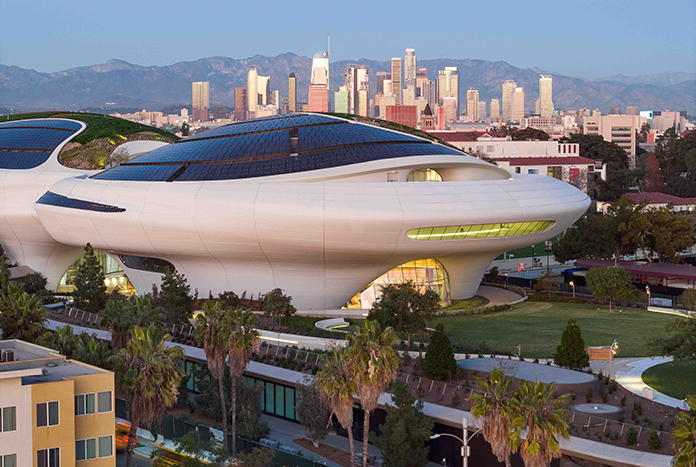
We take off into a landscape of rolling hills of grass and well-pruned trees, extending to what resembles a huge alien craft. Every detail seems to demand a second look. The sprawling park, landscaped by Mia Lehrer of Studio MLA, doubles as the roof of two parking garages buried below. And the five-floor structure, by the architect Ma Yansong of MAD, is an unusual home for an eclectic museum.
“George wanted the artists and the art to be in an important building,” Hobson says. “If the building looks important, people will understand that art must be important too.”
When it comes to the look of things, Hobson and Lucas, who met at a conference in 2006 and married seven years later, can seem to hail from different galaxies. She wears a tailored Sacai jacket with short and blooming sleeves over a crisp white blouse with elegant black loafers. Lucas wears black sweatpants and a black T-shirt printed with a Formula 1 race car—an outfit that, minus his white sneakers, a child might wear when taking to bed with the flu. As the golf cart hums and bounces over a meandering path, under a pedestrian bridge hung with vines, they murmur between themselves—about travel; about their middle-school-age daughter, Everest; about their busy schedule for the day. Then all at once we’re at the main structure, gazing up at its belly, which resembles the plastron of an enormous tortoise. A large fountain burbles nearby, a decorative element that, like the green roof, is part of the museum’s elaborate climate-control system. Hobson and Lucas, hopping out of the golf cart, lead me through a soaring glass entry to a reception lobby.
The structure where we find ourselves is towering with rich wood paneling and almost entirely devoid of right angles. Its ceiling sweeps down; its grand staircases twist. A set of central elevators are threaded through glass tubes. The museum’s façade—its carapace, really—was designed using a process called parametric modeling, which enables its shape to be molded like Play-Doh. It was assembled around an internal skeleton from 1,500 school-bus-size fiberglass panels, each fitted into place, like three-dimensional puzzle pieces, by human crews. “It’s a piece of modern architecture so of its time that you couldn’t have built it 15 years ago,” Michael Siegel, a principal at Stantec architecture and a leader of the project on site, tells me. Yet the effect is classically Californian in its balance of tech futurism and organicity, bringing to mind the designs of Apple’s heyday: openness and compactness, something cool and something warm. The building looks as if it might stretch and lumber off at any moment, like one of Lucas’s fantastical creatures.
In the press, the museum has been described as a gift to the city of Los Angeles, a euphemistic way of saying that Lucas and Hobson are not just designing but paying for it, at a bill of around a billion dollars. Their friends describe the financial outlay as the least of their commitments. “ I know a lot of people who create—I guess the main part of my life has been with people who are creating—but I’ve not really worked with people who have created something to this scale,” says the designer Stella McCartney, who has known both Hobson and Lucas for years. “ I wouldn’t even call it a project, because that’s just not big enough a word. It’s like another limb for them.”
Lucas likens the museum to film production. “It’s like making a movie—exactly the same thing,” he says. Sir Lewis Hamilton, the Formula 1 driver, who knows the couple very well—Lucas is his pancake-eating and movie-watching companion on some mornings when he isn’t racing—describes the museum’s elegant, irregular interior as “like walking through George’s brain.”
On the way to the first gallery, we dip into the gift shop, an irresistible-looking space with glowing shelves and tubular glass cases, which will sell T-shirts, books, and toys that tie into the collection. (Lucas, who may be in better touch with the discerning eight-year-old within than many of us, tells me, “We’re only going to do stuff that’s good—I want to look at it and say, ‘That’s a great toy!’ ”) Most museum gift shops, they were surprised to find, lose money. Lucas thought he could do better. “I know about licensing and merchandising,” he tells me in confidential tones, as if it were a secret. Alongside items tied to the museum collection, the shop will sell Star Wars merchandise. The museum’s attitude toward the famous franchise might be called pragmatic: It is emphatically not a Star Wars museum, but neither does it avoid what might get people in the door to discover, say, the 20th-century illustrator Maxfield Parrish. An exhibition in one gallery will include vehicles and models used in the movies. (“I’m like, That’s the section I’m going to be spending all my time in,” says Hamilton, who, at 41, is building a Lego Millennium Falcon and hopes to build a Lego Death Star soon.) The shop is meant to have something for kids of all backgrounds—a priority for Hobson, who, before making it to Princeton and eventually the helm of Ariel Investments, America’s best-known minority-owned value-investing firm, was reared as one of six children by a struggling single mother in Chicago.
“I thought, If I went to the museum with other people who had money and I had none, would I have to watch them buy things while I get nothing?” she says. With an eye to her childhood self, Hobson, who is now 57, insisted that the gift shop sell something covetable at a price of 25 cents. (She settled on a pencil that says “First Draft,” “Second Draft,” and “Third Draft,” up the sharpening shaft.) In the sleek cafeteria across the entryway, with curvaceous planter benches and seating that spills outside, she guided the menu to a similar goal.
“They would say, ‘Here’s our grilled cheese sandwich. It’s on sourdough, with Gruyère and pesto!’ And I’m like, No, it’s on white bread, with American singles from Kraft and butter,” Hobson says. Lucas, to her bemusement, kept insisting that the museum serve pancakes. “ I’m like, ‘George! Do you understand breakfast?’ ” Hobson says. “Do you understand what time we would have to open the museum?”
Pancakes or not, there are more than a hundred schools within a 10-mile radius of the museum, a reality that, in addition to shaping cheese preferences, inspired its education program. “I wanted the museum to be in a place where kids who don’t have a lot of the advantages that richer kids have can see stuff they can relate to and understand that these things are made possible by a common belief system,” Lucas says. Curatorially speaking, the museum is set up to reflect its founders’ view of what art in society ought to be. “We believe that art is in the eye of the beholder,” he says. “Nobody’s going to tell you that you have to like this. ‘But it doesn’t make any sense to me!’ ‘That’s what art is.’ ” He frowns in distaste. “My feeling is, art is emotional; it’s not intellectual,” he says. “Are you emotionally connected to it? If you’re connected, it’s art. And if you’re not, then it’s not art.”
Unusually for a museum collection, Lucas and Hobson’s centers on illustration: 1,200 pieces of storytelling art that Lucas himself picked from a pool of 40,000 items. There are well-known oil works, such as those by Parrish and Norman Rockwell, made for magazines and advertisers. But there are also comic strips, manga, movie art, and fantasy scenes of dragons and kings. The exceptional range reflects the owners’ particular taste. Lucas began collecting in college, when he discovered he could afford original drawings for comic strips he loved. “It was an underground thing—none of the auction houses handled that kind of stuff,” he says. “It was fanboys, and I could get a little Alley Oop for $35.”
His volume of material (and his budgets) grew from there. “We ended up with all this stuff in storage and our houses, and I thought, We have to do something,” Lucas says. “I’ve worked with hundreds of illustrators and they never get credit for anything. They’re not going to end up in museums, because the art world is elitist and illustrators are seen as lowly.” A concept took shape, eventually encompassing more conventionally museum-worthy pieces from Lucas and Hobson’s collection—pieces like JR’s first photograph or Robert Colescott’s George Washington Carver Crossing the Delaware. Stella McCartney says, “I mean, there’s a Frida Kahlo just sitting there, and Mellody and George are like, ‘Oh, yeah, that was in our bedroom.’ And I’m like, ‘You’re crazy not to wake up with that Frida Kahlo every day—what is wrong with you, Mellody?’ ”
And yet the Lucas Museum’s collection, as a whole, remains unorthodox. Every piece I saw for display was figurative: depictions of people, creatures, and things. (Although Lucas and Hobson own abstract art, those were the works they kept at home.) Given that most accounts of growth in 20th-century art trace a progression through and against nonfigurative work, the focus on what Hobson and Lucas describe as works that tell a story has already stirred up controversy. The critic Christopher Knight, writing in the Los Angeles Times, described the “narrative art” premise of the Lucas Museum as “made-up”: a category without a widely understood definition or conversation around it. “Every time I ask artists what they think of a Museum of Narrative Art, the reply is some variation of ‘What’s that?’ ” he wrote.
To say that Lucas shrugs off such criticisms isn’t quite right. They spur him on in his view of himself as a man standing up for the legitimacy of popular art against the dark forces of an art historical establishment. “They want to do it the way they were taught in the university where they got the PhD,” he tells me. “I say that has nothing to do with art. I’m not in favor of telling people what they like.” It can be surprising to find the founder of one of the nation’s largest, most prosperous popular-creative empires engaged in what he perceives to be an underdog battle against a subset of humanities academics. (One can hardly imagine Oprah or Taylor Swift kept up at night by scholarly critique.) But Lucas has always stayed unusually close to the ground in his work. Long after he had the staffing to retreat into a management and oversight role, he surrounded himself with paper and pencils and continued obsessing over design details for his productions. Long after he’d started huge, thriving companies within companies—production, effects, sound, merchandising, gaming, education—he sat down at a desk, as he always had, to write drafts of screenplays for his movies himself. His habits were no different with the Lucas Museum. If anything, they intensified.
“George is grinding every day in his 80s,” Lewis Hamilton says. “He’s up early, doing his exercises, and dealing with the museum, going through absolutely everything.”
“He spent years doing this on big pieces of paper on the dining room table,” Hobson tells me now, with visible restraint. “On the dining room table—years.”
“Yes, there were floor plans, elevations…,” Lucas drifts off dreamily. He had pored over the designs—and then, when they were done, pored over them again, determining where every piece of artwork ought to go.
The result is a museum that, much more than most, adheres to a single vision, a unified point of view. We walk past two 299-seat movie theaters that, on their own, stand as some of the finest screening spaces in America. The screens are huge. The ambient lighting can be set to any color. Each theater is a discrete acoustic structure, suspended on enormous springs and rubber isolators, so that the booming sound of an action scene in one will be inaudible to audiences enjoying a quiet moment next door. Lucas calls the theaters “galleries,” to put them on par with the other rooms; all through the course of a normal day, one will screen documentaries about artists and filmmakers while the other shows short films, some only a few minutes long.
“What’s the difference between the art that’s in the other galleries and film?” he asks. “Film moves. And the movement creates emotion.” He likes to cite the work of the early Soviet filmmaker Lev Kuleshov, who showed that audiences’ perceptions of emotion transmitted in a neutral-looking face changed in measure with the footage spliced around it—a lesson that he carried through his own work. (“One thing I did in Star Wars was to give C-3PO a very neutral face,” he says.)
Lucas, who continues to dream vividly almost every night, has a way of suddenly making leaps between his many interests and the facets of his work. An associate tells me, “ You’re watching him create something that he feels is totally normal”—even if it hardly seems that way to other people. When Lucas decided to make a museum about myth in society, for instance, it seemed obvious to him that it would start with cave paintings.
“ George calls them the first graffiti,” Hobson says. “They drew the animals figuratively, not literally. They were speaking to them mystically to say, ‘Come back to us, so we have food.’ ”
Read the article in full, as well as the photos taken by Annie Leibovitz, here. Head to the Lucas Museum of Narrative Art website to learn more about the museum, opening on September 22nd, 2026.