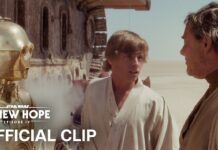
It was fifty years ago today on March 22nd, 1976, that principal photography on what became Star Wars: A New Hope started in Tunisia, and Lucas Seastrom takes us back to the first shot involving Phil Brown as Owen Lars and Mark Hamill as Luke Skywalker.
“Action!”
The first shot captured for The Star Wars was from Scene 26, when the Jawas present their batch of droids for sale to Owen Lars (Phil Brown) and his nephew, frustrated farm boy Luke Skywalker (Mark Hamill). As was typical for the ever resourceful Lucas and his documentary-infused shooting style, two cameras covered the set-up simultaneously. Cinematographer Gilbert Taylor, known as Gil, was supervising. At 61, Taylor brought more than 45 years of experience in filmmaking to the project.
The unit’s A camera, a Panaflex with a 35mm lens, was operated by Ronnie Taylor, a wide shot that established the location of the Jawa sandcrawler vehicle at right with the Lars homestead at left, with a group of Jawas, some of whom were played by local children, seen running up alongside the sandcrawler’s treads.
The B camera, an Arriflex with a 180mm lens, was operated by Geoff Glover capturing a tighter view of the Homestead’s “igloo,” with the main characters in the foreground. It was Brown, playing Uncle Owen, who spoke the first line of dialogue in a Star Wars production, a gruff and matter-of-fact, “Alright, fine, let’s go,” in response to the eager Jawa merchant (Jack Purvis).
In the final cut of the film, the subsequent shot of Aunt Beru, seen down within the troglodytic hole that was the Lars’ dwelling, and that of Luke seen up above at the hole’s rim, was captured at an entirely different Tunisian location at a later date in the shoot. But during that first set-up on March 22, B camera held with actor Mark Hamill as he went up the small rise at the Nefta location, pretending to look down at Beru actor Shelagh Fraser, and calling, “Doesn’t look like we have much of a choice, but I’ll remind him.” This bit of unused performance was Hamill’s first recorded line of dialogue.

Read the article in full here.