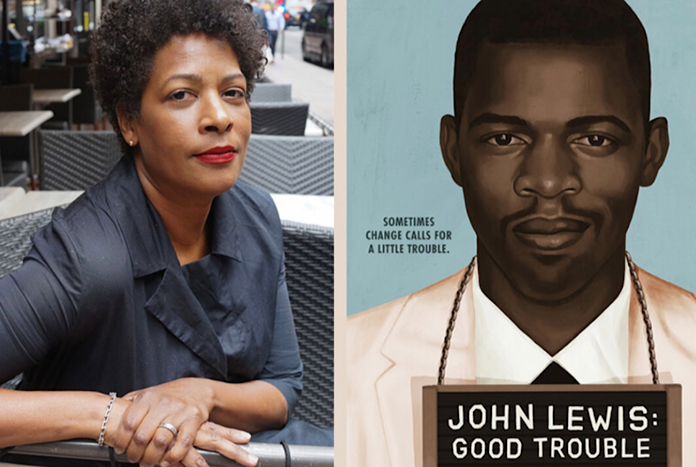
In celebration of Black History Month, Dawn Porter recently chatted with Lucasfilm’s film development coordinator Erin Hill for a virtual discussion about her career, collaborating with Skywalker Sound, and the power of this increasingly relevant story.
Erin Hill: Congratulations on directing and producing John Lewis: Good Trouble, and The Way I See It. I loved that movie this year as well. I know that you started out as a lawyer. Now you have 13 films in your pocket that you’ve directed and you’ve produced even more. How did you make that jump and what was the thing that made you feel confident that you were able to transition like that?
Dawn Porter: I would not say I was confident [laughs]. I would say, I was interested. I kind of moved slowly in the direction of directing. Starting as a lawyer, as a litigator, you really are a storyteller. You’re trying to take something that’s complicated and make it comprehensible to a lay audience. So the skills for being a lawyer, the kind of lawyer I was, and being a documentary director are really complimentary.
During my time as a lawyer, I took countless depositions, which means that you have to listen to people. I think for all directing, the most underrated skill is listening. Instead of directing somebody I think of myself as kind of uncovering the story that’s there from the person who’s the protagonist. But to be more mechanical about it – I went from a lawyer at a firm to in-house at ABC. And I moved then to the journalism side, where I worked for ABC News doing ethics and standards. And in that job, my role as the lawyer was not to say “what can you legally do,” it was “what should you do.”
When you start thinking about the ethics of storytelling you really start thinking about what’s necessary to tell the story without being exploitative. What does this story need to be told fully and honestly? What does it need to know to be true? From there, once you get in the groove of doing that and finding that heart of a story, it was really easy for me to say, “I could do this with things I come up with,” rather than doing it for other people and helping them find their way to their story.
But, to tell you the truth, I didn’t call myself a director – I hadn’t been to film school, I hadn’t done any of those kinds of traditional paths. Really until my first film was finished. And even when I was making it, to tell you the truth, I didn’t have a, “Oh, this is going to be a film in a festival.” I didn’t have that vision for it – I just really wanted to tell the story of these young public defenders with pictures and images. So I just kind of went one step at a time and then, as the film started getting developed, the steps kind of started to reveal themselves to what was possible for it. But I didn’t start out with a grand hope of, “This is going to be a whole new thing,” [laughs] it just kind of kept going, naturally.
EH: What was that moment, when you did feel comfortable calling yourself a director?
DP: The real moment was Sundance – the premiere of Gideon’s Army. I remember the lights went down and everyone was quiet, anticipating the film, and I felt my face getting hot, and I thought, “This was a terrible mistake.” [laughs] If this is a failure it’s going to be on such a huge stage. So, then when it was received well, I felt, “Okay, yeah, I really did this.” By the way, when I say “I” it’s a “royal we” kind of situation, because nobody makes a film by themselves. It’s really, in the best circumstances, a beautiful collaboration among people who are all contributing bits and pieces, so it’s very hard to put the “I” in film. It’s very much a “we.” And I can say that confidently now, knowing what I bring to it. But also knowing the people I collaborate with and how important they are to the film and to me.
That actually brings us to Skywalker [Sound] because Skywalker and the mixers that I’ve worked with have been such an integral part – I mean that so sincerely. It never occurred to me how much fun their music and sound mix was going to be until I got in that room. And they really encouraged me to say out loud what I wanted and to not be embarrassed about asking for things. And I think that’s a really important lesson for filmmakers who either are just starting out, or are a little quieter. Say what’s in your head – in English. You don’t have to know all the technical terms for things. What I would express to your people – to Chris in particular – is, “This is the feeling I want from something, and how can we then get there?” It’s like a dance, and it’s very satisfying when you’re able to communicate that to a partner who can then bring it to life.
EH: And you’re talking about Chris Barnett from Skywalker Sound?
DP: I’m talking about Chris Barnett, and Pete Horner. Those are the two mixers. I’ve worked more with Chris – I love Pete, but I’ve worked more with Chris. I think what he’s helped me to do is develop a language for speaking not only with the Skywalker team, but also with the composers. Because now I carry all of that information. I know that if we don’t have these options we’re not going to be able to make or do the things we want to do in the mix and in the sound design. I’ve just learned so much and it’s been really fun. Plus, Chris in particular is the most honest critic. He’s like, “That was good, that was good.” [laughs]
EH: For a filmmaker who’s looking to potentially work with Skywalker Sound, can you tell us about how you were introduced to them? I’m also curious to know, throughout the pandemic and having to do things remotely, how you were able to build off of that relationship and keep things going?
DP: Yeah so the real story is the year before getting Gideon’s Army, my first film – the year before it premiered at Sundance. The editor Matt Hamachek – who’s just directed his first film about Tiger [Woods] for HBO – Matt and I went to Sundance the year before we had a film there just to see films and network with people. And the true story is once upon a time there was a whiskey tasting party at Sundance that Matt and my husband went to and he came back and he was really excited. And he said, “I met the Skywalker guys and they would love to hear what we’re up to with this movie.”
So it kind of happened at a Sundance whiskey bar to tell you the truth. But then, we wrote to them – and the reason we had to write to them – you could clearly just call your people and say, “Hey I have this movie, and this is what we’re doing,” but we didn’t have enough money. But Skywalker was really leaning in to working with documentaries. I don’t know if this is still the case, but the way it was described to me is it was almost a gift to the sound design team, because a lot of documentaries are quiet. And so the sound really just shines through, and it’s such a crucial element, and people like Chris and Pete, they understand that so intuitively well that everything they do is going to be heard exquisitely and expressively. So they really worked with us on our budget to make sure that we could get that kind of attention to it. And that’s a great investment in a relationship, because now I’ve been back several times and the budgets of the things I’m working on are larger. So that relationship is really, really important. And I will say that even though we were certainly one of the smaller budget projects – I think we were next to the equivalent of Tron 19 or something. But what I really appreciated is how they did not make us feel like a small project. We got a beautiful suite, we got muffins, we got the full attention of our team and appreciation of the team – we got a parking space! It was very clear to us that everybody there cares about every project. If you put that name Skywalker Sound on it, they’re going to make sure that it delivers to that standard of quality. And I have felt that with every single project that I have brought there, which I think is really saying something for how much the people who are doing the work there care about the work. They’re not just paying attention to the famous rich people. [laughs]
EH: Was John Lewis a subject that you pursued developing on your own or was it something that was presented to you?
DP: I had done a four-part series for Netflix called Bobby Kennedy For President, and John Lewis appeared in that series, and he gave a really emotional and fantastic interview for us that really elevated the four episodes. So CNN came to me, and this was after they’d had a lot of success with RBG, and I tease that they were looking for another 80-year-old to highlight, so they came to me. But they just said, “What would you do with it?” And so I came back with a pitch that the thing about John Lewis was to take him out of the past and bring him into the present. Most people thought of him in terms of his civil rights activity, but he had been in Congress for so many decades and had been taking all of that civil rights energy into the present and was still such a powerful voice, so I really wanted to show how his past influenced his present. So that’s how that came about, and by then I had mixed Gideon’s Army at Skywalker, Bobby Kennedy, which is four episodes, Trapped – so, by the time I got to John Lewis, it was about seven projects, working with basically the same people, and when you have that relationship it certainly pays off anytime that you have a working understanding and you know how the other person works, and you know what they need to do their best work.
Where that really paid off, was in the pandemic, because I was on the east coast, so I couldn’t travel out there. And because we’d worked together so many times before, Chris just knew a bunch of things that we would normally go through and say, “Do you want this, do you want that,” or, “I’ll just do the usual, right?” So he did a first pass that was exactly what I would do, so we could really focus remotely on the particular details. I don’t really know how he did this, but somehow through Apple TV we were able to communicate in real time, so it was almost like being in the room together. But I will say I really miss being in the room. It’s such a gift to be able to be without interruption, just focused on your work on a big screen with someone who’s going minute by minute on your movie and making sure it’s everything it should be. I mean, it’s just such a special experience.
Read the fascinating interview in full here.