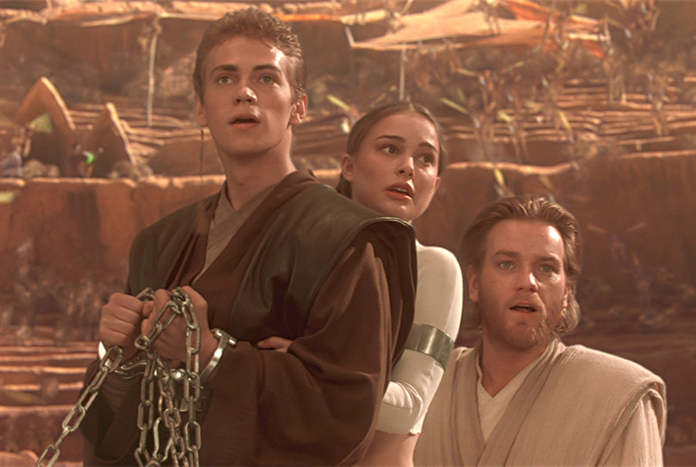
Some of the greatest Star Wars stories happen behind the scenes, and Lucasfilm’s Lucas Seastrom tells those tales in a new series on StarWars.com. Prequel Trilogy veteran Mike Blanchard recounts the setbacks and success in shooting Star Wars: Attack of the Clones as the first all digital blockbuster.
Star Wars: Attack of the Clones was the first major blockbuster movie shot entirely in a digital format. Over five years in active development, Lucasfilm partnered with Sony and Panavision to create a prototype digital cinema camera that bypassed the use of traditional celluloid film. For Lucasfilm, it was the continuation of a decades-long series of innovations to improve the craft of filmmaking and allow storytellers like George Lucas to realize their full vision onscreen.
Now 20 years after the release of Attack of the Clones, productions across the film and television industries use digital cameras of all kinds as others continue to use celluloid film. Mike Blanchard is Lucasfilm’s vice president of post-production and worked as post-supervisor and technical supervisor on all three of the Star Wars prequel films. Intimately involved in the development of Clones’ digital camera system and related workflow, he reflects on the momentous experience and discusses how Episode II helped change filmmaking.
Note: This interview originally appeared in the Star Wars Celebration 2022 Commemorative Guide.
Mike Blanchard, Lucasfilm vice president of post production
StarWars.com: To begin, could you provide some background about how you first came to Lucasfilm?
Mike Blanchard: I got to Lucasfilm in 1995, and I was hired to work on The Young Indiana Jones Chronicles. It was after the show’s ABC broadcast run, and we were joining the episodes together into feature-length versions to be released on video. We were shooting new material to bridge the episodes and we also changed the openings to be more theatrical. I had gone to film school and I’d wanted to work at Lucasfilm for years.
StarWars.com: So you came onto the team that worked very closely with George Lucas on his film and television projects.
Mike Blanchard: George created a small company called JAK Films that was separate from the rest of the company. We were all in the Main House at Skywalker Ranch, and the center of activity was the editorial area downstairs.
Since we were a small group, that meant when things were really busy we weren’t just going to bring in a lot of people. We had to figure things out, and that was great because it meant you had to have a general knowledge of everything. We were always learning new things. It was great because you never knew what you might be doing when you came into the office each day. I was constantly researching newer technologies that were coming out, because you never knew when something might be applicable to what we were doing. Or, more accurately, since George has a keen ability to identify ways of working that are antiquated or hindering to his creative process, you have to be ready.
StarWars.com: Did you have any prior experience working with video or digital formats of any kind?
Mike Blanchard: I had to work my way through college with multiple jobs, and those tended to be in the audio/visual field. Making corporate videos, doing multi-camera set-ups in courtrooms, audio engineering for bands, those types of things. When I was in film school, for students like me who didn’t have a lot of resources, the idea that we were going to pay for film stock and processing to shoot on 16mm film was kind of a non-starter.
I had embraced video both as a student and in these jobs that I was doing, and I knew it much better than I did film processes. The more I worked with film, the more frustrated I’d get. I remember arguing with my professors because they hated video, but I thought I should be allowed to do projects with it. Clearly the quality had a long way to go, but for learning the craft of storytelling, it had a lot of advantages. That was ten years before I came to Lucasfilm. I understood that video was something very practical and more accessible, but I certainly didn’t think that you could shoot a major motion picture with it. The image quality just wasn’t good enough.
Mike Blanchard testing early Sony digital cameras at Skywalker Ranch.
StarWars.com: Lucasfilm had been involved in the integration of computer technology and filmmaking tools since way back on the production of Star Wars: A New Hope. This involved everything from visual effects to picture and sound editing tools. By the time George Lucas was preparing to make the Star Wars prequel trilogy, he desired to make the films with a completely digital, computer-based workflow. Were these preparations already taking place when you first arrived?
Mike Blanchard: Relatively soon after I arrived in 1995, one of the first things we were doing was digital beta-cam tests. We shot them at Skywalker Ranch, and we tried out different lenses that used adaptors that would allow us to use more cinema-quality glass. There was a lot of stuff going on as we were ramping up to do the Star Wars Trilogy Special Edition and The Phantom Menace. It was exploratory. We were trying to discover the potential benefits and the roadblocks. At the time, there was not a clear pathway to shooting an entire movie with digital cameras.
StarWars.com: It’s important to understand that Lucasfilm had been helping develop these tools and technologies since before principal photography started on The Phantom Menace, let alone Attack of the Clones. You would make visits to the National Association of Broadcasters (NAB) convention and other shows to meet with potential technology partners. What was your view of the industry landscape at that time?
Mike Blanchard: We were all very busy and had several projects going on and we didn’t want to waste George or [producer] Rick McCallum’s time. We needed to find people to help us, and we didn’t have the time to get bogged down in the usual back and forth between legal departments before we could even determine if it would be fruitful to work together. I would go to NAB and have these meetings with vendors and manufacturers, it was very informal. I was like an advance scout trying to gauge if what we needed done would be mutually beneficial enough for them to remain committed. Companies want to work with Lucasfilm given our reputation and the vast reach of Star Wars but we needed to find partners that would embrace the rebel spirit of this.
It became pretty clear early on that the only viable choice for the camera manufacturer was Sony. They had an end-to-end broadcast business with their cameras, monitors, and ancillary equipment, and we felt there were enough components that we could adapt to make it work for us. Sony offered the shortest path to reach our goal, and they recognized that it could turn into a new business for them.
StarWars.com: And Panavision was chosen to make the lenses, correct?
Mike Blanchard: Yes. That was really important because building lenses is a long, complicated process, and there are only a few companies that could do it well. I looked at the camera reports from the original Star Wars trilogy to see what prime lenses were used, but there was no way they could make all of those lenses in time, so instead they just made two zoom lenses to cover that entire focal range.
StarWars.com: And, of course, it’s also important to keep in mind that initially the plan was to shoot digitally for The Phantom Menace, but that was deemed too difficult to manage in time. There were some digital shots captured during pick-ups of that film, but it shows that this was continuing to evolve in parallel with the creation of the prequel films.
Mike Blanchard: Ultimately, what happened was we shot some scenes digitally for Episode I, but that system was vastly different than what we used for Episode II. Episode I was a reel-to-reel 30 frames-per-second system. Just thinking about it makes me laugh! For George it was a way to signal to the industry how serious he was about it. Our next line in the sand was that we’d be shooting all of Episode II digitally in June of 2000, which meant ideally we had to have the new camera package ready to go a few months before that. From there it was about determining what was possible within that timeline.
The Episode I pick-ups were shot in August of 1998. So we had about a year and a half to get the new camera and all the ancillary equipment and workflows in place. Even with all of the research and development that we had been doing, we weren’t close to being ready ahead of Episode II. We were pushing the envelope with beta equipment, and I mean that in the software sense of using systems that aren’t fully baked or tested. The four main cameras we used in Australia for principal photography had the serial numbers 00001-00004. That’s how close it was. No wonder we were stressed! We essentially had less than a year from the release of Episode I to the start of shooting on Episode II.
Fred Meyers, high definition supervisor
StarWars.com: As this experimentation continued ahead of Attack of the Clones, one important colleague who joined the team was engineer Fred Meyers.
Mike Blanchard: Fred joined us pretty early in the process. He was working at Industrial Light & Magic [ILM]. He was the perfect person to shepherd the engineering aspects of this because in addition to him being the chief engineer at ILM, he had a vast knowledge of camera imaging and optics. He knew all the potential pinch points that would be created given ILM’s current workflow and how it would need to change to make it work in an end-to-end digital pipeline. This was important because it allowed us to work through both the camera challenges and all the back-end post-production and distribution challenges in parallel. Without Fred, there is no way all of the engineering issues could have been sorted out in time to be able to shoot Episode II digitally.


Read the article in full at StarWars.com.