Dan Brooks, Kristin Baver, Amy Ratcliffe, and Lucas Seastrom talk about the legacy of Lucasfilm animation, from George Lucas’s first short to The Star Wars Holiday Special segment that introduced Boba Fett, Star Wars: The Clone Wars, and beyond.
Dan Brooks: We’re here to talk about the legacy of Star Wars animation. I wanted to start at the beginning because I think that when we talk about Star Wars animation and understanding animation’s role in Star Wars and Lucasfilm, it’s important to understand where it begins. And I think it really begins with George Lucas. So I’m going to call on our own Lucas — Lucas Seastrom — who’s kind of our resident historian. Lucas, can you talk about what you know of George Lucas’s interest in animation, and how that might have led to Lucasfilm and Star Wars getting into animated series and animated storytelling?
Lucas Seastrom: Sure, well, hello everyone. Thank you very much for including me, it’s nice to see all of you and to talk about Star Wars a little bit and animation. At different times throughout his career, George has spoken to that interest and it manifests itself in different ways and…I should say George Lucas, of course, because he’s not a personal acquaintance of mine. The first movie that we know of that George Lucas made was an animated film. It was a one-minute short called “Look at Life.” That was his first student project at the University of Southern California in 1965 using clip art from Look and Life magazines. He was already beginning to explore dynamic camera movements and editing techniques and even socio-political themes. It goes all the way back to USC. Continuing from that, of course, there was a visual effects animation and rotoscope department at Industrial Light & Magic on Star Wars: A New Hope. That was set up by Adam Beckett. And then Larry Cuba was doing computer animation for the Death Star plans. Both Beckett and Cuba were California Institute of the Arts alumni, which if you’re interested in Disney animation, Cal Arts is important for that as well.
As far as traditional hand-drawn cel animation is concerned, the first major example is from The Star Wars Holiday Special. There was this plan for a short sequence within the Special, which aired in November of 1978. The understanding that I have is that George Lucas had seen a television special called A Cosmic Christmas that had aired in 1977 and was made by a studio called Nelvana in Toronto, Canada. It was decided that Nelvana Studios would produce this 10-minute animated short, The Story of the Faithful Wookiee, as it’s now referred to, which also saw the debut of Boba Fett.
Dan Brooks: That’s perfect because I wanted to get into The Holiday Special. I think we can all agree that that animated sequence is the highlight of The Holiday Special from a qualitative point of view.
[Everyone agrees.]
Kristin Baver: Although there are other highlights with Bea Arthur’s Cantina Song and Jefferson Starship or, at least I think they were Jefferson Starship at that point?
Dan Brooks: Oh yeah. Jefferson Starship at that point.
Kristin Baver: Yeah. The entire Wookiee cooking sequence, you know, there’s a lot of high points for me, but the animation is definitely a standout moment.
Dan Brooks: Yeah. The Holiday Special is really…the animated sequence within that was kind of the first real Star Wars animation. So Lucasfilm is now in animation, to a degree, but then as far as I know, Droids and Ewoks were what came next. I have to be honest, this is like my moment of Luke’s, “I have no memory of my mother.” I have no memory of Droids and Ewoks when I was a kid. Did anybody grow up watching Droids and Ewoks, or aware of them?
[Lucas raises his hand]
Amy Ratcliffe: I haven’t seen them.
Kristin Baver: Do we know what years they aired? Lucas?
Lucas Seastrom: Droids and Ewoks would be the next Star Wars animation. Lucasfilm also co-produced Twice Upon a Time in 1983, which was our first animated feature. And the Computer Division’s graphics group made The Adventures of André and Wally B. in 1984 using their new image computer called the “Pixar.”
Droids and Ewoks were similar to The Holiday Special in that we didn’t have an animation team within Lucasfilm making it. We were collaborating with an outside group. It was a part of the strategy for a post-Return of the Jedi world for Star Wars. It was the era of Saturday morning animation on television. Droids and Ewoks first premiered together in 1985 and only Ewoks got picked up for a second season in ’86. There was a licensing program that was involved with it, but one of the coolest things about it is that Nelvana Studios produced it. That was the same group — or at least some of the same group – from seven years earlier in Toronto that had made the sequence in The Holiday Special. The visual styles were quite different, but there was that consistency there.
Dan Brooks: We’re moving forward in the timeline and before we kind of get into The Clone Wars and the real birth of Lucasfilm Animation, there was a significant release with Genndy Tartakovsky’s Clone Wars cartoon, which I would be remiss if I didn’t talk about because I love it. It’s some of my favorite Star Wars storytelling.
And it will have just arrived on Disney+ when this article comes out. I think people will discover it, which is important because it set up a lot of things that maybe we saw later [in other Star Wars stories]. But it’s also just visually beautiful and really creative.
Amy Ratcliffe: I discovered it long after it came out and I managed to find the DVDs when they were still a little more widely available. It’s stylistically beautiful. It’s very bold. It almost leans into that cell style. And the thing I like most about it is the sparing use of dialogue, which is very much a Tartakovsky thing. It’s very bombastic and over-the-top as far as like Mace Windu just basically has superpowers. And it was so cool to see him that way. But I was really taken in by the power of the visual and that very minimal dialogue was needed to sell that story.
Dan Brooks: What I really love about it is that it feels to me like it’s someone else’s interpretation of Star Wars, but it still feels very much true to the spirit of it. But the energy is very uniquely Tartakovsky.
Kristin Baver: I will admit I have not seen it in full. I’m excited to see it in full when it comes to Disney+ , but one of the things that strikes me about it from the snippets I have seen and from what I know of it, is it that even though the animation style is vastly different from the Star Wars: The Clone Wars that Dave Filoni brought to life starting in 2008…I love that it does have some through lines. It introduced us to Asajj Ventress and then we really got to know her in the contemporary incarnation of The Clone Wars. But it’s your first hint at a new character like that. And it really did start to expand upon what this period between Attack of the Clones and Revenge of the Sith really was like. And I feel like that’s so important because from the time it’s kind of mentioned almost offhandedly in A New Hope to the point where the prequels were done, I still feel like the films — they don’t gloss over the Clone Wars as much as there’s just not enough time to give you a sense of what that conflict was really like.
Dan Brooks: They’re sort of focused on the character drama. The war part of it is happening in the background, really.
Kristin Baver: Yeah, yeah. It’s more like an aside, especially, I mean, in Attack of the Clones, the war has just broken out at the very, very end. But even in Revenge of the Sith, it’s taking place over just a couple of days, and they’re really just the downfall of Anakin Skywalker days. You’re so laser-focused on what’s happening in that corner of this vast galaxy that you are missing a lot of the components of what drove it to this point. So I’m so glad that animation kind of picked up that ball and ran with it and gave us both of those series to explore from two different points of view.
Lucas Seastrom: In the context of when the micro-series, as it was known then, first came out – those were the days when we still had to wait three years for a new Star Wars feature and the micro-series episodes were only a minute long or so during the first season. And I’d just be waiting, sitting through everything else on Cartoon Network – not that it was bad; there was a lot of good stuff – but waiting and waiting for Friday night and then you get 90 seconds. It was brilliant in the sense that it just brought you to the edge of your seat and you wanted more and you were so excited for the next week. It was wonderfully excruciating because it was so limited in its presentation.
Dan Brooks: Yeah. I just love them. And I love that we’re letting a new audience find them.
But that leads to 2008, really, or the formation of Lucasfilm Animation, where we’re really doing it in-house and launching Star Wars: The Clone Wars, which is really the sea change, I think, in terms of Lucasfilm’s approach to animation and animated storytelling.
Amy, I wanted to start with you because from what I remember, Star Wars: The Clone Wars meant a lot to you and means a lot to you.
Amy Ratcliffe: Absolutely, I referred to it as my Star Wars because even though I had seen Star Wars before the Clone Wars, this is what made me really care and really kind of enter the fandom and do that deep dive where you just revisit everything and see it in a new way. I think I just stumbled upon it on Cartoon Network…it was the right place, right time looking at that little cable TV guide on the bottom of your screen. And it was pretty early on and immediately getting to see, to Kristin’s point, actually, some of this war that was referred to and you kind of see in the background in Revenge of the Sith, but we know it went on for years. And getting to see the Jedi’s role and then ultimately understanding the really, in my opinion, terrible choice they made to join the war, but that they didn’t really have much of a choice. Seeing Obi-Wan and Anakin’s relationship, which again was teased in the prequels, but just really had time to luxuriate — all their bonds and their jabs at each other.
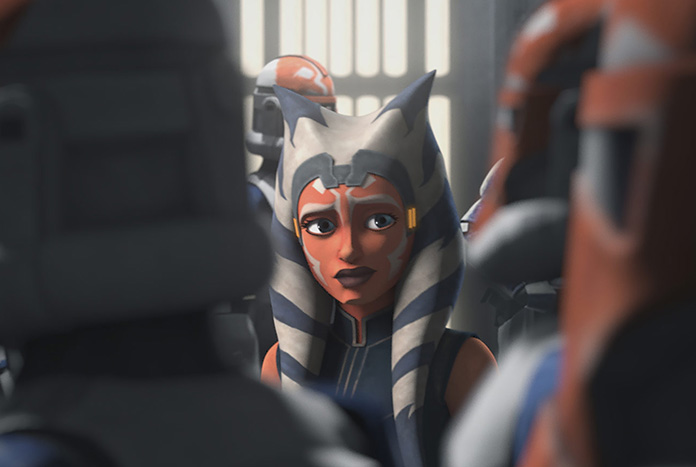
And Ahsoka. To come into this and see a young female character right there alongside Anakin and Obi-Wan, who wasn’t afraid to speak her mind — I kind of related to that and watching her grow, I felt like in [some] ways I grew up with her, but in my fandom, as she grew up in the show and matured.
Sinking into that time period and those relationships, that’s what really got me, and then the animation is just beautiful. Getting to visit so many new worlds on a weekly episodic basis. It’s the Star Wars I revisit the most, still.
[Amy’s cat, Ahsoka, walks into frame.]
Dan Brooks: Yeah, I think there are so many ways that Star Wars: The Clone Wars really impacted Star Wars and Lucasfilm. What really impressed me about Clone Wars is how it felt almost like it reverse-engineered Star Wars. Like, I always saw Star Wars as this genre mash up. It was monster movies, Samurai movies, Westerns, thrown into one. And then Clone Wars would pick those bits out and tell complete stories. You know, “The Bounty Hunters” episode was like Seven Samurai in Star Wars. That impressed me so much.
It’s important to say that George Lucas was really involved in Star Wars: The Clone Wars, and he mentored Dave Filoni throughout it. So you’re getting the [largest number of] Star Wars stories from George Lucas that you have in all of Star Wars, right? And I think he was using it as a way to see like, “Well, what else can I do with Star Wars?” It’s kind of amazing to sit back and see how different it is episode to episode.
What do you all think in terms of the impact it had on Star Wars or the chances it took?
Lucas Seastrom: Well, the biggest impact that has already been introduced is one character: Ahsoka. She’s gone on and appeared in other shows and is going to have her own show. Really, that’s what drives good television: characters. And so from Ahsoka down, the show either would expand on existing characters — give you more Anakin, give you more Obi-Wan, give you more Yoda and Padmé and Windu and all of them — but also give you time with lots of new characters that have taken on lives of their own. The fact that Hondo Ohnaka can end up in a theme park attraction is another kind of example of this great legacy. So I’d go back to the characters and I also like that consistency, thinking that The Holiday Special introduced us to Boba Fett and even Genndy introduced us to General Grievous. That’s one of the biggest legacies of The Clone Wars, is the lives of these characters throughout the rest of Star Wars.
Kristin Baver: One of the other legacies of that series for me is that it gave the clones identity and individuality in a way that made me, as a fan and viewer, care about them in a far different way than I had previous to watching this series. And I think that’s a really important and powerful thing, because when you see the clones in the movies, at least for me, I couldn’t tell the difference between them. They were clones, you know, they were all kind of blending in the background. I felt the same way about them pretty much as I felt about the B1 battle droids, even though they’re organic. And then you get to the animated series and all of a sudden different clones are getting story arcs. You’re seeing them blossom as these individual characters where they’re trying to differentiate themselves with the way they do their hair, or the tattoos that they get, or the way that they paint and style their armor. And it kind of opens something that, I guess, I hadn’t realized that I had almost a bias against the clone army in the films. And the animated series kind of forced me to reconcile with that and see that these are individual people and they have identities. They have very different personalities from one another. Just because they’re clones doesn’t mean that they’re all just one person. And I think that’s a really important thing just in terms of themes and messaging for kids and adults to see through the animated series.
Amy Ratcliffe: I’d like to add, I agree with the characters, especially obviously, Ahsoka, which — that’s my cat’s name and she’s like, “Are you talking? I heard you say Ahsoka.”
Kristin Baver: Was that Ahsoka who showed up?
Amy Ratcliffe: Yes.
Kristin Baver: Yeah!
Dan Brooks: That’s probably why.
Amy Ratcliffe: She’s like, “I’ve been summoned.”
But to your point, Dan, about the different genres they were able to do, I just felt like Clone Wars… having that episodic format, and especially in the earlier years when George was — my close, personal friend, George — was like, “Here I am funding this; I will tell stories I want to tell.” It got to be experimental, so we had the episode with the brain worms that was like straight-up horror. And especially in the later seasons, they started going on three-to-four episode arcs. I watch some animation and the animation, especially in the world of Marvel or DC, is often episodic and that doesn’t continue. Like there’s this episode about Mr. Freeze and the next episode is about something entirely different. So I liked having those arcs and the excitement of, “Tune in next week to see what happens.” Just taking the time to explore Mortis and kind of go off on these tangents that maybe wouldn’t show up in the film. But when you have 22 episodes a season, you can take risks. You can try new things. You can explore corners of the galaxy, weird as they may be, that you wouldn’t otherwise get a chance to.
Kristin Baver: When you said brain worms that reminded me that I love when Star Wars gets weird. You have those pockets of it in the films where you enter the cantina and you enter Jabba’s Palace and it’s just this bizarre, wonderful conglomeration of all of these aliens meeting together. But you also saw that a lot in the animated series. The brain worms was a good one. The Nightsisters’ zombie army is terrifying, but also pretty weird. But the one that I love the most is the Sy Snootles/Ziro the Hutt love story, which gave us the line, “from the bottom of my fluid sack.” It’s just…
Amy Ratcliffe: So good, so good.
[Everyone laughs.]
Kristin Baver: It’s so good!
Dan Brooks: I can picture the writer smiling as they type that one into the computer.
Amy, to go back to your point, I think it’s really impressive because it did two things. It broadened our understanding of the galaxy on a large scale. Things like what are all the different kinds of planets and how they could all react to war, and all these different cultures. But at the same time, it did what the movies do. It did focus on the personal relationships, as well, and really deepened a lot of those. And the fact that it was able to do both of those things… Like, what is life like on Coruscant? Now we know. But also, what did Obi-Wan know about Anakin and Padmé? We have more of an understanding of that, too. So I just think it’s an incredible accomplishment…
Kristin Baver: And Obi-Wan and Satine!
Dan Brooks: And Obi-Wan and Satine.
Amy Ratcliffe: Yes!
Dan Brooks: Also, we do have to take a moment to just recognize Dave Filoni and his massive influence. And I think a lot of what Star Wars is now and where it’s going stems from his work on The Clone Wars. So much of The Clone Wars is in The Mandalorian. Obviously, there’s The Bad Batch, which we’ll get to. It starts with Star Wars: The Clone Wars.
Favorite episodes? Lucas, why don’t you go first.
Lucas Seastrom: “Lightsaber Lost,” which Kristin knows about…
Kristin Baver: I thought you were going to say that!
Lucas Seastrom:Because I nagged her for two years to write an article about it. I mean, I love just about every episode in the whole series, but I especially love a lot of the one-act stories, the self-contained episodes. And “Lightsaber Lost” is great because you get to see Ahsoka without Anakin. It’s one of the earliest times you get that opportunity to see how she is interacting with other people. And then there’s another great opportunity for a brand new character in Tera Sinube. I just love the dynamic between those two characters. And it’s a good little fable about learning humility.
Dan Brooks: Yeah, for sure. And it shows that she’s growing up, right? She’s going to make mistakes, which I think is important.
Kristin Baver: I feel like I know what all three of you are going to say for this, and I’m curious if I’m right.
Amy Ratcliffe: Picking a favorite is hard, even when there are arcs where you can technically be like, “All four of those are the same story and they’re my favorite.”
Dan Brooks: I’ll allow an arc.
Amy Ratcliffe: You’ll allow an arc? OK. Very good. Just because I was revisiting it recently — which usually determines what is my favorite — the Nightsisters arc in the middle of Season 3. Just the concept of getting to know the Nightsisters…and especially Mother Talzin and kind of seeing basically space witches, which is really cool because we see the Force and it’s something different.
The design is just very Gothic horror-like, which I appreciate, and the costumes and their skills, but seeing Mother Talzin come in because she’s not immediately introduced as a villain, but you’re like, “I don’t think this is a place that’s entirely on the up-and-up doing good things for the galaxy,”
Kristin Baver: Something seems a little bit off about her, maybe.
Amy Ratcliffe: A little bit! And that’s not even including the arc that Ventress starts to go on where we learn about her history. She was a character I really enjoyed at that point, [but] it was like a turning point where she became one of my favorite characters of The Clone Wars because she just has to figure some things out.
Dan Brooks: Kristin?
Kristin Baver: Can we choose from Season 7 or are we going to talk about the revival separately?
Dan Brooks: Anything.
Kristin Baver: Ok. Hmm. It’s hard because I love trash-panda-garbage-spider-legs Maul a lot and that whole episode, but I think after Season 7, I have to say the Siege of Mandalore arc now. It’s so powerful on its own in terms of storytelling, but also it benefited from the evolution of what you can do with technology in terms of animation. The animation style is just a little bit smoother than when The Clone Wars first started out in 2008. But also just the way that arc wrecks me every time emotionally and changed how I felt about watching Revenge of the Sith.
Both of those things are something that you do get out of a lot of different Clone Wars arcs. But for that one in particular, every time Rex cries, I know I’m going to cry. And every time Ahsoka feels Anakin slipping toward the dark side, I find myself wondering, “Could she have saved him if she had actually gotten a chance to get her message to him instead of just leaving things with Obi-Wan?” So just the way that it’s captured so beautifully in animation, but also alters storytelling that I thought I knew really well before that. How about you, Dan?
Dan Brooks: Well. I’m going to pick two, ok, because if I’m allowed…
Kristin Baver: Wait, wait, wait! We’re allowed to pick two?
Dan Brooks: Oh, you know what? Since I’m moderating, I’m going to do a late rule change and give myself two picks. So…
Kristin Baver: The judges will allow it apparently. Because you’re the judges.
Dan Brooks: Well, first, I’ll just say the Siege of Mandalore arc was going to be one of my picks. I think you said it really well. It’s just incredible. It’s some of the best Star Wars in any form. It’s so good. It’s really the culmination of everything from Ahsoka’s journey and everything else that was going on.
My real favorite, which is well documented — I think one of the first editorials I ever wrote on StarWars.com was about a “A Sunny Day in the Void.”
Kristin Baver: I knew it!


Read more here, it’s worth it!