To celebrate the 25th anniversary of Star Wars: The Phantom Menace, StarWars.com presents “Phantom at 25,” a special series of interviews and editorials, with this entry looking at the multiple hats that Lucasfilm’s first sound designer had on the prequel.
Back in 1975, Ben Burtt had been hired as the sound designer for Star Wars: A New Hope (1977), becoming one of the first artists of any discipline to work on George Lucas’ space fantasy. Some two decades later, as Lucas began to lay the groundwork for his new prequel trilogy of Star Wars films, Burtt was recruited once again to join the upstart crew.
“I had been working on some project at the Technical Building at Skywalker Ranch,” Burtt tells StarWars.com, “and I got a call from Jane Bay, George’s executive assistant, and she said, ‘Ben, George wants to talk to you about something. Can you come up right now?’ [laughs] I knew that they always started this way.”
At that early stage, Lucas was still drafting the screenplay for what would become Star Wars: The Phantom Menace (1999). An art department had been established at Skywalker Ranch, and Burtt would start work as not only a sound designer, but a picture editor as well. “It was understood from the beginning that I would do the sound design because that was my official job. But throughout the ‘90s, I had been involved with the Young Indiana Jones series as a picture editor, second unit director, even a writer. I had the chance to wear those hats, and so George knew he could turn to me as someone he knew and was already part of the post-production team. I had been easing into all of these positions on Young Indy.”
Burtt’s introduction to The Phantom Menace was a lone sequence: the podrace. “George described that he wanted to create this race that, in a sense, was like the chariot race in Ben-Hur [1959], which we both knew well,” he explains. “I knew how to make videomatics, where we started working with images – stock footage of car races, helicopter chases, whatever it might be. We put together all of the different gags and actions from the best chases in movie history.
“I didn’t have a sense of the whole story yet,” Burtt continues. “I was simply working on visuals for the podrace. This was probably six months or more before any filming took place. With his foresight, George always wanted to develop the complex visual effects sequences in a cheap way before you committed ILM [Industrial Light & Magic] to adding their gifts and talents to it at great expense. We had a habit of just shooting home video and borrowing shots from other movies. I was creating sounds for it as well, and we’d sit down to watch and keep developing it.”
For the earliest versions of the podrace, Burtt mocked up a rear projection screen in his own home and had his 12-year-old son Benny (now a Skywalker Sound employee himself) and his neighborhood friends “fly” in laundry basket cockpits wearing helmets and goggles while desert landscape footage played in the background. Later a green screen was also installed in a basement room in the Technical Building and more elaborate foam core mock-ups of vehicles were constructed.
“The whole idea of developing the videomatics is to determine what the shots are that you really need to make the race,” says Burtt. “What are the angles you need on the characters? Is it a wide shot, a side-view, or a three-quarter view? Do you see two or three pods in the same shot? With video you’re not dealing with a lab or film expense. You can come back the next day and try something else. Remember, George was a pioneer of leaving film behind for digital. The first step was to go to video, which we’d done on Young Indy with the EditDroid, which was developed at Lucasfilm. We could do temporary visual effects in video like dissolves, pans, colors, and re-sizing. It was a work platform where we could quickly mock-up scenes. That was the George Lucas methodology, and today that’s all commonplace. There are companies that create beautiful videomatics with talented artists who can do it all digitally.”
More and more, digital filmmaking tools were being integrated into the overall process. Burtt and fellow editor Paul Martin Smith cut footage using Avid Technology’s Media Composer, a system that utilized Lucasfilm’s former EditDroid software. Together, they had to develop a new workflow to accommodate the many in-progress digital effects elements that were yet to be finalized.
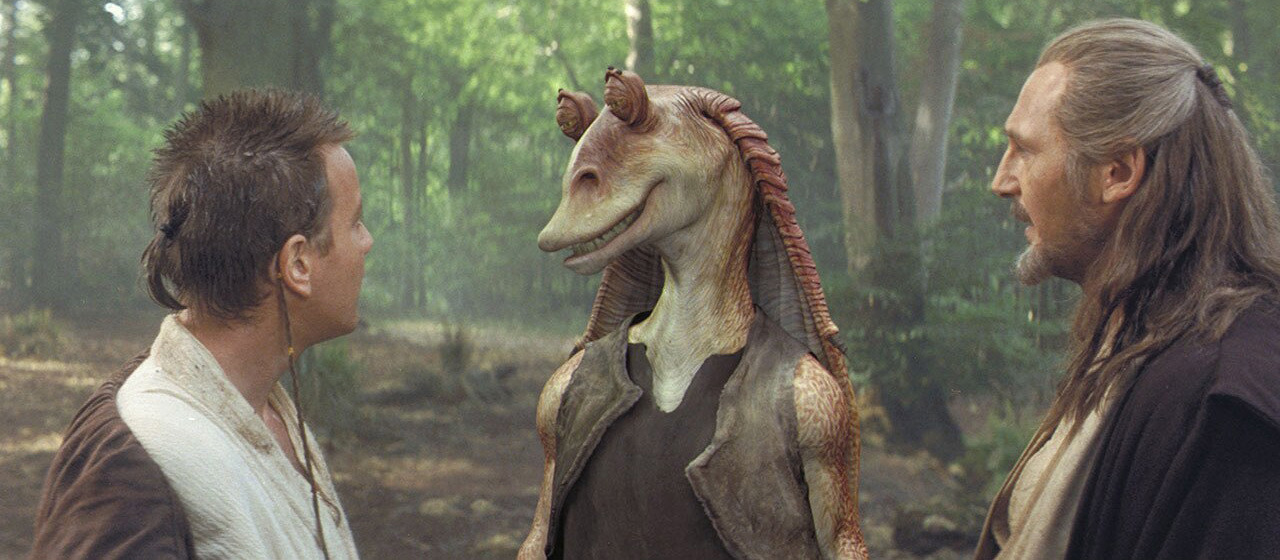
“You’re developing all of the visual effects as you go,” says Burtt, “and there were some important pioneering steps made during The Phantom Menace, in particular the inclusion of Jar Jar Binks. Ahmed [Best] was there on the set for reference and vocal performance, but George had to direct the film in such a way that allowed for the addition of an animated character after the fact. This was a major supporting character who appeared throughout the movie, a first of its kind. Working in the editing room, putting any scene together with Jar Jar, you have a lot on your hands. You’re cutting the scene using Ahmed there, and you’re making all of the pacing and editorial decisions. But then you have to go back and cut a version of the scene with no Ahmed, just with the backgrounds.
“They would do two passes in every scene,” Burtt continues, “one with Ahmed performing and one without him. So for editing, you have two different cuts, one with the Ahmed shots as reference and another with no Jar Jar, just blank backgrounds where ILM can composite the character in. It gets very complicated when one character may step in front of another one or go behind something. Today this is all commonplace. Laying out the visual effects in layers as you’re cutting the film became a responsibility of the editors. Scenes took more time, effort, and care to cut.”
The Avid software even allowed the editors to cut and replace partial segments of a given shot and combine them with others from different shots. Lucas embraced the new capability, multiplying almost exponentially the possible versions of a given scene. Both live-action and digital characters could be rearranged or removed. Different takes could be combined together to form an ideal performance. Burtt would dub the process “re-composing,” and explains that in Lucas’ editing room, nothing was sacred.
“Once he saw where the technology was going, George could begin to fulfill a dream that he’d always had,” Burtt explains. “When he’s in the editing room, he wanted to be able to alter imagery that had been previously captured. He might look at a shot and think, ‘I don’t really want to have this character standing here in the background, so let’s take him out.’ Or, ‘Let’s shrink the whole image and then we’ll expand the set all around them with a matte painting.’ We began doing that with practically every shot. [laughs] The shooting was only providing raw material for yet another assembly of the story.”
Burtt admits that the new process began to alter his thinking as an editor, not to make changes for their own sake, but to continuously improve the drama onscreen. The technology empowered the filmmakers to have more options in the calm setting of the editing room, thus relieving pressure in the hasty atmosphere of a movie set. This workflow had been developed on previous Lucasfilm productions by Lucas and producer Rick McCallum.
“George and Rick took the Young Indiana Jones approach, which is that you shoot the script on schedule,” says Burtt. “If something doesn’t quite work, you do the best you can with it, and move on. Then we put the movie together in a first cut, second cut, third cut. You see where the strengths and weaknesses are, then you go back and do some reshooting. They were always budgeted for reshooting, knowing that there was further need for new or altered material. These weren’t giant reshoots. It was a very specific list of things we wanted to make it a better film.”


Read the article in full at StarWars.com.