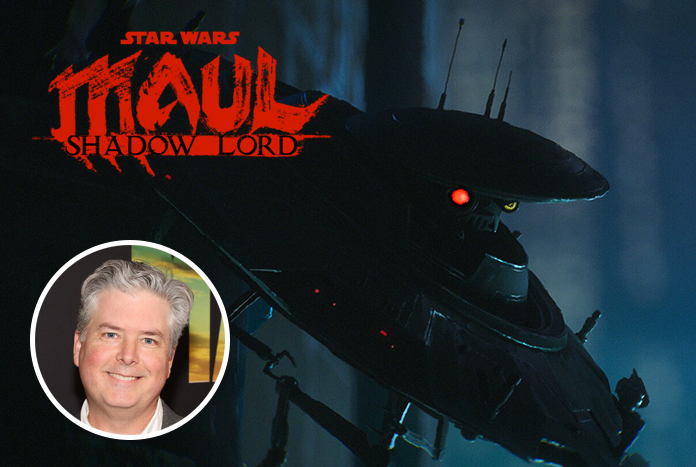
David W. Collins is no stranger to voicing droids in the Star Warsgalaxy. In fact, he may just be an expert at it.
You’ve heard him as Luthen Rael’s ship’s computer the “Fondor Droid Mod” in Andor, as well as the 1-JAC bounty hunter droid in Obi-Wan Kenobi. And, as any video game fan remembers, Collins’ dulcet (albeit robotic) tones could be first heard as the sometimes murderous “PROXY” in the the Force Unleashed video game series. Debuting in 2008, PROXY was the droid companion to Starkiller — the secret apprentice of Darth Vader portrayed by Sam Witwer.
Now, Collins is back as another droid companion to a dark protagonist portrayed by Sam Witwer, voicing Spybot, the cat-like circular droid hovering around the action in Star Wars: Maul – Shadow Lord.
When StarWars.com recently asked him about reuniting with Witwer, Collins was initially at a rare loss for words. Witwer and Collins have known each other for over 25 years. They have been best friends for decades. And, for Collins, the thing that still stands out is Witwer’s commitment to his craft. “It’s in our nature to hold ourselves back a little bit, whether it’s modesty or anxiety or something else,” explains Collins. “But Sam Witwer doesn’t do that. He does not hold back. He is 110 percent all the time. I have seen him continuously go in front of a microphone and blow people away on the other side of the glass. Not just with bombast or screaming — although he certainly can do that — but in the level of intensity. It’s the level of commitment. It’s the clarity of purpose that he gives to every line.”
In fact, according to Witwer, it was Collins who first slid the actor’s headshot into the stack as LucasArts was trying to find the voice of Starkiller, effectively bringing him into the fold. Witwer, who was already a devoted StarWars fan and avid gamer, had gone to college with one of Collins’ oldest friends. “His generosity, his kindness, his passion all led to us easily becoming fast friends,” Collins says now. “He was doing all kinds of shows in the early 2000s, so when I started to voice direct at LucasArts, I threw him auditions. Finally, this game came up that he was perfect for. I slipped his headshot in the pile — he literally looked like the concept art — and he got an audition,” Collins confirms. “I was the actor reading across from him in that audition. And that was The Force Unleashed.”
Sound of Metal
Nearly 20 years later, Collins and Witwer are playing off each other once more as devoted droid Spybot and dark sider Maul in Maul – Shadow Lord, where Collins also serves as sound supervisor.
The journey to defining Spybot’s voice was “interesting,” recounts Collins. There is an immense legacy of droid sounds over nearly 50 years of Star Wars storytelling, including astromechs, protocol droids, and battle droids. “I thought a lot about the older droids in Star Wars that have been around forever: Chopper, BB-8, and of course, R2-D2,” says Collins. “Because there were actual lines of dialogue in parentheses in the script, it needed to sound like gibberish but also be understandable. So, I went into the booth and I tried all kinds of different accents and what ended up coming out was this almost homage to Peter Lorre.”
That voice works well within the setting of Maul – Shadow Lord, which mostly takes place on the new world of Janix. “I was watching the first episode, which is very noir-inspired, and that sort of accent started coming out. Suddenly I started growling and speaking gibberish. But then it became funnier if he was actually commenting on things or making plot points clearer.”
Collins’ proximity to the post-production process was also key to the further development of the character. “Because I was actually mixing the show, I would also just pitch new lines later in the process,” says Collins. “I was always trying to get reactions from [executive producers] Brad Rau and Athena Portillo. Spybot just took on a life of his own as this kind of Hidden Fortress junkyard dog. He’s just a little jerk, but he’s so fun.”
As the show’s sound supervisor, Collins also helped to design the rest of Spybot’s noises. “For the sound of Spybot hovering, I took a crystal wine glass, filled it with water, and then just did that trick where you rub your finger around the ring so it starts to resonate. I recorded that with several different glasses, found the right frequency, and then processed it and pitched it around to play it on a sampler while he was flying around,” Collins reveals. “But he already has a lot of wild sounds in there — his cameras, his eyes moving — so I didn’t really go to the beeps and classic synth the way that I would have with a different droid character.”
And that’s where Spybot stands out among those other astromechs and PROXYs of the galaxy: He’s a new type of Star Wars droid for a new type of Star Wars show. “Not all droids are the same,” says Collins. “They’re not all the same level of intelligibility. They don’t all have the same tone. I’m happy to be part of expanding the lore of vocal and sound possibilities for what droids in Star Wars can sound like, because it’s always surprising…It’s wild pushing yourself to a different place that is still going to surprise audiences. And I think that’s something that Star Wars does really well.”
The Sound of Silence
That mentality continues in Collins’s broader soundwork for the show. “There are a lot of sequences that I’m really proud of,” recounts Collins. “Of course, there are big lightsaber fights. There are big vehicle chases. There are lots of big action scenes. But the scene that I’m most proud of is in the fifth episode.”
In the midpoint of the season, the Empire has arrived on Janix. “Lawson’s boss, the chief, has just been taken away. There’s a scene where Lawson’s looking around and he’s worried that he’s next. He’s sitting at his desk and there are troopers everywhere and people are walking around with datapads,” says Collins. “When I got the cut as a sound designer, there wasn’t a lot of music in it. In fact, there was almost none. And I kept looking at Lawson. It’s not in the script, but I was looking at him and thought, ‘I think he’s having a panic attack.’ What do I do with this scene?”
Collins turned inward. He thought back to a time in his late 20s when he was in the midst of a medical scare. “There was a moment where I was in the doctor’s office and there were doctors out in the hall nervously looking at me,” Collins says. “I remember trying to slow down my breathing when I was in that office but eventually tingles started and — I didn’t know it at that age — but I was experiencing a panic attack.”
Flash forward to working on episode 5. “I’m looking at Lawson, his mouth is closed and I said, ‘What if I recorded myself breathing, just reliving that memory, and started cutting in that muffled sound of blood pressure. Then I started filtering down the sound of the world around me. And then I edited in the noise of a little tinnitus, high ringing.” The sound design effectively turns the moment into a panic attack interrupted only by Two-Boots spilling some caf. “If you’re an artist, any good art is personal,” Collins adds. “And if I’m not putting myself into whatever art I’m asked to work on, then what’s the point?”


Read the article in full at StarWars.com and stream Maul: Shadow Lord on Disney+.