Kristin Baver at StarWars.com talks to Tippett Studio about how they created the terrifying stop-motion mama crab puppet, known as Tet’niss, from the latest episode of Star Wars: Skeleton Crew at their studio in their Berkeley, California.
The studio was founded by legendary animator and creature creator Phil Tippett, who led the innovative animation techniques for the tauntauns and AT-AT walkers of Star Wars: The Empire Strikes Back and sculpted several of the aliens, including Max Rebo, populating Jabba’s Palace as the head of the creature department for Star Wars: Return of the Jedi. In recent years, the Tippett Studio has been called in to recreate Tippett’s stop-motion dejarik chess set from Star Wars: A New Hope for three recent Star Wars films — The Force Awakens, Solo: A Star Wars Story, and The Rise of Skywalker — and create new stop-motion masterpieces for The Mandalorian and The Book of Boba Fett. For Skeleton Crew, the Mama Crab puppet, lovingly nicknamed Tet’niss, would become the studio’s heaviest creation to date.
Making Mama
The Tippett Studio team didn’t set out to establish a studio record, but Mama Crab’s sheer size on screen dictated much of her design. Filmmakers wanted the creature to appear to be a staggering 30-feet-tall compared to the young actors. That scale also helped determine the size of the trash greeblies that would adorn her shell. “We 3D printed a lot of the parts that went onto the crab, but the thing that really took it to that next level for detail was the handcrafted elements that were placed on it: the antennas, the wires, and all of those little things that really gave it that sense of scale,” says visual effects supervisor Chris “CMo” Morley, who also served as director of photography on the shoot.
First, art director and fabrication supervisor Mark Dubeau worked with the series’ production designer Doug Chiang to digitally render the crab creature. Initial concept art passes defined the overall shape, but left the facial details out. “The original concept didn’t have much of a face,” says Morley. “It was essentially a giant meatball with legs on it and a bunch of stuff sticking out of the back,” adds Dubeau, so he kitbashed a more detailed version in ZBrush. The only problem was he didn’t have a sense of the overall tone of the show. “I knew that it was kids and it kind of had a bit of a Goonies vibe, but when Doug saw it, its face was terrifying.” Chiang and his art department elongated the features, now complete with a snapping beak, and Dubeau realized the creature needed to be a little more friendly looking. “It has a little bit of a Muppet quality to it,” he says of the final design. “It’s meant to be kind of creepy and scary, but you don’t want to terrify children. That’s not the tone of the show.”
In his digital studio, Dubeau added model kit pieces similar to those used in the original Star Wars films, mindful that everything had to be sized to the younger characters for scale. Once the model went into fabrication, even more greeblies were added on. “I was having so much fun. I even invited Doug at one point and gave him a hot glue gun, and he came and he put junk on the legs,” Dubeau says. “It’s completely festooned with garbage.”
Hidden Treasures
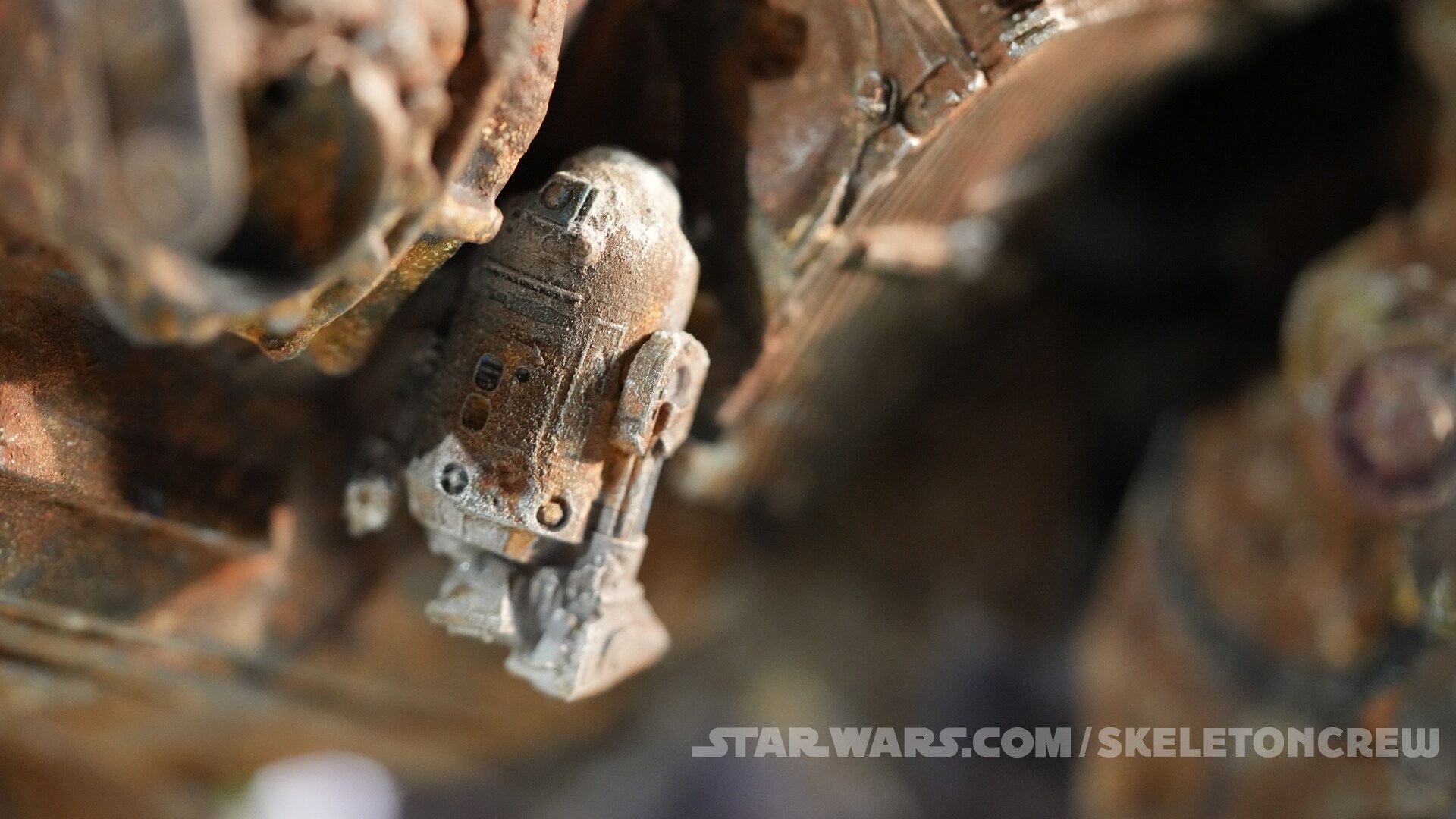
Look carefully and you may find some of the Easter eggs the team added to Mama Crab’s shell, hiding some elements with weathering and rust so it wasn’t immediately apparent where they were borrowed from. “If you look closely at the junk on his back, it’s not just random parts. There’s pieces of the Millennium Falcon in there,” says Dubeau. “There’s pieces of an Imperial walker. There [are] droids stuck in there! I just wanted to make it look as bizarre as humanly possible.”
Scaled versions of R2-D2, K-2SO and C-3PO, complete with one articulated arm that can wave, were added alongside a plaque listing the names of the Tippett Studio team in Aurebesh affixed to the puppet’s posterior. But Chiang was adamant that any callbacks remained disguised. “Doug was very specific,” Dubeau says. “He didn’t want it to look like there was an X-wing sticking out of it. So, it’s very well disguised.” Other elements include parts from the scrap walker seen in The Mandalorian Season 2 and panels from an X-wing starfighter.
The final creation also shares some Tippett DNA with the rancor from Return of the Jedi. Phil Tippett used ball bearings coated in Sharpie to create the glossy eyes of the hand puppet lurking in Jabba the Hutt’s dungeon, and the crab’s four gleaming eyestalks are tipped with ball bearings as well. “I wanted to make Phil proud so we used a lot of his tricks,” Dubeau says. And just like the rancor, Mama Crab has a similarly sticky maw. “We really wanted to add something to show that there is a vulnerability to this creature,” says Morley. “There’s got to be some soft parts somewhere so we chose the interior of the mouth. And in order to really sell that, we shot some slime in our hands and created strings of slime that we composited digitally into the mouth during the roars, just adding that little sense of organic wetness.”
“It was a fun process. It took a long time, but I think we wound up with a creature that nobody’s seen before,” Dubeau adds.



Head to StarWars.com to read the interview in full, and stream the first six episodes of Star Wars: Skeleton Crew on Disney+ now.