Visual Effects Supervisor Bill George looks back at his career at ILM from the years being a junior modeler to working of the third Star Wars film, now celebrating its 40th anniversary, the models that made the final cut of the film, and some that did not.
Visual Effects Supervisor Bill George is a veteran of landmark effects pictures at Industrial Light & Magic (ILM), with Indiana Jones and the Temple of Doom (1984), Ghostbusters II (1989), and The Goonies (1985) gracing his resume, (alongside an Academy Award for his work on Joe Dante’s 1987 film Innerspace). Bill George has also contributed significantly to one of the most enduring movie franchises of all time: Star Wars. He designed the Fireball for Star Wars: Resistance (2018) out of a kitbashed Vought F4U Corsair model kit. He was a matte painter on George Lucas’ first entry in the prequel trilogy: Star Wars: Episode I – The Phantom Menace (1999). And very early in his career, he built miniature models for some of the most iconic ships in the Star Warsfranchise. The year was 1983. The film was Star Wars: Episode VI – Return of the Jedi. That’s a solid body of work for anyone in the visual effects industry, but much like the legendary Jedi Master Luke Skywalker and his humble beginnings as a farm boy on the Outer Rim planet of Tatooine, Bill George started off as a starry-eyed dreamer, yearning for adventure.“It was interesting, I went through a number of stages as a kid,” George remembers. “I was into makeup, like Planet of the Apes-style prosthetic makeup. Then I went through a puppet stage, where I was really inspired by The Muppets, so I learned how to use a sewing machine to make crude little creations. And then Star Wars came out when I was in high school, and that changed everything. I was transfixed; there was nothing like that movie at the time, and I simply fell in love with it. But it wasn’t enough for me just to love it – I had to manifest my love of it in some way, and the way that I did that was through building scale models. As they say, necessity is the mother of invention, and when the movie came out, no one knew it was going to be as successful as it was, and Lucasfilm hadn’t made any model kits or anything like that, so it forced me into kitbashing different kits together and scratchbuilding these Star Wars models. My first ones were pretty terrible, but every time I’d build a new one, they’d get a little bit better than my last attempt.”
A BOY, A DREAM, AND A DUMPSTER
“I was always interested in genre films and special effects and science fiction, but it wasn’t until I saw the behind-the-scenes photos of the early ILM’ers building models from Star Wars that I thought, ‘my gosh people actually get to do this for a living,’” recalled George. “It didn’t seem like they were that much older than me, which was really invigorating. Back in those days, Hollywood felt like this very rigid system with the studios making these movies, but ILM looked super casual and open, and they all looked like fun people. And for the first time in my life, I thought, ‘Maybe I could do this for a living?’ Eventually my model-building skills got good enough that I felt like I could start showcasing them, so slowly I started showing them at science-fiction conventions, hoping that I might meet people and find Star Wars model reference material. I found some, but I learned where even better stuff might be hiding.”
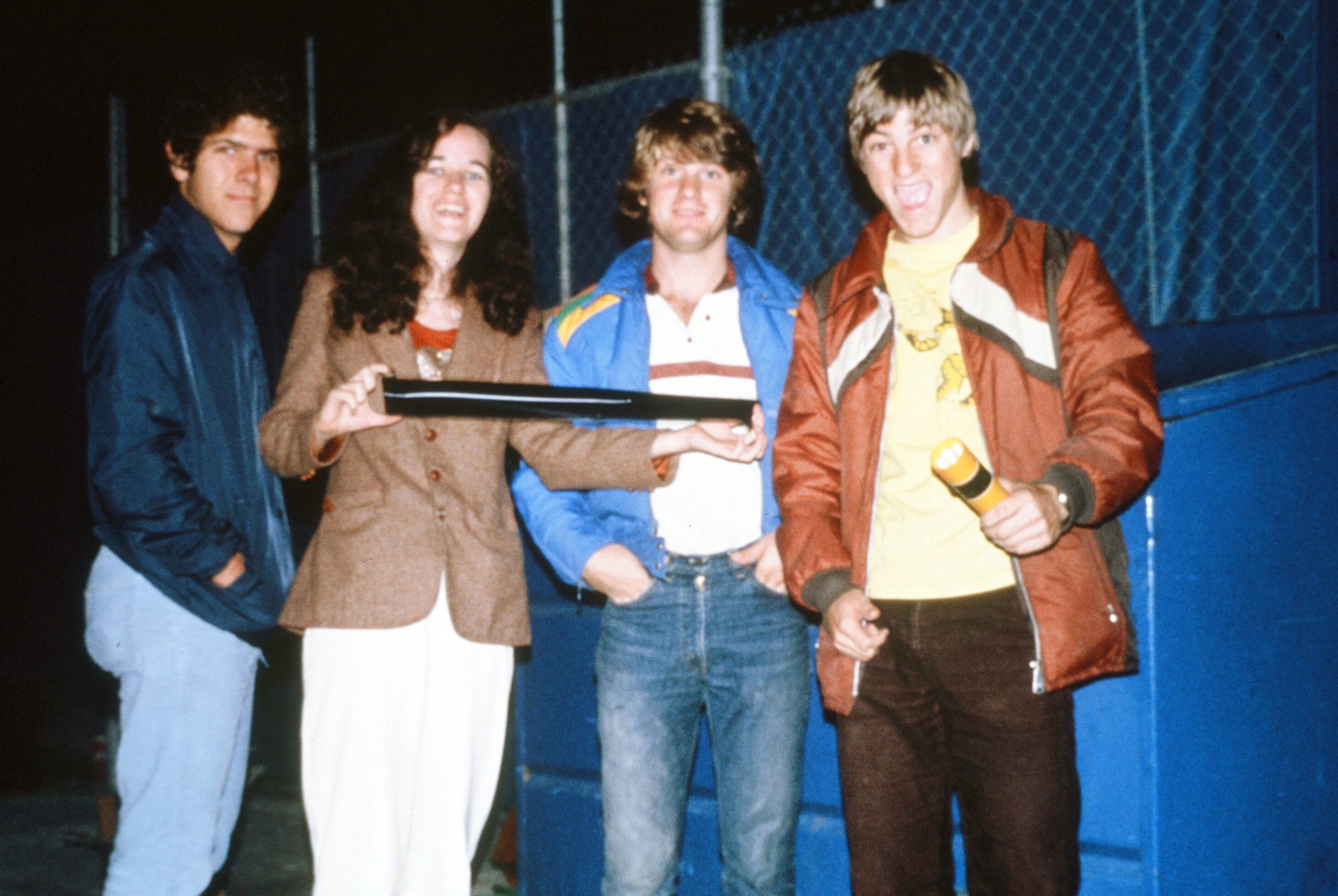
Nestled in the southeast outskirts of the Van Nuys Airport at 6842 Valjean Avenue, behind a chain-link fence lined with barbed wire, was a seemingly unremarkable two-story cinder block building. To the untrained eye it was an industrial warehouse. To a Star Wars fan and model maker like Bill George, it was the home of Industrial Light & Magic. “This was before ILM packed up and moved to San Francisco,” George says. “I had friends that knew where it was in the Valley, so we started going down there at one o’clock, two o’clock in the morning to go dumpster-diving. We thought maybe we would find some Star Wars treasure, and we did. Storyboards, and art work, and model pieces – and lots and lots of film. It was the early days, and things weren’t as secretive as they are now. In hindsight, I don’t think they cared that we were rummaging through their trash.”
Image: Bill George and his friends search for Star Wars souvenirs in the dumpsters behind ILM’s Van Nuys warehouse.
It was in 1979 that Bill George’s talent as a model builder eventually caught the eye of Greg Jein, the Oscar-nominated model maker behind Steven Spielberg’s Close Encounters of the Third Kind (1977) and 1941 (1979). It was during his tenure with Jein that Georgecut his teeth on Star Trek: The Motion Picture (1979), as well as the Francis Ford Coppola film, One from the Heart (1981). It was this experience that got him an interview at Industrial Light & Magic in 1981. “I knew I had to come prepared,” recalls George. “When I was in LA and dreaming of working at ILM, a book came out called The Art of Star Wars by Carol Titelman. In it were some really great shots of the Y-wing. I made the decision that I was going to build my own Y-wing model from those photographs. About a year later I got the job interview at ILM, so I brought my Y-wing along to show [chief model maker] Lorne Peterson what I could do. On my flight, they put it in the overhead bin – I remember that so vividly because it looked like it was in a tiny coffin [laughs].
Lorne was impressed with George’s model-building skills, and offered him a job with ILM working on Star Trek II: The Wrath of Khan (1982). “First of all, working at ILM was my absolute dream,” recalls George. “I was happy just to be working in the industry, let alone the one place I had dreamed of working. I jumped at every opportunity that came my way. Of course I knew that Revenge of the Jedi, as it was known then, was coming down the pipeline. I was hoping that I could prove myself and then be kept on for that film – that was my ultimate dream.”
“IN MY EXPERIENCE, THERE’S NO SUCH THING AS LUCK”
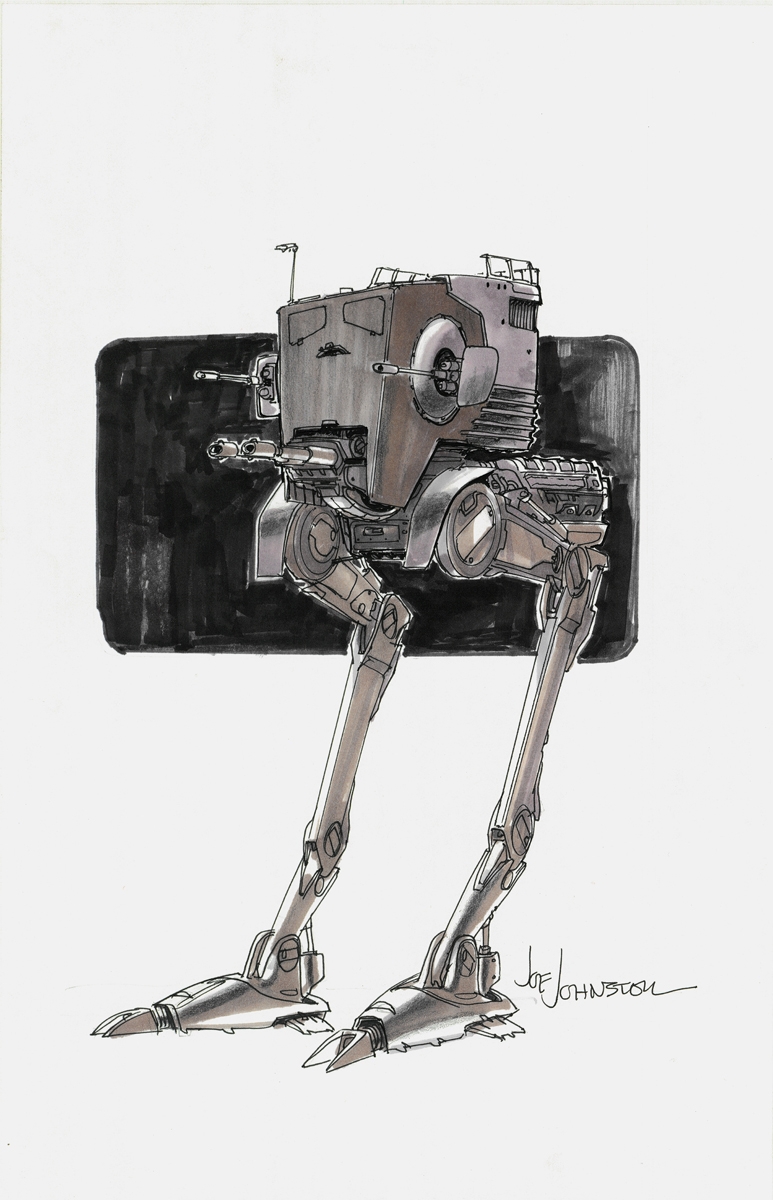
Though George was able to prove his talent as a junior modeler at ILM in the years leading up to the third Star Wars picture, he would need to get creative if he wanted to secure himself a role on the film. “One of the things that I got pretty skillful at was building small prototypes”, says George. “Taking a single sketch and building something in 3D that is related to that. That skill helped me stay on for Jedi. I would be given these ship sketches from [art director] Joe Johnston, who, by the way, was a hero of mine. So getting to work with him was incredible. But I would create 3D versions of his sketches, those would then get modified, changed, and edited, before finally serving as a guide for the larger stage models. There is an art to taking something that’s 2D, and making it three-dimensional. With a single sketch, you never see the backside, so you have to be able to extrapolate.”
Image: An All Terrain Scout Transport (AT-ST) sketch from Joe Johnston.
BRINGING STAR WARS VEHICLES TO LIFE
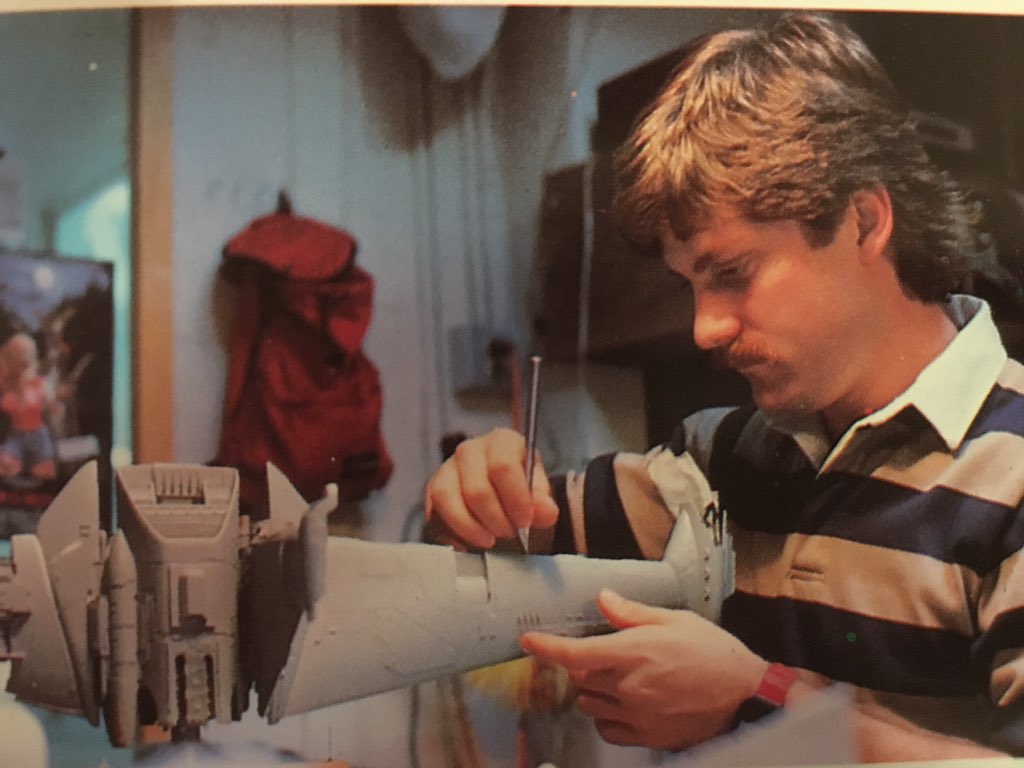
Out of all of the Joe Johnston designs that George was tasked with realizing, one of the most beloved among fans is the B-wing, with its rotating cockpit borrowed from early Millennium Falcon concept art. . The ship’s blade-like design proved problematic for blue-screen photography. “It was disappointing that we couldn’t utilize the ship more,” says George. “It was supposed to be the new X-wing. The new hero ship. It was so unique, the way that the cockpit would rotate, and how the S-foils would deploy.” But it was those same S-foils that would be the ship’s undoing. “They were too thin, so as soon as the ship got too far away, those wings would start to disappear into the starfield.” It was because of that flaw that the B-wing had limited use in the picture, pushing the A-wing interceptor to step up in its place.
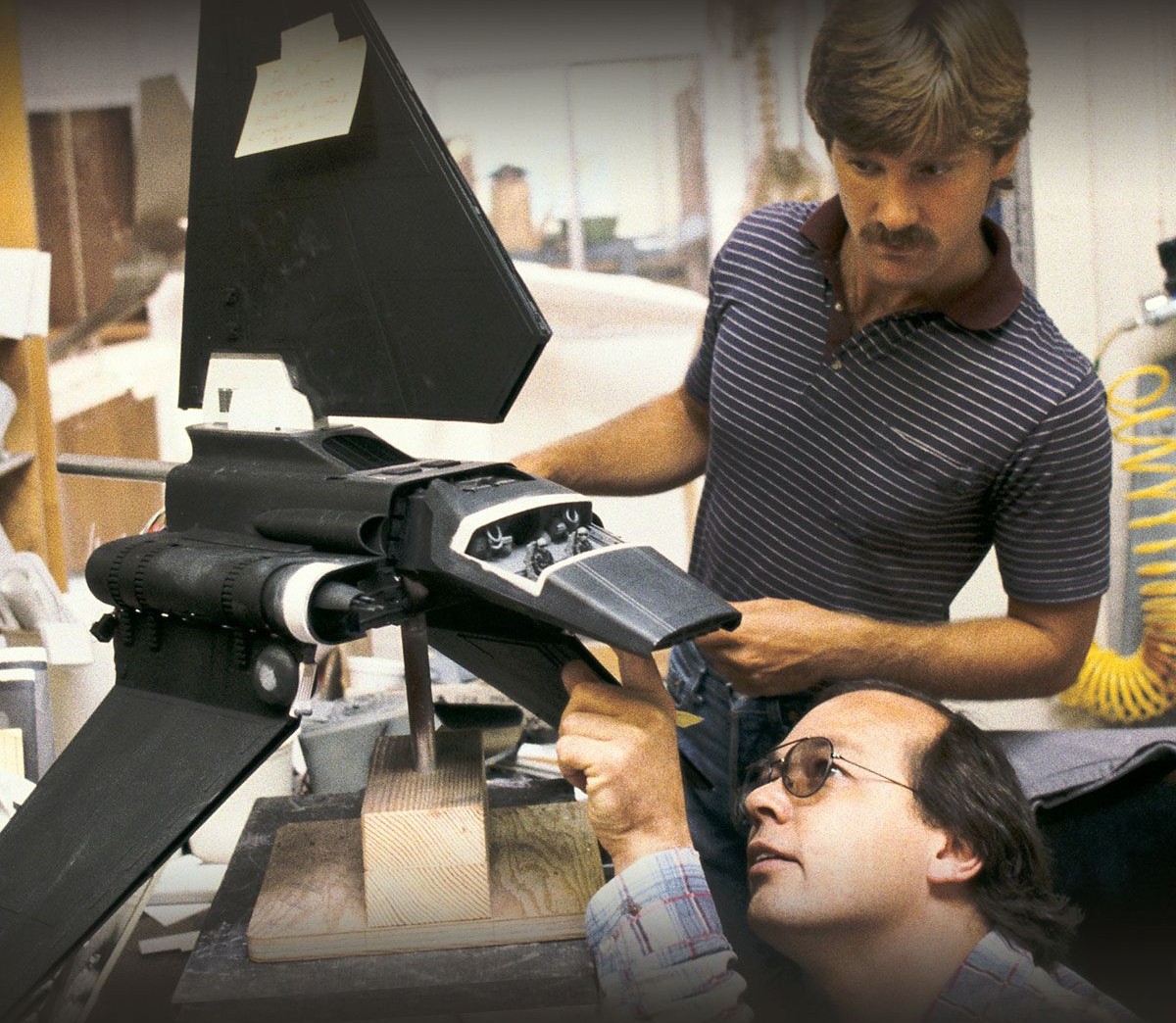
Image: Bill George and model maker Charlie Bailey at work on the Shuttle Tydirium.
Image: Bill George adds detail to the B-wing starfighter.
In addition to both the B-wing and A-wing, George contributed significantly to the Imperial Shuttle Tydirium. “I originally had to build a prototype, because they were building a full-sized version in England. I worked with Joe Johnston to build a small mockup which was sent overseas. The team there then modified it so they could build the full-sized version. After that, they sent us the blueprints, which we then used to build the hero stage model at ILM.”
George’s contributions extended to ground vehicles as well. “I worked on the AT-ST, known back then as the chicken walker,” says George. “There was the larger pyro version that Paul Huston built that was crushed by logs from the traps set by the Ewoks, and then there was the smaller stop-motion ones that I worked on. [Stop-motion animator] Phil Tippett actually came to me and said, ‘You know what, on The Empire Strikes Back, I kept breaking pieces off of the Walker. I want you to build these so they are indestructible.’ So the way that we approached that challenge, Tom St. Amand built the metal armature, and then all of the pieces on the outside were patterns that were cast to be one solid piece, and then they were bolted to the aluminum. Phil could then go and wrestle with them, without the risk of breaking pieces off.”
Read the full interview at ILM.