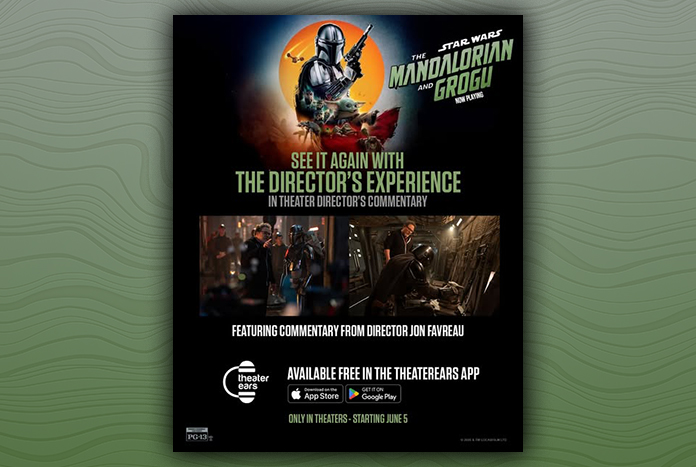
The directors commentary of Star Wars: The Mandalorian and Grogu is currently only available in selected territories via the TheaterEars app, but fortunately, the folks at LaughingPlace.com have shared the highlights of what Jon Favreau had to say.
• The very opening scene, in the Imperial Warlord’s meeting room, was shot on the Volume, and the set was chilled overnight, with moisture pumped into the air to provide authentic “cold breath,” much like Favreau did previously with the cave set in the first Iron Man movie.
• Most of the practical sets for the film were build on a soundstage in Manhattan Beach, California– where the bulk of The Mandalorian Disney+ series was shot as well.
• Throughout the film Favreau provided an informative running guide as to which shots of Din Djarin were performed by stand-in Brendan Wayne, stuntman Lateef Crowder, or stunt coordinator J.J. Dashnaw.
• Background plates for the ice planet were shot in Vancouver, British Columbia.
• Favreau cited James Bond and Indiana Jones movies as the inspiration for the opening scene, where we meet up with the Mandalorian and Grogu already on a mission.
• There was some discussion of the film’s various aspect ratios, and how many sets had to be built to accommodate the taller IMAX frame.
• The popular video game Star Wars: Jedi – Fallen Order was used as reference material for what the inside of an AT-AT walker looks like.
• Favreau confirmed that the shot of the X-wing starfighters in silhouette was inspired by both Star Wars: The Force Awakens and Francis Ford Coppola’s Apocalypse Now.
• Plates for the Adelphi Base beach exterior sequences were shot in Crystal Cove and Laguna Beach, California.
• The shots of New Republic starfighters on the landing strip were heavily influenced by Tony Scott’s Top Gun. Favreau’s goal with this sequence was to “ground extraordinary things in an ordinary world.”
• The exterior of Adelphi Base was modeled after the real-world interior of Favreau’s Fairview Portals studio, AKA Thunder Alley.
• The Razor Crest on the landing strip was a miniature model of the ship, and shots of the live-action actors were superimposed against it. The interiors of the ship were recycled from The Mandalorianseries, but refurbished to make it look like a new version of the Razor Crest.
• The Volume was not used nearly as much on the movie as it was on the show, with Favreau preferring to utilize practical sets whenever possible.
• Favreau heaped praise on composer Ludwig Goransson, saying he did a “tremendous job” with his score for the film, which was recorded on the Newman Stage at the Fox Lot in Los Angeles.
• The Droid Gotra was borrowed from the cancelled LucasArts video game Star Wars: 1313, which would have seen bounty hunter Boba Fett exploring the Coruscant underworld. Favreau also cited the worlds of Star Wars graphic novels and animation for providing an established look for the planet of Nal Hutta.
• Not only did Phil Tippett Studio build and execute the two stop-motion droid guards in the Hutts’ palace, but they also designed and built the miniature set that those two characters inhabit.
• Everything in the Hutt twins’ throne room was shot on the Volume, which Favreau says was mostly used for interactive light and framing, with the backgrounds being replaced digitally in post-production.
• Interestingly, it became clear while listening that this audio commentary was recorded after the movie’s release.
• Favreau says that old boxing, wrestling, and gladiator movies were used as reference for the moon of Shakari, which was intended to resemble 1930s Chicago in design. Ridley Scott’s film Blade Runner was also studied for its use of neon lights and a futuristic cityscape.
• Some exterior scenes for Shakari were shot in Downtown Los Angeles, with video walls used to extend the end of the physical location.
• Here Favreau talked about chef Roy Choi’s influence on the food truck sequence in the film, which can be further explored in a fun YouTube video.
• Several real-life animals were studied as reference for Rotta the Hutt’s movements.
• Disneyland’s Star Wars: Galaxy’s Edge indeed provided the inspiration for the popcorn that Grogu eats in the arena.
• Lucasfilm / Skywalker Sound mainstay Matthew Wood help craft Rotta’s voice from actor Jeremy Allen White’s vocal recordings.
• The cell where Rotta stayed was a physical set build in Manhattan Beach, alongside a full-size arena where the pit fight takes place.
• The CGI animators for the Hugo Durant character were influenced by the physicality of filmmaker Martin Scorsese’s voice performance in the recording booth.
• Shot of the Mandalorian looking down on Hugo in the food truck were fully CGI, as they couldn’t get it to look quite right practically.
• The underground “Salt Diner” sequence was inspired by the tea shop scene in John Woo’s Hard Boiled. Favreau said that this being a practical set allowed the team to feature a lot of interaction with (and do a lot of damage to) the surroundings.
• The interns at Legacy Effects were invited to design the animal cages in Lord Janu’s diner, so they could put their own individual imprints on the movie.
• Lord Janu’s bird is a rod puppet, and here Favreau talked about how he has always associated Star Wars with lots of costumes, armor, and creatures.
• He also talked about the use characters with masks and how “we respond to the Star Wars that we grew up with.”
• To get Grogu to climb up the water pipe and crawl through the window outside the area, puppeteers had to stand on ladders. Favreau doesn’t think any CGI was used in creating Grogu for that scene.
• Favreau considers Grogu to be “the conscience of the audience.”
• Stunt performers wearing pads stood in for Rotta the Hutt during the pit fight sequence, in order to provide resistance to Mando’s hits.
• The red power barriers on the doors in the pit fight were inspired by the “Duel of the Fates” sequence in Star Wars: Episode I – The Phantom Menace.
• Favreau talked a lot about his second-unit directors Peter Ramsay and Dave Filoni, the latter of which handled most of the puppet work.
• The films King Kong, Mighty Joe Young, Jumanji, and Ghostbusters were cited as influences on the scene wherein the monsters break out and run amok on Shakari.
• The chase scene between Mando, Grogu, and Rotta is mostly digital, and Favreau cited John Landis’s The Blues Brothers and William Friedkin’s The French Connection as influences on this sequence.
• The physics of the cargo net holding Rotta in the Razor Crest‘s hold were difficult to make work.
• Another movie influence: Favreau cites Martin Brest’s bounty hunter movie Midnight Run as inspiration for the evolving relationship between Din Djarin and his target Rotta the Hutt.
• The exterior plates for Lord Janu’s compound were shot in Quebec’s Magdalen Islands, sometimes using drones, while the interior sets were built in Manhattan Beach.
• The character of Zeb Orrelios had a human proxy performer who was replaced in post, even during action sequences. The animation in Star Wars Rebels was referenced for how he should move.
• Hayao Miyazaki’s My Neighbor Totoro was confirmed as the inspiration for the shot in which Grogu is sleeping on top of Rotta the Hutt.
• During the Lord Janu chase sequence, the production only used one blue speeder, which was replicated multiple times over.
• Favreau cited hot rod culture and George Lucas’s American Graffiti as the inspiration for Mando and Zeb having to remove the new Razor Crest‘s restrictors, saying that Djarin prioritizes performance over aesthetics when it comes to his ship.
• The plate of the ocean where Grogu frolics with Rotta was the first thing shot for the movie.
• Apparently all of the other Mandalorian filmmakers with cameos in the film were “reticent to be on camera,” says Favreau, but “deep down everybody’s childhood dream is to be an X-wing pilot.”
• The lava planet of Nevarro was inspired by Kona in Hawaii.
• Filmmaker Edgar Wright attended an early screening of The Mandalorian and Grogu and suggested that the bounty hunter Embo should be introduced early than he originally was, which is why Favreau chose to add him to the shot of the Razor Crest flying over Nevarro City.
• The sound effect of the Anzellans’ speeder was inspired by the flying cars in The Jetsons.
• Favreau talked a lot about Western movie language and tropes for the Mandalorian homestead sequence, plus the influence of Samurai films on Star Wars.
• Steven Spielberg’s Close Encounters of the Third Kind was a reference for the overhead arrival of Embo’s ship the Guillotine.
• Only about one-quarter of the interior of the Guillotine was built for the physical set, with the rest being filled in digitally.
• Donald Mills was the suit and stunt performer for Embo, though he was replaced digitally in post.
• Favreau made an effort to disguise the size of the Anzellans’ starship until the shot that reveals that its ceiling is too low even for Grogu. He loves the “sense of scale” in Star Wars, with little creatures working alongside big creatures.
• The shot of the Anzellans’ ship hiding among a flock of Reptavians was invented by the visual effects team during post-production.
• The Volume was used for certain exterior scenes on Nal Hutta to provide reflections, though once again they replaced the backgrounds in post.
• Other scenes on Nal Hutta made use of physical sets, which were built to accommodate puppeteers working from underneath.
• The Anzellan puppets were operated individually for their own performances, except in shots where they had to touch each other.
• Star Wars: The Rise of Skywalker director J.J. Abrams visited the set of The Mandalorian and Grogu to monitor and approve the use of the Anzellan species, which he co-created.
• Favreau implied that the “Big pipe, huh?” line was ad-libbed by Anzellan voice actor Shirley Henderson.
• They made a conscious effort to ensure that Embo did not see Din Djarin’s face when the character’s helmet was removed in the Hutt twins’ throne room.
• The female Hutt is intended to be drinking “Boba balls,” not smoking a hookah.
• The Dragonsnake pit set was built on a soundstage with a water tank. For the underwater shots, the camera was tilted to make the water look deeper.
• Apparently Dave Filoni calls background characters like Amanaman from Return of the Jedi “peg-warmers” because their action figures were not as popular, but they like to feature overlooked legacy characters such as the Amani species, which never got their due until this movie.
• Favreau says that every shot where you can see actor Pedro Pascal’s face in the movie is really him. “We didn’t do any face replacement.” But he also says it was tough work and that Mando’s armor is quite heavy when wet.
• Yojimbo / Seven Samurai actor Toshiro Mifune is cited as the inspiration for Mando’s reverse katana thrust move used against the Amani in the film.
• The work of fantasy artist Frank Fazella was cited as an influence on the lighting for the Dragonsnake sequence.
• “We try to be inspired by what inspired George [Lucas],” reiterates Favreau, citing the influence of Flash Gordon and other Saturday morning cliffhanger serials on the movie.
• Stunt coordinator J.J. Dashnaw doubles for Pedro Pascal a lot in the Dragonsnake sequence when Din Djarin’s helmet is on or when you can’t see the character’s face.
• The Dragonsnake poison is new Star Wars lore invented for the movie, though Favreau notes that the creature originates from The Empire Strikes Back and The Clone Wars cartoon.
• Favreau says that water simulation has come a long way in the art of CGI visual effects.
• An underwater version of the Grogu puppet with fewer mechanical elements had to be built for the swimming sequence, but the Anzellans were “floaties” that were replaced in post. Favreau says the teams worked very hard to make the integration of practical and digital effects more seamless in this film.
• One of the practical Nal Hutta sets was so realistic that a family of raccoons moved into it during production.
• Ludwig Goransson’s music goes a long way to help us understand that the Mando fight sequence after the Anzellan ship leaves “is not a triumphant moment.”
• Some of the Droid Gotra designs were inspired by director Gareth Edwards’s movie The Creator, with human performers dressed in suits that could be accentuated in post.
• Mando’s near-death scene was shot on the Volume, and the digital bugs emerging from the ground were inspired by real-life whalefalls.
• Favreau praised the puppeteers multiple times over for the emotions exhibited by Grogu during the “Grogu’s World” sequence while Mando is in his coma. “Their performances bring a humanity to the movie.”
• The echoes of Yoda during this sequence were definitely intentional, right down to the walking stick and the design of the hut, with the implication being that this might be what members of Yoda’s species build on their home planet.
• For the helmet knocking against the back of the hut gag, the Mandalorian’s body was on a track that moved back and forth.
• Jim Henson’s puppet-heavy filmmaking, specifically The Dark Crystal, was cited as a huge influence on the “Grogu’s World” sequence.
• There’s another Apocalypse Now reference as Grogu emerges from the swamp on Nal Hutta.
• Gatori’s shack was built on the Volume, with some set extensions being utilized, but most of the cabin was real.
• While Gatori himself was entirely CGI, they tried to limit his movements to what a puppet would be capable of, mostly having him sitting in his rocking chair. Another shot when he gets up and starts walking was choreographed as though they had switched to a different, more ambulatory puppet of the same character. His hands are real in close-ups!
• Favreau came up with Grogu’s meditation on set during that day of production, and they got two different angles of it using some leftover time. He theorizes that Grogu learned it from Luke Skywalker and might be “continuing Jedi training on his own.”
Read the full list here and see Star Wars: The Mandalorian and Grogu in theaters and IMAX.