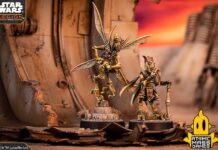
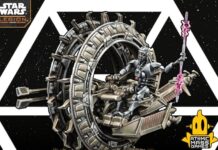
Following on from Part 1, where I looked at unboxing, organising, and building everything in the core box, I finally got a chance to actually sit down and play Star Wars: Shatterpoint. This is a skirmish game that visually looks tremendous on the board. The physical presence, with its slightly larger miniatures and the vast array of terrain, really puts you straight into the Star Wars galaxy. Once the game starts, players will take it in turns to try and control objectives by moving and attacking with their squads, while moving an off-board marker (called the struggle token) closer to the player’s end goal in order to complete a mission. This is played over a best of three rounds – or three missions – meaning some games will only take two rounds. An average game takes about 90 minutes once you know the rules and have played a few games.


I’ve played three games so far. The first was against my son (Charlie, aged 16) where I was the Light Side and Charlie the Dark. The second I played at my local store, Tritex Games, and played the Dark Side against my good friend and employee, Joe. Finally, I played against Charlie again, this time with Charlie being the Light Side. The reason I went to my local store to play my middle game is that stores will happily provide demos to show you how to play the game and I cannot stress how important this can be. After our first game, I was pretty sure of the beats of the game, but missed rules or misconceptions can easily be answered by your local store. This way, I was able to make sure the rules Charlie and I were playing were correct. Not only is it a great place to try the game, but your local store can also offer the latest releases and other players to play against. At Tritex Games in Stafford, we go over every Tuesday night to play games against a completely varied array of opponents. It’s always a great time!


So, onto the game itself. What worked well? As soon as I started playing, the first thing that instantly strikes you (apart from the impressive terrain), is the immersion into the Star Wars universe. Every character has abilities that they can do every turn and this really gives each one their own unique feel. Take Darth Maul – he can damage himself to use his abilities (usually done by using the Force through tokens) and roll more dice for attacks. Not only that, when I was against Ahsoka and Rex, Maul attacked Rex, pushed Ahsoka off a gantry before jumping to an objective token. I just stood there admiring the grace of this, the almost cinematic sense of action that takes place right in front of you. It’s not just Maul, every character in the core set (all that we have used so far), have these abilities that add a little uniqueness to them. How you use them, how you time it, is up to you.
Which brings me to the initiative deck. There’s only one other game I’ve played that uses an initiative deck and I was a little hesitant at first. When it is your turn, you don’t choose who you activate, instead you draw a card from your initiative deck that will tell you who will activate. There are some ways around this, such as spending a Force token to reserve a character for later, but on the whole, you are at the mercy of these cards. As I said, to begin with I wasn’t sure of this method of activation but after several plays I’m sold. In other games, timing is everything and for a player who knows their team well, you can have every step of what you are going to do planned out from the very start of the game. In Shatterpoint, you can’t use this method. You have to think on your feet, having to come up with a strategy as you go. It makes players really stop and think about what they are going to do. I also think for new players, particularly against experienced players, it levels the field a little for them. A little detail that I really like with the initiative deck, is that some characters have an ability that activates when the character does. The cards for these characters have a symbol on their inactive card to remind you. It’s something small but shows the care the designers have taken with the game.


Talking about levelling the field, there is also the struggle. Using cubes, the game itself balances things to try and make things more even. When a player isn’t able to move the struggle a lot on their turn, the game will help by making the struggle less for them. It’s a clever little mechanism that I really like. It means no one should be having an easy win. The struggle also encourages you to attack one another, rather than just sitting on objectives and let’s be honest, isn’t that what we want from a Star Wars game?
Perhaps the most interesting aspect of the game is the combat tree. I initially thought this was a way for Atomic Mass Games to make the game different from Marvel: Crisis Protocol but it’s one of the parts of the game I have come to love the most. When you roll successes (and subtract defences), your successes aren’t hits, but let you move along a combat tree that will usually allow you to hit but also enable other abilities or conditions. It really allows you to have some differences between characters and units. For the Jedi, you can actually turn their cards over for a completely different combat tree that represents a different lightsaber form. I mean as a fan of Star Wars, this made my geek flag fly just a little higher! It’s a really nice touch that characters can show their own style but also switch between their own styles as we see in the movies and TV shows. There is also another advantage to these trees. No matter how many dice and successes you get, you can only utilise a certain amount of these hits – anything after that has no effect. It means it is very difficult to do too much damage to a unit and doesn’t let someone have a runaway victory. Again, for beginners I think this makes the game much easier, but also makes more experienced players pause and think about what they are actually doing.


Let’s not forget that when you are playing this game, visually it is stunning. I mentioned it in Part 1. The miniatures in this game are stunning. They are some of the best miniatures I have ever seen. The size and detail really help to immerse you in this galaxy. Then the buildings in the core set are enough to really start you off on your battles. They are very solid and there is very little I’m concerned about in terms of breakages with them. And the figures. Initially, it looked like the delicacy of the lightsaber’s could be an issue, yet after three games and a fair bit of bashing around, they were absolutely fine. This makes me a lot less worried about damages to the actual miniatures themselves. Having seen what has also been released and what is coming, this game promises to be one of the most highly detailed miniature games on the market. Although I haven’t even had a chance to paint my models yet, I cannot wait to get started on them. You can see the painted models I used at Tritex Games, and it added a whole other level to the experience.


The terrain. Now, I have a couple of thoughts on this. The terrain does play an important part in the game when securing objectives. If you and the objective are elevated and your opponent isn’t, then you score the objective. Being higher up to an objective is needed, shoving your characters off a gantry slows them down, and then they have to spend a move to get back up. Yet the game has no fall damage. Now don’t get me wrong, that doesn’t actually bother me as it encourages characters to climb all over the place for these objectives. It would also give certain characters who can shove or push far too much power over others who couldn’t. A big part of this game, of the core box, is the terrain and yet, although it is important to the game play, I suppose I wanted a bit more to it. That’s not to say more advanced rules might not come out in the future to change this though. The other thing that I am wondering is, with more terrain sets in future waves, especially ones that will go even higher, then maybe the importance of the terrain type will increase. I’m leaning towards this and am starting to think I need to get the terrain sets to add to the core set to see how much it can add to the game. After all, this is just a core game, you expect that it will need some expansion.
With so much positivity for Shatterpoint, what are the negatives? The first are the dice and tokens. After playing several times, I feel that there are not enough of either of them. Even with just the characters from the core set, there are some characters who will need more attack dice than are in the game (eight attack dice, six defence dice). Not having enough dice to be able to roll is a bit frustrating and means that the dice packs that Atomic Mass Games have released alongside the core set are all but essential extra purchases. The same can be said for the tokens, which my son and I ran out of during our games. As you can’t buy extras of these (at least not yet), this is very frustrating, and we were having to substitute tokens to try and remember who had what.


The table may look impressive with all the buildings and miniatures, but the amount of table space you need for the assortment of cards, the struggle track, and initiative deck is vast. We don’t have a small table by any means and even we struggled to fit everything on it. The character cards could have been smaller just to try and help a little with this issue. We also found that the Dark Side team tended to be a bit stronger than the Light Side team. This isn’t necessarily a problem if you’re buying a few expansions straight away, but if you are just getting the core set, it is something to bear in mind. Those battle droids, used correctly, pack a punch!
Lastly, that price point. Star Wars: Shatterpoint retails at £160 ($164.99) for just the core set. That is a lot of money and is by far the most expensive core set for a miniature skirmish game I have ever seen. It is a lot to ask, particularly when you are going to need to buy another dice pack as well. At such an expense is it worth it? The lack of enough dice and tokens, at this cost, does annoy me, yet it doesn’t stop me from really enjoying the game. It is fast paced, with characters that feel like the onscreen counterparts. You can’t spend hours and hours thinking of strategies – you have to live in the moment. It’s unique combat tree for successes on dice, which once you get used to it is easy to use, really helps this game stand out from others. And the miniatures and the terrain. The larger scale makes such a difference for both, and your tabletop does look very impressive. Being such a prolific player of Marvel: Crisis Protocol, I did ask, do I really need a game so similar for Star Wars? Yet this game plays very differently, with a very different feel to it. Yes, it is an expensive start, but I think that once you can see it on the board, the cost is understandable. With expansions being released regularly, this is a game that I think will become a firm favourite of Star Wars fans and gamers alike, and I can’t help but recommend it. I do want to try the game with more terrain and different teams to see how it changes certain aspects, which we’ll feature in upcoming content. This is certainly a game that will open many fans to a wider world. A much wider world…