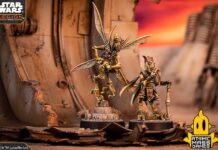
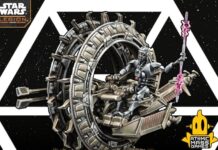
Star Wars: Shatterpoint has been on our gaming tables for just over a year. It is a game with exceptional miniatures, great gameplay and deep-thinking strategy. It’s certainly a game that has found its market and doesn’t show any signs of slowing down. Having become such a staple of Star Wars gaming, I wanted to learn more about the team behind the game. Thankfully, Will Shick, Vice President of Product Development at Atomic Mass (as well as designer of Atomic Mass’ other very successful skirmish game – Marvel: Crisis Protocol), was on hand to offer us some insights to the game and his passion for designing.
Let’s start right at the beginning, how did you first experience Star Wars?
I was four years old and saw A New Hope (though it was still just Star Wars back then) on broadcast television for one of the three network’s Sunday movie nights. Needless to say, by the time the Death Star blew up, I was immediately hooked for life.
Which film out of the saga is your favourite and why?
Zero question or debate: the best film is still and always will be A New Hope. Not only did it launch it all, it’s a fantastic complete story that has all the quintessential elements of what makes Star Wars so great. I can watch that movie twenty times in a row and never get bored with it. In fact, A New Hope isn’t just my favorite Star Wars movie, it’s easily my favorite movie of all time.
What were your favourite games growing up?
I was lucky in that my mom was pretty big into board games, so we had a lot of exposure to a number of games even at a young age. As I got into middle school and expanded into more serious tabletop gaming, my primary ones where Marvel OverPower, Decipher’s Star Wars CCG, and classic BattleTech. But by the time I was nearing high school, my LGS brought in miniatures games with Warhammer 40,000 and Warhammer Fantasy Battle and those two basically became my entire teenage gaming experience. I loved everything about miniatures games from the in-depth strategy and tactics to the hobby elements of being able to build and paint my very own collection of cool miniature warriors.
Outside of tabletop games I was a huge fan of arcade fighters like Street Fighter, Marvel vs. Capcom, and my all-time favorite fighter Killer Instinct. Similar to miniatures games, I was really captivated by the strategy and tactics and loved how you could see your skills and ability at being good at the game grow with every rep you put in. While side scrolling beat ’em ups are really fun, at the end of the day to succeed at those you just need quarters. To win at a good fighter required practiced skill and knowledge and for me that was always the most rewarding feeling.
Marvel: Crisis Protocol was the game that really exploded. How did you go about designing that?
From the design perspective Crisis Protocol was mostly built from my decades of miniatures game experience and even more years of being a huge fan of Marvel comics.
The original ideas and design for the game were really about capturing the excitement and essence of great fighting games like Marvel vs. Capcom and then applying those concepts to a wider team-based skirmish battle game.
One of the ideas that I was really excited about was the concept of power as a game resource. I’ve always found resource management in games to be very compelling and it really adds to how each player’s approach to a battle can be very different. In Crisis Protocol the Power mechanic is heavily influenced again by how Meter works in some of the best fighting games. In fact, in the early alpha rules for the game Power was just called Meter, as that was the feeling I was aiming for with the system.
From there it was largely about making sure the characters were really evocative of the beloved Marvel heroes and villains so many of us have spent so much time with in the pages of comics, over episodes of the many great Marvel animated series, and of course the absolute force that was the MCU.
Some of the more interesting innovations for the game were the Roster system, which borrowed concepts from CCG sideboards, allowing players to adapt and respond to the dynamic missions by drawing their teams from a larger pool of characters and the interactive terrain mechanics that allowed characters to pick up and throw terrain at their enemies just like we so often see in the comics. After all, how could we sleep at night as stewards of the Marvel Universe if Hulk couldn’t SMASH in the game?
In the end, though, the thing that brought everything together and created the force that Marvel: Crisis Protocol has become was the incredible team around me. From the incredible development skills of our now Development Director Will Pagani, to the sculpting and engineering artistry of our now Sculpting Director Marco Segovia, to the incredible miniatures and hobby design expertise of our Creative Director Dallas Kemp, every single person in our original, tiny little outfit was critical to the game that has exploded over the last five years since its release. And there were so many people even outside our four-person studio who were also so integral to the ultimate creation of the game, including a number of teams at our publisher Asmodee as well as the numerous freelancers and playtesters who all had a hand in shaping the final version.
Crisis Protocol has been going strong for several years, how do you keep it still interesting and engaging for the fans that have been playing it since the very start?
One of our original studio mission statements was to ensure that we always created games that were built to allow exploration and innovation when it came to the player experience. As all of us were veteran miniatures gamers, we deeply understood the value and importance of a player’s miniature collection. So even when we were working on the base game rules, we were also looking at making sure the final base game rules would provide us with a solid foundation from which to build as many different game modes for players as possible. I think this commitment to continuing to push the game in new directions in order to provide as much value and opportunity for players has been a big component of the overall success of the game. From Ultimate Encounters to narrative scenarios, to multi-player free-for-alls, to pick and ban formats, and even our newest Mojo Ball Scenario Pack, there is a wealth of gameplay for players to explore.
Beyond providing as many game experiences as possible, we also have the great fortune of getting to design and develop within the Marvel Universe. With such a vast wealth of diverse characters and power sets, there is always inspiration for adding new and unique mechanics to the game. Whether that’s Infinity Gems, transforming characters, unique leaderships like Apocalypse and his Horsemen, or giving characters the opportunity to bring along a few good henchmen, we’ve been able to constantly add impactful and interesting options for players to master.
Rather than just game designer, you are now the Vice President of Product Development. How has this changed your role within Atomic Mass?
Mostly it just means instead of overseeing the creative efforts of one game I do it for all our games. While I do often originate or guide the initial design of our products, in the end I’ve always relied on the amazing team of talented people at Atomic Mass to make those designs into reality. Largely it’s my responsibility to oversee all their efforts and connect the dots between the departments to ensure that the final product presents a cohesive vision and experience. It is an amazing opportunity to work with and learn from some of the best and brightest minds in the industry, as well as being able to help define the roadmap and ultimate vision for what we are hoping to achieve with our games.
Another important part of my role is then presenting that vision and plan to our publisher at Asmodee, alongside our fearless Head of Studio and Marketing Director, to ensure that what we are doing also aligns with the whole organization’s goals and needs.
How did designing Star Wars: Shatterpoint come about?
After we had Marvel: Crisis Protocol off and running we were presented with an opportunity by our publisher Asmodee to do a similar style game for Star Wars. Of course, as any rational fans would, we jumped at the chance.
Was there a need or desire to try and make it very different from Crisis?
We definitely told Asmodee from the beginning that if we were going to do a Star Wars skirmish game it wasn’t going to be a clone of Crisis Protocol. While I know that the MCP system could have translated those characters, the style and theme of the game doesn’t quite fit with Star Wars.
The whole team at AMG very much believes in a theme-first mentality when it comes to design and development. When we think about some of the most iconic moments in the franchise, it’s impossible not to think about the cinematic and climactic personal combat. Obi-Wan vs. Anakin on Mustafar, Ahsoka vs. Maul in Clone Wars, Luke vs. Vader in the Emperor’s throne room. I really wanted to see if we could create a game that could capture the character and dynamism of Star Wars combat in a way that I hadn’t ever seen before. Working through some of those ideas and designs with the team gave me the confidence that we could really make something that would hit the mark. So, I presented to Asmodee a very rough alpha version of what would become the Shatterpoint people know today and, fortunately, they saw what we at the studio saw and greenlit the project.
Were there any lessons that you had learnt from spending a number of years with Crisis that have aided with the designing and implementation of Shatterpoint?
I think what our work on MCP had taught us was where the most likely pitfalls would be and what the hardest mountains to climb were. But honestly the game designs were so radically different that there were very few direct lessons we could apply to one or the other.
However, I do think from the miniatures design standpoint Shatterpoint absolutely benefited from the sculpting and engineering team’s previous experience on MCP. There were a large number of lessons we had learned that were applied that really pushed the Shatterpoint minis to be, in my opinion, some of the absolute best miniatures in the world today.
How long did it take to design Shatterpoint? Were there any major stumbling blocks?
Shatterpoint was in development for a little over three years. And boy, there were stumbling blocks a plenty.
One of the things about that game is that we began with the standpoint that we weren’t going to automatically fall back on the standard expectations for a minis game. We were willing and excited to challenge all the normal preconceived notions about how those games are supposed to work.
On the one hand we knew that doing things like having a completely random activation mechanic, making a game where lethality didn’t equal removing the miniature from play, and creating a wide synergistic network of abilities that made different units in the game feel like cohesive and trained squads (even though the game itself still functioned like a skirmish game) with each activation being locked to a single unit/character would potentially push the game away from the hardcore miniatures game audience. But on the other hand, we also believed in the opportunity to innovate and create a really unique experience by not tying the game to standard expectations.
And again, this applied even beyond the game design itself and into the creative design too. While we could have just gone with an expected visual design route, instead we presented our partners at LFL this idea to reimagine all of Star Wars in the style of an 80s/90s Saturday morning animated adventure series. The kind of show that we all dreamed about seeing when we were kids, turning on the TV to start our weekend with a morning of incredible cartoon adventures.
This led to some of the hardest visual design back and forth I think we’ve ever done, but thankfully we have a great partnership with LFL and they were willing to put in the work to provide feedback and guidance at every step of the process, ensuring that the final look and style of the iconic Star Wars galaxy was one we could all be proud of putting our stamp of approval on.
All of this meant that what could have been easy was doubly as difficult. Ultimately though, seeing how it all turned out, it was worth every bit of additional effort we put in.
There are a lot of people involved in the design of squads, from the game mechanics to the sculpting, to the artwork. How long does it all take from start to finish?
Typically, it takes two years for a squad pack or character pack to go from design idea/concept to product on the shelf. This includes the initial concepting, rules design and development, sculpting and engineering, art direction, graphic design, so many reviews and approvals both internal and with our licensors and publisher Asmodee, and then everything that goes into the actual tooling and manufacturing of the product before it finally ships globally to arrive on store shelves.
However, if you are making a whole new game or a bigger starter or core-box style product, that timeline can be anywhere from three years or more based on the complexity and challenge of the project.
Is there a particular point in the process when you sit back and think, wow, this is going to be great?
I’m lucky enough that my position gives me the opportunity to see the project at every step and through every department during its creation, so I definitely have multiple moments where I get glimpses of just how exciting the final project is going to be.
But the big moment for any project is when it finally hits peer review and all the different work of the different departments is finally brought together into the first draft of the final product. Of course, as peer review, there’s always plenty of edits and revisions that have to be made, but it is always the moment we get to see just how everyone’s effort Voltrons together to create something incredible.
For new players looking to get into the game, what would you say separates Shatterpoint from the other tabletop miniature games out there?
While most miniatures games have a heavy focus on strategy (i.e., challenging players to generate a perfect battle plan at the start of the game and then execute it using evolving tactics), Shatterpoint flips that standard on its head. In Shatterpoint, the player is largely left to the whims of fate and luck in regards to which unit or character will activate when. So larger-scale strategy takes a backseat to a player’s ability to adapt and innovate based on the immediate needs of the moment, while doing so in a way that keeps the larger mission needs in mind. It really is a game that rewards tactical acumen. This means that you can play the exact same game multiple times but your approach in how to claim victory will never be the same. This makes it ideal for people who really want a game that is very approachable without having to spend hours and hours outside the game planning on how to execute the perfect Turn Zero. Skill and game knowledge are still very important, but Shatterpoint rewards and asks for a very different type of skill and knowledge.
The second thing I would point out is Shatterpoint’s unique combat system. In Shatterpoint, success in combat isn’t translated to plain old damage being done to your target. Rather, the game is built around a very robust narrative combat system that provides players with a ton of decision making and possible outcomes that replicate the dynamic and cinematic nature of Star Wars combat in movies and media. To accomplish this, Shatterpoint uses a branching Combat Tree that offers each character a unique blend of damage, displacement, and control, which leads to duels becoming a kinetic experience as miniatures drive opponents back or leap away after delivering a flurry of blows or blaster bolts.
Who is your favourite character so far to appear in Shatterpoint?
Cad Bane is one of my all-time favourite Star Wars characters, so he is definitely at the top of the list for very selfish reasons. I am really happy with how we were able to translate him from the screen to the table both in terms of his rules and his miniature.
Is there any character that hasn’t been designed yet that you would like to see in Shatterpoint?
Pong Krell, the treacherous Jedi from the Umbara arc in the Clone Wars animated series is probably at the top of that list. His design is just so cool and there is definitely something really compelling about his whole character, even before he turns on the Republic. I just think he’d make an amazing miniature, as well as a way to provide some really different abilities and synergies into Republic-centric teams.
It has been a joy to play with Dark Troopers as I grew up playing Dark Forces, and thankfully they have appeared in The Mandalorian. Is there any chance that characters from the Legends line may make an appearance in the game or is it strictly canonical characters?
It’s certainly not impossible that on a long enough timeline we may see some characters from Legends creep into Shatterpoint or even Legion!
Do you have a particular era that you like to work on or is easier in terms of the game?
I think personal preference really plays into the ease of rules design, so for me the original trilogy or Clone Wars are always ones that seem to flow from idea to character design document simply because I have so much familiarity with those characters and their stories.
That said, there’s a huge benefit to working on characters that I don’t have as much knowledge about because than I get to dive into research, which is basically consuming and watching key Star Wars media in order to learn everything that we need to know to be able to translate the character successfully to the tabletop.
How far along are the plans for Shatterpoint? Does it ever cause you a headache to plan so far in advance?
Because our production timeline is significant at two years, a big part of my job and responsibilities is to make sure there is a five to six year plan for where each of our game lines are going. This ensures that we can develop upcoming releases with an eye to how they may affect or interact with future releases.
Of course, this longer-term plan is more guidelines than rules, and it can and is adjusted based on multiple factors as we gather information and feedback on the games, learn about new exciting developments with the IPs from our licensing partners, and get inspired internally for cool things we can add to the games as we work on them. However, with things beyond the two-year production cycle typically open to shifting, it can lead to something you are really excited about kind of being a tease, as it might keep getting moved further and further out for one reason or another.
A huge thank you to Will for taking the time to talk to us and a huge thank you as well to Ross Thompson at Atomic Mass who was able to make all of this possible. I don’t want to say I let a little cheer for Legends, let’s hope it does one day happen!