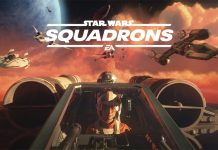
All eyes are on EA to deliver what they promise to be the “definitive” Star Wars space combat experience with the release of Star Wars: Squadrons on October 2nd, 2020, and Polygon have spoken to creative director Ian Frazier to hear how they are going to make this happen.
Polygon: Tell me about your team.
Ian Frazier: Our team, it’s a mix of people in terms of their origin stories. We have folks that are coming from Bioware. We have folks coming from the original Motive team that was on Battlefront 2, the single player campaign. And, of course, new people that we’ve hired along the way.
As it seems to come together, we have, as you’d expect, a lot of Star Wars fans. A lot of people that came to the company specifically because they wanted to work on Star Wars. And one of the things that’s been fun about this project is that, well, I’ll put it this way. One of the questions people have been asking a lot lately is, “Hey, what were your inspirations? Is this game coming from, you know, X-Wing or from Rogue Squadron or whatever?” And the answer is kind of, “Yes?” Because depending on the person and, in some cases, just the age of the person we have different inspirations across the team. You’ve got people that are coming to it and they remember Rogue Squadron and love it dearly, and what’s inspiring to them. I’m an old fart, so I remember X-Wing and TIE Fighter, they’re a big inspiration for me. And you get a lot of these different kind of threads of Star Wars fan juice coming from different angles.
When I am flying one of these fighters what film am I in? Am I in Rogue One: A Star Wars Story? Am I in Solo? Where did you ground the experience in the cockpit within the Star Wars fictional universe?
When we started, we actually looked at more than just Star Wars as a comparison point. So we looked at the original films, first and foremost. The classic trilogy. We looked a lot at Rogue One, because it’s just an excellent film. It does some amazing things with space battles that we thought were just great reference. It does something that we try to do even with the game, which is that if you take a freeze frame of A New Hope and you put it next to Rogue One, they don’t actually look the same. Rogue One has more technical quality to it. It’s better produced because it’s been decades, but they managed to hit the style and the flavor spot on. So it really very, very much feels like original.
I think that’s similar to what we’re trying to do. We don’t want the game to feel old. We want it to feel appropriate to 2020. But, at the same time, when we look at those films we want to make sure we are evoking the feelings of the original. If you kind of move your head forward in VR and really look closely at the displays in our cockpits, you’ll notice that we’ve we’ve constructed them in a way that looks like how ILM would have built a prop in 1977. It’s fake, obviously. We’re making everything inside a video game, but we’re trying to build it based off the physical realities of how these props were made in the late 70s.
Another thing we did early on is that we looked at a lot of different franchises. We looked at Star Trek and we looked at [the reboot of] Battlestar Galactica. We looked at other sources to say, “How are they different? What is uniquely Star Wars?” And there’s a lot of different things that are uniquely Star Wars. With certain exceptions, it’s not as much about battles of attrition. It’s more about these quick, zippy dogfights.
First and foremost, it’s inspired by World War II aerial combat footage. You see that in the original films, even down to the fact that the TIEs have green lasers and the Rebels have red lasers. That’s because those are the colors of the tracer fire in World War II for the Axis and Allies. There’s that heritage you see there, and so we’re trying to keep that same kind of theme.
When you look at our flight model, your ships don’t move like a ship would actually move in space because ships in Star Wars don’t move like ships would move in space. They move like ships move in Star Wars. There isn’t any real one moment in the cinematic history, to really go back to your question. There’s no one specific moment. We’re really looking at the classic trilogy, elements of Rogue One, and kind of puttin’ them in the stew, and then the game emerges.
I play a lot of space combat games. I was in Elite: Dangerous last night. I’m gonna be in Star Citizen tomorrow. I really am excited to get into In The Black [previously Starfighter Inc.]. But all three of those games handle completely differently. Except for In The Black, which is like flying an Apollo capsule. That’s not as fun as it could be in my opinion, but you get into Elite and, to some extent, Star Citizen, and those ships fly more like terrestrial airplanes.
Talk to me about how your flight model is unique, and how it’s Star Wars, and how it differentiates itself.
I think where we started from is we went back to a lot of the classic games. I looked at Star Wars: X-Wing and Star Wars: X-Wing Versus TIE Fighter — that whole series — because they’re first-person like us. What was unique about their flight model 20 years ago, versus looking at, say, Starfighter Assault [mode from Star Wars Battlefront 2].
We tried to start with something that felt, again, like that World War II simulation kind of basis, in terms of how the ships actually handle, how they move. It is, as in your example, more terrestrial. Then, once we started layering on things like power management, we went, “Okay, how do we use things like power management to take that World War II sort of base, but then amp it? What does the accelerated version of that look like?”
For instance, we went as a team and we saw Star Wars: The Last Jedi, and the opening scene where you know, Poe is boosting and he goes under the shields, and he’s doing his crazy kind of reckless maneuvers. We loved how that looked, we loved how that felt, and we went “Okay, well, within our context, how can we get something of that flavor and some of the feel?”
You see him do that kind of spin out move by one of the turrets. Can we can we achieve that mechanically? Can we hit something that that feels right for Star Wars and does that. And we did, actually.
We’ve got a drift maneuver implemented in the game. This is just an example — but if you put your power to engines: First, putting your power to engines makes your ship faster, and it makes it turn better. In addition, where you sit on the throttle also determines your turn speed. So that combination of things is a way to be better at dogfighting in and of itself.
Another reason to max power to engines — not just put a few pips in it, but max it — is that when it’s maxed it builds like a boost charge, and that is a finite amount of crazy superspeed. And you can’t turn very well when you’re doing that. You can a little, but it’s really meant for forward blasting. Every dogfighting game has the problem of the death loop. You get stuck in the loop. They’re chasing you, you’re chasing them, and you can never escape. So part of why we have this boost is to resolve that problem — in addition to getting my throttle dead center, and having power to engines helps me turn.
On top of that, if you boost you can then cut off the boost kind of mid-stream. That shuts off your engines completely, so you have a brief moment of drift where you can whip around in a 180 and shoot at them. Or do whatever you want! Change course and hit boost again, if you have more juice left. So there’s stuff like that we’ve tried to do to take it beyond just the core World War II feeling, but to give it something a little special on top.
Read more here. Star Wars: Squadrons will be released later this fall on October 2 for PC, PlayStation 4, and Xbox One (crossplay across all platforms is supported) and offers several pre-order bonuses. For more information and to pre-order your copy, visit the game’s official website.