From the Fantasy Flight Games website:
“The more you tighten your grasp, Tarkin, the more star systems will slip through your fingers.”
–Leia Organa™
Star Wars™: Rebellion is a board game of epic conflict between the Galactic Empire and Rebel Alliance for two to four players!
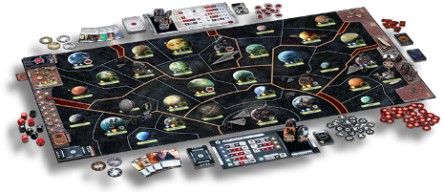
Experience the Galactic Civil War like never before. In Star Wars™: Rebellion, you control the entire Galactic Empire or the fledgling Rebel Alliance. You must command starships, account for troop movements, and rally systems to your cause. Featuring more than 150 plastic miniatures and two game boards that account for thirty-two of the Star Wars™ galaxy’s most notable systems, Star Wars™: Rebellion features a scope that is as large and sweeping as any Star Wars™ game before it.
Yet for all its grandiosity, Star Wars™: Rebellion remains intensely personal, cinematic, and heroic. As much as your success depends upon the strength of your starships, vehicles, and troops, it depends upon the individual efforts of such notable characters as Leia Organa™, Mon Mothma™, Grand Moff Tarkin™, and Emperor Palpatine™. As civil war spreads throughout the galaxy, these leaders are invaluable to your efforts, and the secret missions they attempt will evoke many of the most inspiring moments from the classic trilogy. You might send Luke Skywalker™ to receive Jedi training on Dagobah™ or have Darth Vader™ spring a trap that freezes Han Solo™ in carbonite!
Contents include:
1 game board (split in 2 halves)
153 plastic miniatures
25 leaders (with stands)
10 custom dice
Over 170 cards
1 Learn to Play Booklet
1 Rules Reference
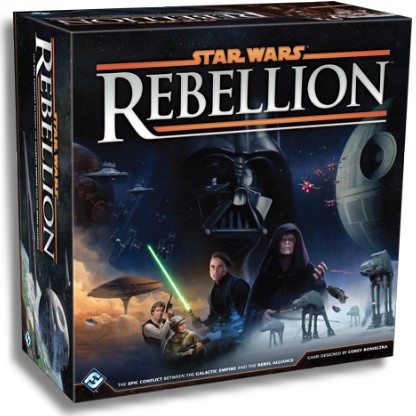
This box is HUGE! I had to tell my opponent to cut the chatter because he just kept saying ‘Look at the size of that thing!’ and that just set off a whole slew of Star Wars quotes as we unboxed it.
‘If the box is this big then this is going to be the greatest thing EVER!’ I told myself. I mean , I used to bullseye womp rats in my T-16 back home, and they weren’t much bigger than this box… but I don’t know where I got these delusions, laser-brain. I like my boardgames, but there are a few conditions I like to tick off before I get stuck into one.
1 – Not too complicated. I like my boardgames to have depth, but if I’m required to spend several hours with a scientific calculator and get myself a PhD in Mathematics to get the basics of a game then I’m immediately put off.
2 – Not too many pieces. If there are enough tokens, playing pieces, cards and markers in the box to put together eight separate games, then I’m usually out. I don’t want to be managing so much; I’m playing the game for an evening’s entertainment, not invading another country.
3 – I want to be able to beat the other player. I like co-operative games, but I like to play to win.
So, when I opened the box and I was confronted with a game board split in 2 halves, 153 plastic miniatures. 25 leaders on stands, 10 custom dice, more than 170 cards, sheets, markers, tokens, and a rules booklet with a rules reference, then I pretty much passed out. No wonder the box was so big.
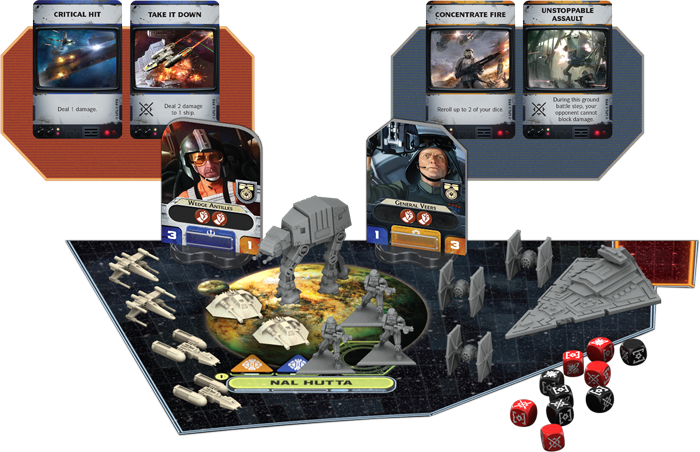
After going through the components and looking at my opposition with a mixture of emotions (basically a combination of ‘By the Maker!’ and ‘Cool Star Wars stuff, dude!’) I was ready to dive in.
And what cool Star Wars stuff it is. In addition to the high-standard quality of art, durable card stock and layout, there are LOADS of ridiculously cute Star Wars miniatures to push around the boards. The game is in the Original Trilogy setting, so the Death Stars (both versions, Episode IV and VI), the Star Destroyers (Imperial and Super Class), TIE fighters, AT-ATs and AT-STs, X-Wings, Y-Wings, troopers… it was something of a delight, although it does take a few minutes to get past the ‘playing with them’ phase; you know, diving at the Death Star making the engine and pew-pew sounds with the X-wings, having the troopers shooting at each other with more pew-pew sounds and then doing the ‘urgh!’ as one hits the deck, flying Rebel starships up to the second Death Star and shouting ‘It’s a trap!’. You know, standard Star Wars toys stuff.
They’re good, sturdy pieces. Not sure if they’d be any good for painting as the detail isn’t exceptional, but they’re good for what they’re needed for. The boardgame, I mean, not playing with them and doing the pew-pew thing.
So, with the quality out of the way, the game was on.
It probably took about two hours to prepare the pieces, put them where they needed to be and set up the first game. That’s a long time. A very long time. I suppose a lot of that was down to the pew-pew thing, but that’s still a lot of your evening gone. If you were planning to play for a day or a weekend it’s not so much of a problem, but those of us with limited time might find it a little frustrating – see my boardgame rule 1. Still, with the game set up we were good to go.
I took the side of the Empire, with the goal of hunting down and eradicating the Rebel’s hidden base before they could cause any more trouble, and my opponent took the side of the Rebellion, who’s aim was to win over worlds to join their forces and defeat the evil Galactic Empire.
In general, characters try to influence, mobilise and inspire their forces, and all combat is decided with both space and ground warfare, which is where the miniatures come in (with plenty of pew-pew stuff, of course).
I was going to go into detail about the rules, but in true Fantasy Flight Games fashion they’ve made the rules available for free. They’re fully aware that certain boardgames are made for certain kinds of players, so you can read the rules here.
There’s also a rules reference and a FAQ sheet to help out with some of the trickier rules questions, so it’s all very handy. I could go into a long description of how the game works, but any description I attempt will either be too complicated to make sense, or too simple to accurately get across the dynamics of the game.
So, I’m going to concentrate on how the game went for us.
Let me get a bit of a nitpick out of the way first, and this comes back to my boardgames rule 1. We never actually got a full game played out during our first session. In fact, we practically didn’t start the game. After all the time spent prepping the game and going through the rules we ran out of time, and had to leave it to the next session to get into playing proper. I’m going to be honest – it’s not an easy game to learn. There was a lot of rules checking, then double checking, then going back to check again before resetting the pieces and starting again. The rulebook isn’t perfect and doesn’t lend itself to page-flipping when you’re trying to find something particular, but once you ‘get’ the rule and see how it fits then it’s usually pretty easy to press on, but expect to spend time double checking rules or surfing the net for answers. The game is complicated, and it’s a steep learning curve, but once you get into the swing of things it’s a fun game to play and flows really well. My issue is actually getting to that point can take a lot of time, patience and many board resets.
We also needed a large table to game on – the sheer amount of pieces in the box, once laid out, needs a table of it’s own. Make sure that you have plenty of space because you’re going to need it. Thank the Force there were just the two of us playing it – more bodies would have no doubt made learning the game easier, but the space around a table in a room that houses one of the largest and most complex Star Wars collections in the United Kingdom was at a premium with just the two of us. Any more and we would have had to play on the floor, and there are all kinds of issues with my back that I’m just not going to get into.
Like I said, nitpicks.
The game itself, once we hit our stride and made sure that we had the three to four hours of playing time that the box recommends, was a joy to play.
It’s not just about combat, or positioning pieces to attack worlds or fly into enemy ships, it’s also about characters. Emperors and Grand Moffs fly to worlds to seek out the Rebels and marshal their forces, and Princesses and Scoundrels desperately try to convince systems to join their cause, all the while trying to make sure that the Empire don’t discover their hidden fortress and vaporise it with one of their Death Stars.
There’s a round tracker that keeps the game moving, and the Empire win if they discover the Rebel Base and destroy it, or the Rebels get a high enough reputation to pull star systems to their side and win the game. It’s all about the balance of power; oppression and subjugation from the Empire, resistance and justice for the Rebellion.
You know, like the films.
That’s where the game shines. The gameplay is really pushing that conflict between the Empire and the Rebel Alliance, that striving for dominance over the galaxy, that need for control and order and the desire for freedom – the core driving force behind the original Star Wars trilogy. When you’re sending your characters out on diplomatic missions you really root for them, in part because you want to win the game but there’s also the fact that you know these characters, you can imagine their attitudes and desires, and you can see them desperately trying to shift the balance of power, or cruelly trying to maintain it, when conflicts arise.
With all those playing pieces I felt invulnerable (which was my downfall, as it happens) as I had Star Destroyers, fighters, troops and war machines at my fingertips. I was pushing those pieces around trying to outsmart and out-manoeuvre my opponent; I felt like an officer in the RAF control room in World War Two, pushing small models and markers around a map with a stick, deciding on deployment and strategy. It felt a little like Risk, but this wasn’t a world, this was an entire galaxy. I really felt like I was in control of the fate of billions.
The game is so big that there’s still lots I haven’t done; I haven’t interrogated any Rebels yet. That sounds like fun. The length of a game means that you can get about five or six rounds of play in, but each single round takes so long, and some things you begin might not be ready for a few rounds at which point the game might be over. However, all those other cool things you could have done will have to wait until a later game and that’s a good thing, as it keeps the game fresh and instils a lot of longevity and variety.
The rules are many and can take a long time to fully grasp – and the rulebook doesn’t help in this regard as it’s not user friendly – but once you’re on top of them you can enjoy some huge, expansive games that are really exciting. Yes, the learning curve and the laborious first couple of run-throughs can be something of a chore, even tedious, but don’t let that put you off; once you’re into it, the game really comes alive.
One thing that Star Wars: Rebellion really needs is commitment; commitment in time, energy and patience. This is not a small game – the hefty box is testament to that – and the many choices to make, characters to utilise, pieces to play and paths to take can, at first, seem a little daunting. However, get past that and what you’re left with is an incredibly rich and sometimes exhilarating game that’s very satisfying to play.
Highly recommended.
Pew-pew!