A couple of months ago, in my search for the best paint to use for my Star Wars: Shatterpoint terrain, I discovered Archive X paints. Paints that were matched to the colours used by the original ILM team, it was exactly what I had been looking for. What I hadn’t banked on, was the introduction to a much wider world of studio scale models and the difference in techniques and effects that go into models that are much larger in scale than the ones that I work on. Having been raised on all the documentaries that I could get my hands on for the Original Trilogy, the Archive X store was a treasure trove that I still think about almost daily, particularly the gorgeous Y-Wing model that Guy Cowen was working on at the time of my visit. It was something that I just couldn’t forget.


Fast forward to today, what with work and family, I can finally say that the Star Wars: Shatterpoint terrain painting is complete (well, ok, maybe one building but we haven’t been using it for game play so I’m completely dismissing it!). It’s always an achievement to paint the terrain for a miniature game. I remember several years ago painting a 2ft-by-2ft board for Games Workshop’s Kill Team, with a modelled base and three stories worth of levels, it was exhausting to say the least. Shatterpoint has been less strenuous, lessons learnt from that first board but most importantly, because of the Archive X paint. Apart from the washes and the blue lights, everything has been painted with Archive X. If you need the minute details, please see my previous review as it all still stands, but after hours of painting, I can still say this is some of the best paint I’ve ever had the pleasure to paint with.
The coverage and quick drying paint mean you can get so much more done in a given amount of time, and with family life taking up a good proportion of that, every second is valuable. Then of course there is the colour itself, which always feels so ‘Star Wars’. There’s no escaping how wonderful it is to see and utilise these colours in your own work. Not only that, but the effects that you can achieve with the paints are outstanding and really help to bring that weathered and worn look that Star Wars is so famous for. I think the photos I’ve taken speak for themselves to the quality of the paint. What’s more, I haven’t even emptied a single pot of paint yet! That’s some coverage!


But now that’s complete you’d think I’d finally get round to the backlog of models for Shatterpoint. Yet something played on my mind too much: those studio models. It had been a learning curve of how best to use Archive X on miniature models for Shatterpoint. When to use the techniques, I’ve always used and when to hold back and let the model’s natural shadow shine through. Now, I wanted to try the paint for what it had always been intended for, to learn the techniques that ILM used. I turned to the Archive X Facebook page and community to try and figure out where I should head.
This community is wonderful. You can tell they are all passionate about what they do but this isn’t a competition. Everyone is so supportive of each other and it’s really refreshing to see a community that will help guide each other and celebrate in each and every creation. They also were very patient with me, a newbie! Lee Ralph, who works with Guy at Archive X, is a fountain of knowledge and pointed me to all the right places and there’s a TIE fighter waiting to be painted. However, larger scale models can be expensive and as I’m still learning, I wanted a cheap alternative to get me started, to learn the basics and see if I had what it takes to create the amazing models I’d seen.
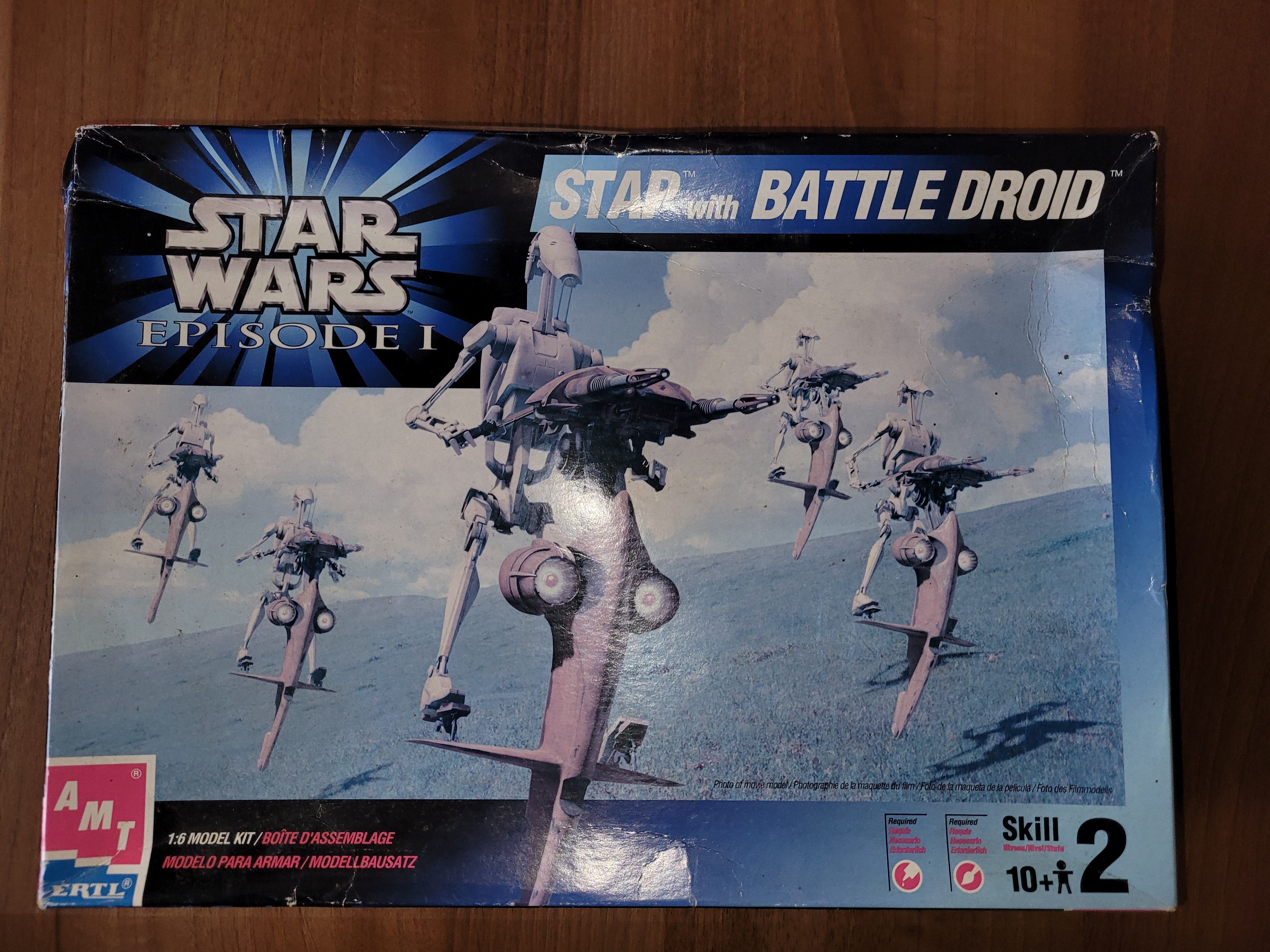


Twin Suns Miniatures is a member of the group and had found a ⅙ scale STAP model from back in the late nineties. He decided to build and paint it. Although I wanted to focus on the Original Trilogy, I was able to find this model on eBay for £20. Fairly cheap, an impressively sized model and the perfect start to try and learn some new techniques. What’s more, Twin Suns Miniatures has a YouTube channel, which meant if I got stuck with anything I had a video guide, as well as him answering many, many questions I had on the Archive X Facebook group. It all seemed to make perfect sense.


The faded box, slightly crumpled, still in cellophane. I ripped it off and was assaulted by that smell from the nineties. I can’t really describe it, that plastic smell that seemed to linger on any toys from back then, suffice to say, if you grew up during that time, you’ll know the smell I mean. Inside the box, were two plastic bags, one for the battle droid and one for the STAP (plus a metal rod to have the STAP stand up). The instructions were on normal paper with black and white images; weren’t things so much simpler and easier back then. I got to work on the battle droid, and it very quickly became apparent just how different model building is to miniature building.
The first, most obvious reason, is just how big these models can be. The battle droid was huge. Just assembling the head, it dwarfed my miniatures in comparison. This, of course, is obvious, I would expect this. But it does lead to the biggest difference for me, assembly. Assembly on miniatures takes no time at all. Even the most complex models can take an hour or two and then it’s straight onto painting. With model building, this increases by a rather large amount. The first issue that you come across is that some of the parts don’t go perfectly together. This might (and it’s very rare) happen on miniatures, but at the scale, it’s barely noticeable. However, at ⅙ scale, these are very clearly seen and need fixing. Which brings me onto the second issue: perfection. At such a larger scale, any imperfections, mould lines, mis joined pieces, etc are all extremely noticeable. If you want something that will, in essence, look like it has come from the studios of ILM, there can be nothing noticeable. It means most of your time is holding pieces together (or going to Hobbycraft to buy clamps!) and filing joins down till the joins are invisible. Joining several pieces together and doing all the work on them can take several hours, just for that section. The build itself has taken me well over a week! That’s not to say I didn’t enjoy doing it. It’s fascinating to see how these pieces join together, the larger detail allowing you to appreciate the design, but it does take a long, long time. When you’re trying to fit in work and family life, I wouldn’t expect to see a complete model for a while (and this isn’t even a studio scale ship model).


Once the sections of the battle droid were complete, it was onto the STAP. Just Like the battle droid, this was all about patience and filing. I had recently completely cleaned my painting area from top to bottom. With the amount of filing, I had to do to provide clean lines, I’m not sure there was much point! It certainly gets you to see models in a very different light, having to be a lot more critical of the work you are doing.
That said, once the finished model was complete, I did have to stand back in awe: this thing is huge! Even knowing this was a scale of ⅙, having worked so long on tabletop miniatures, the size still took me by surprise. This is something that, if painted right, will certainly become a focal point in most rooms. The detail and the care you must take constructing it, means that this is something, even unpainted, I’m looking at it again and again. I’m really seeing the appeal of these larger scale models. It’s certainly not easy, particularly if you want it looking like it belongs in a museum, but it is certainly worth the effort. I’ve had to leave the battle droid unglued to the STAP to make painting easier.
Which brings me onto where to go next? I’ve always painted by hand, I know what I’m doing, how to manipulate the brush for the desired effect… my plan had always been to paint this by hand. Yet, as I look at it, I’m coming to the realisation that an air airbrush would be far easier, I mean it’s what model builders typically use; I can see why! Having gone to all the effort of building it, filing it, taking my time, why not paint it properly? Well, I can see this being another trip down another rabbit hole! I just wish I’d thought of this little trip before I’d painted all that Shatterpoint terrain by hand.