I’ve loved all the sets we’ve had for the Clone Wars so far for Star Wars: Shatterpoint. This year has seen a massive shift towards the other two major animated series: Rebels and The Bad Batch. While we’ve had the crew of the Ghost released, the Imperials needed a little more bolstering. In enters one of the most beloved enemies to the Rebellion: Thrawn. It is difficult to describe the importance of this character. Yes, he is in Rebels and will be playing an even more pivotal role within the new timeline as we’ve seen started in Ahsoka. Yet for those fans that were growing up in the nineties, this was the villain that brought Star Wars back. His introduction (and the real start of the Expanded Universe) showed a different type of enemy. He was just as powerful as any Force user yet had no force ability. The loyalty of his troops was unquestionable, and he almost brought the Empire back, forcing the Rebellion to its knees.

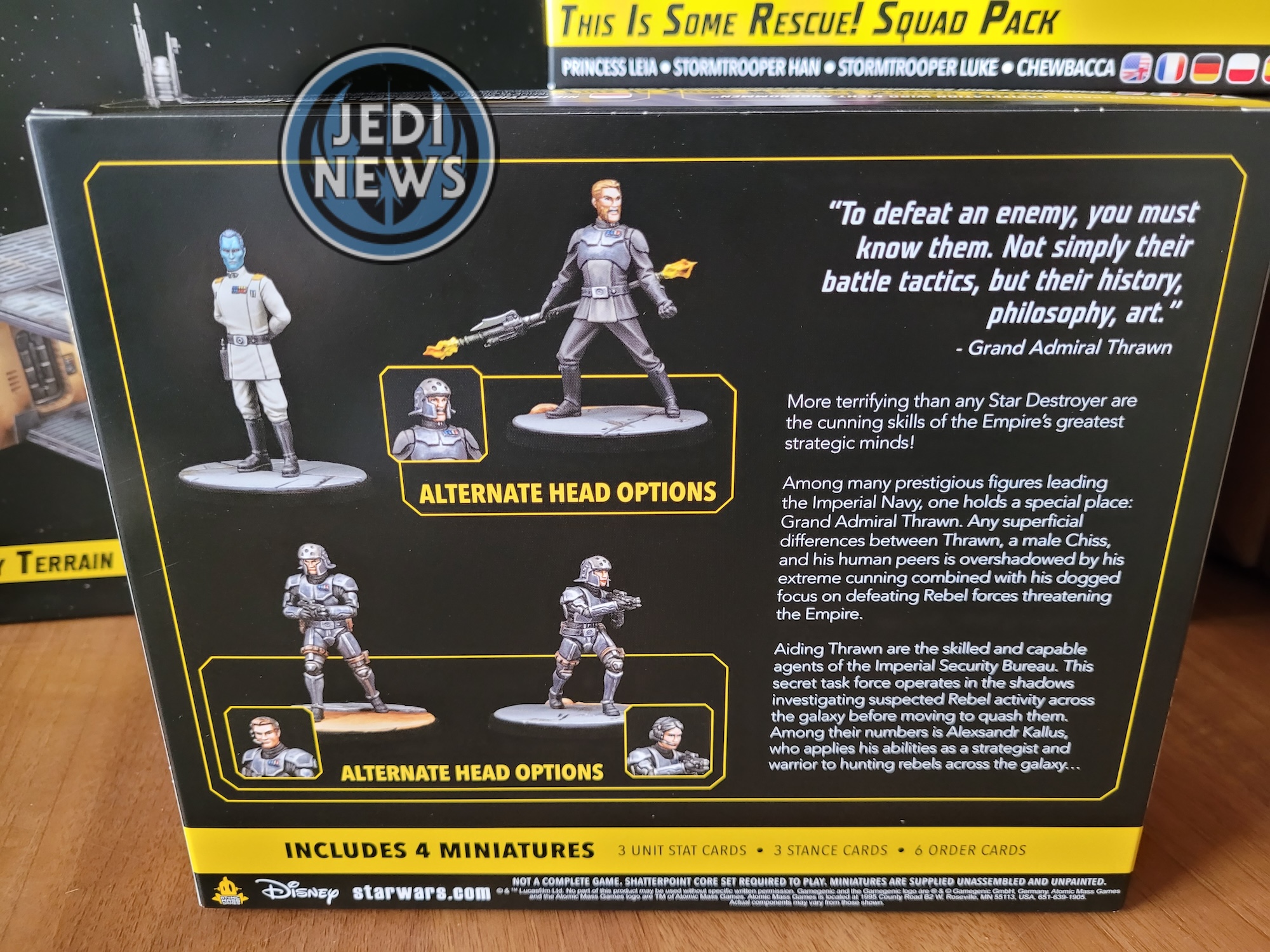
No matter what incarnation that this Thrawn is based on, it is absolutely amazing to see him join the ranks of Star Wars: Shatterpoint. The character in Rebels was designed with the help of Timothy Zahn. There are so many similarities that they are – by and large – the same character. He is also joined by ISB agents, a very different model design to what we already have in the game. And finally, we have Agent Kallus. Imperial? Rebel? I presume this set will provide us with the Imperial version of the character, but I’m very interested to see if there are any little additions to his character. What I like about this set is that these are characters and designs we have yet to see in the Imperial line up. It adds some more variety to the game and I’m sure some different styles of gaming.


Onto the box and the contents. It’s great to see the alternate designs for the characters on the box. Some head swaps for the secondary and supporting characters. They look great although I can already see I’m going to have my usual problem of deciding on what I want to go for! Inside the box we have sprue, cards and leaflet, ready to start building the models.
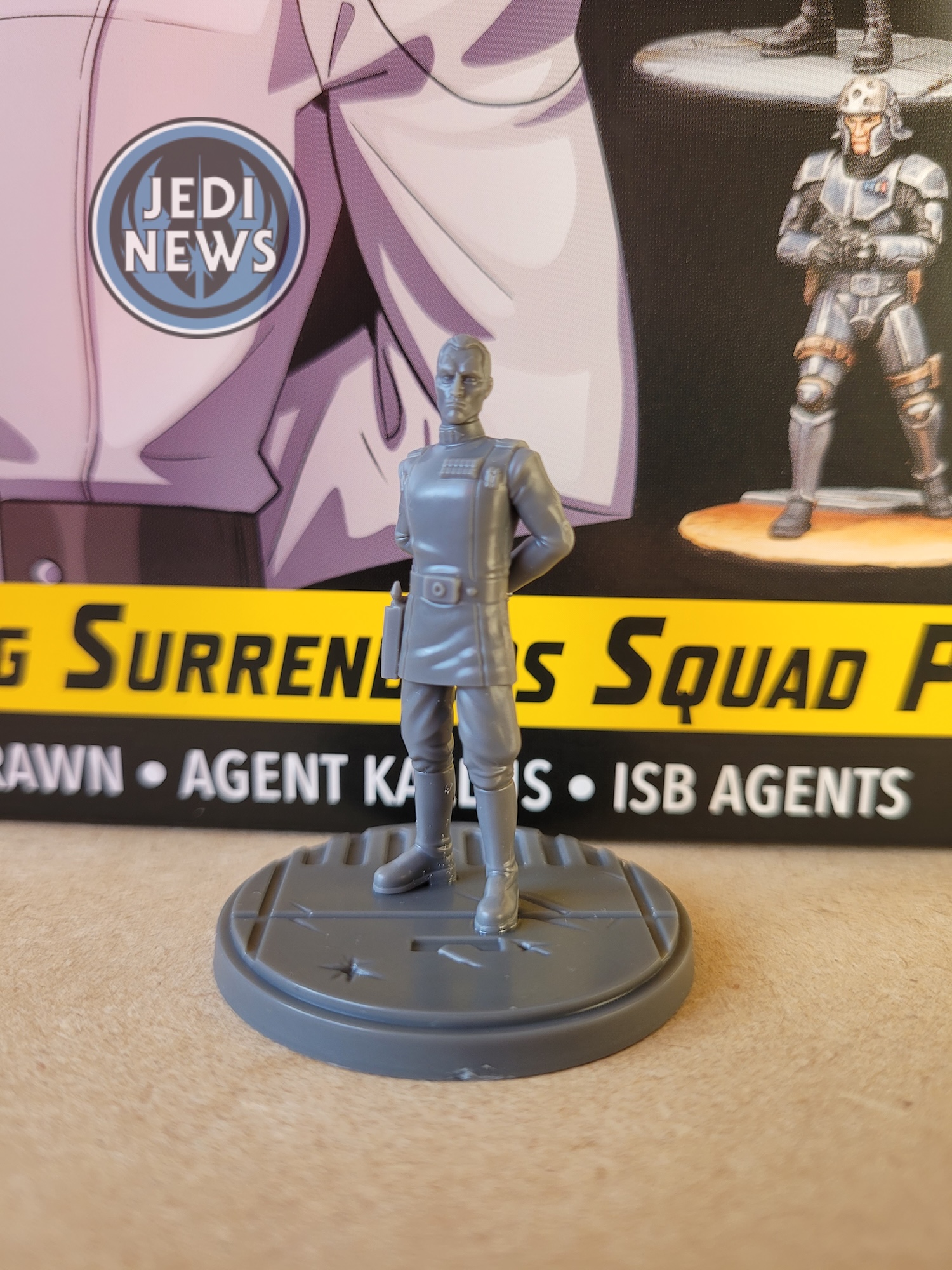
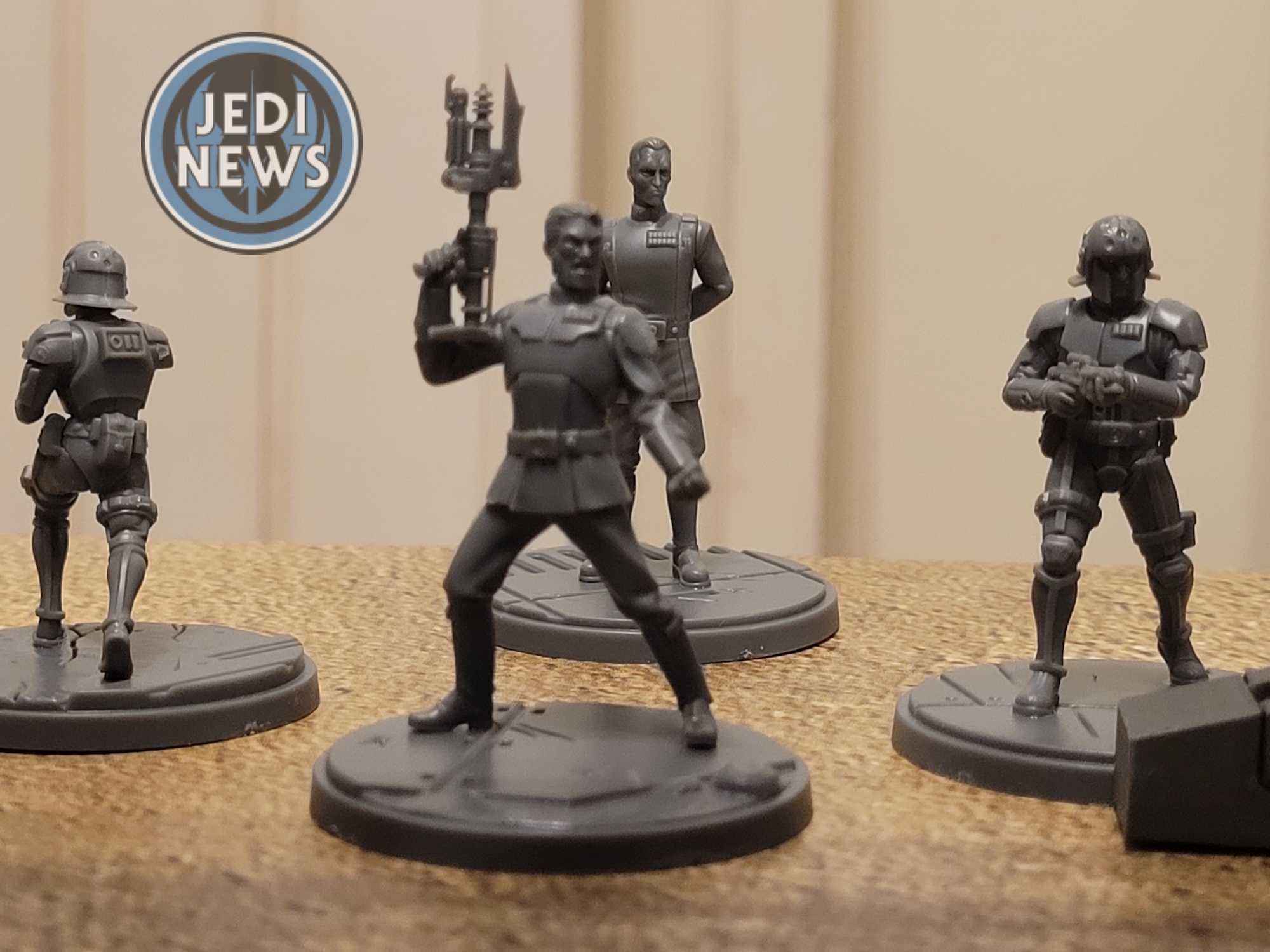
Of course, it is the Grand Admiral himself first, Thrawn. Thrawn is very simple to put together: two body halves, then head, then one arm, the other arm and finally the blaster pistol. There is not much that can go wrong. I will say that when joining the two body halves together, because of how the peg is angled, make sure you put pressure down the body, not just pressure to push the two pieces together. I was very impressed that the sculptors kept the two hands together, having the join between the arms to be the sleeve. It makes fitting the two parts together seamless. As for the finished model, it encompasses Thrawn so well. There is no motion in the model, nor should there be. Thrawn is standing proud, surveying everything and everyone. The detail on the model is just right, not too much, yet the face is spot on, no matter which incarnation of Thrawn you know. It’s a great model.

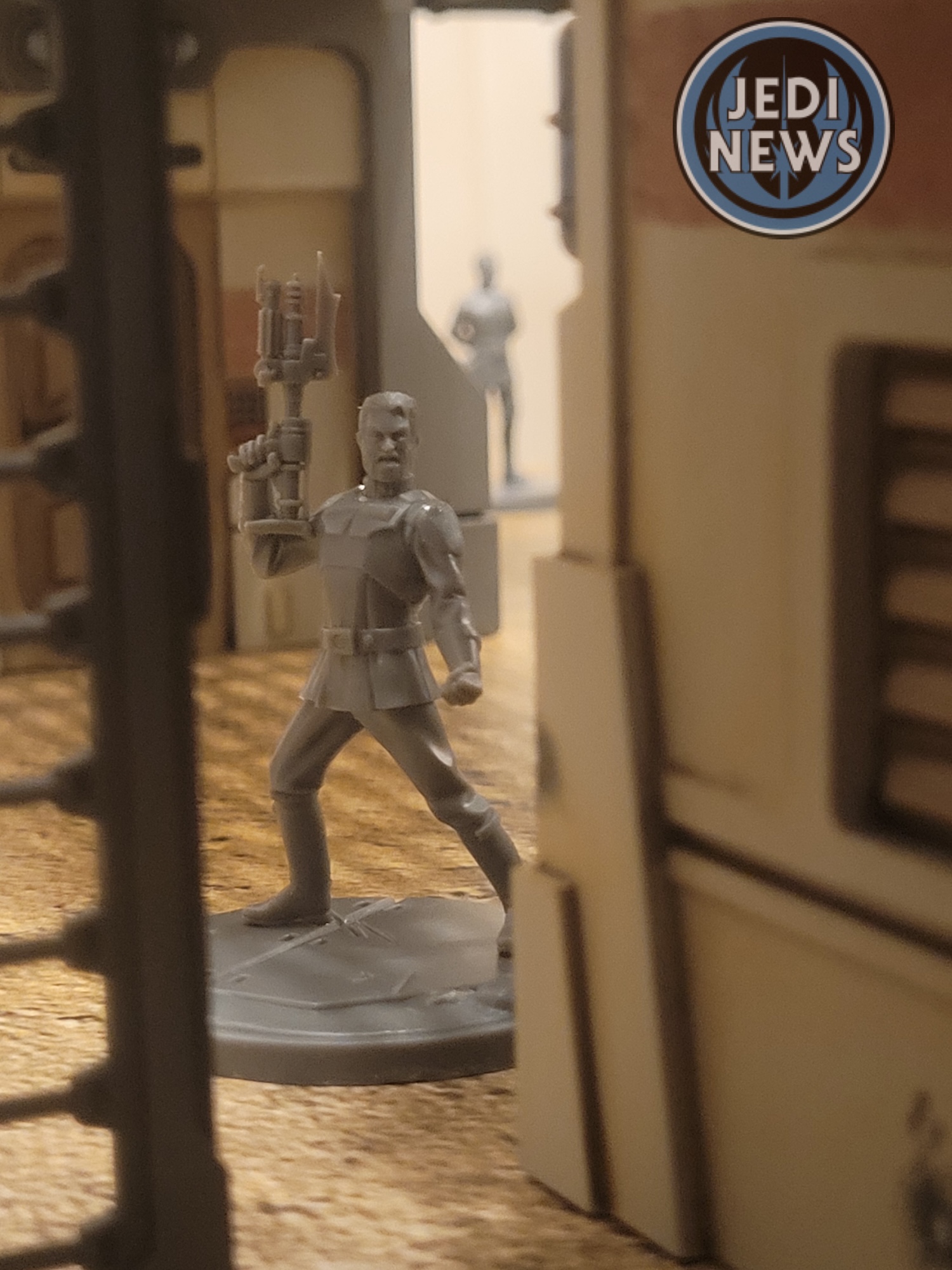
Next is Kallus. Now on the box it shows that there is an alternate head, but what it doesn’t show you is that there is an alternate weapon layout. Like the Zeb model, Kallus can have his bo-rifle normal or extended (as it is on the box). Like with Zeb, this actually wasn’t a hard decision, and I went for the compact form of the weapon. The head, well, I’ve never really liked the helmet so unhelmeted it would be for Kallus (and I’m not looking back to regret it). As soon as I had completed step two – glueing Kallus’ legs together – I glued them straight into the body. I found it gave me something to really ensure the legs were together and lined up correctly. The rest of the build, like Thrawn, is easy. The pose is so in keeping with the character from the show and – also like Thrawn – the head sculpt is superb. The team at Atomic Mass Games really get these animated characters so spot on that it’s a joy to see them in the flesh.


Then we come to the two ISB agents. They have a helmeted version and an unhelmeted version. This was a lot less easy than Kallus. To have Kallus unhelmeted makes sense, we see the character without it and also on the battlefield it makes him easy to spot in terms of game play. Yet the ISB agents. I don’t like the helmet design, but the uniqueness of the helmet would make it easier to spot these nameless characters on the board. It also makes them a little unique to other troopers, even if I don’t particularly like it. The unhelmeted version is very well sculpted and each has a headphone set that they are talking into. I so wanted to go unhelmeted but whether I like it or not, the design is part of the Empire and I should use it when it’s available. With the difficult decision made, it was time to assemble them, helmets and all. The build for both is the same. When assembling the helmets, I found there was more give than I had expected, so just make sure the different parts of the helmets are lined up correctly, otherwise it will look wonky. With the arms, always put the arm that’s holding the blaster on first, then the handless arm, it works far better. Even with this, I found the second agent’s arms far trickier than the first. No matter what I did they didn’t seem to slot in and join together well. I ended up with a slight gap in the right join which I’ll fill in later. Also take some care with the heads, at least for the helmeted ones there was quite a bit of give so make sure you line them up to a position you’re happy with. When finished, I have to say, I’m very glad I went with the helmeted versions. They actually help to make the model for me! It helps to separate them from the troopers that are out (or going to come out) and I like that bit of individuality to them.
Now for the part that I’ve been really intrigued to see, the cards. How do you capture two of these very unique characters into the Shatterpoint format? Thrawn is the primary (of course!) and gives you seven spending points and two force. The two sides of his stance card are ‘Strategic Genius’ (which is slightly focused more on range) and ‘Aggressive Assault’ (which is much more focused on melee). The former can do a maximum of seven damage but it’s the options within the combat tree that give you so many options: you can shove your opponent’s lot, dash and reposition yourself, put whatever affects you need on. It feels like Thrawn with an answer to every situation. The flip side can do a maximum of nine damage and is a lot more straightforward. Not that this is a bad thing, I can see how both stances work well. It’s shenanigans or all out combat.
Onto abilities and I’m going to leap straight to battle tactics. Thrawn allows you to include two (out of three) Grand Strategy Battle Tactic Cards in your order deck, in a similar way as the trap cards for the Ewoks. Let’s take a closer look at the Battle Tactic Cards before we carry on looking at Thrawn directly. Each card has two effects, and you can pick one. ‘I Expect Results, Not Perfection’ allows Thrawn to gain an ability that allows an allied character to push an enemy it is engaged with two away, but the allied character suffers three damage. If you don’t want that effect, you can choose a Galactic Empire secondary or supporting unit, they can dash but lose any hunker tokens they may have. ‘Turn Their Strength Against Them’ allows the next unit’s activation – if they’re Galactic Empire – when making an attack against a unit that’s contesting an objective to add an attack expertise for each defence expertise the opponent rolls. However, your allied unit will then get disarmed. If that doesn’t sound good, you can choose an allied unit to advance. If they’re Empire, Bounty Hunter or Mercenary, they can reposition instead. However, the unit then gets bleed. The last card, ‘Sometimes Brutality Serves a Purpose’, allows you to choose an active objective within five of Thrawn. Each character within two of that objectives may dash but if they are still within two, they suffer two damage and lose all hunker tokens. Or you can choose an enemy character and allied Empire supporting unit. The unit gains two damage but then may dash towards the enemy character. With all of these cards, if you pick the first option, you can activate a unit in reserve rather than the next card in the order deck. Now a lot of these are very, very situational and means you are doing something not great for your own units. I’m not sure how I feel about that and if they will be worth the hurt for the gain. I need to see these in battle.

Back to Thrawn’s abilities, for one force you can use ‘I Want You to Know Failure, Utter Defeat’ which allows Thrawn to reposition. If this means he ends on a contested active objective, he adds three dice to his next attack roll. This could be very useful, but like his tactic cards, very situational. ‘We Must Wait and Watch’ allows you to spend one less force when placing a Galactic Empire order card in reserve. If there are one or more cards in your order deck, you can spend a force for the unit in reserve to remove a damage or condition and reposition. This seems incredible and I can see myself using this a lot during the game. Finally, Thrawn’s identity ability is called ‘To Defeat an Enemy You Must Know Them’. Galactic Empire units that have injured tokens and engaged gain protection. Also, when an allied primary unit is wounded, you get to refresh your order deck. These seem very handy and seem very in keeping with Thrawn’s character. Although I wouldn’t want to damage my own units, having them injured will at least provide some benefit for them.
Onto the secondary, Agent Kallus. He costs four points and, well, let’s just go straight to one of his abilities before his stance card. At the end of set-up, you get to choose which tags he has. He can either be ‘Loyal Servant’ and have the Galactic Empire, Spy and Trooper tags or he can be ‘Double Agent’ and have the Rebel Alliance, Scoundrel and Spectre tags. This is fantastic and I really like it. You choose which side Kallus is fighting on. It means as a secondary he has a lot of versatility as he can be included in a lot more lists and still be effective. It’s a great decision by the designers to do it this way, rather than release two separate models for the character. So, what about that stance card? Kallus is rolling six attack dice, no matter whether it’s melee or ranged, doing a maximum of nine if you can find an ability to give you extra dice, seven if you’re just using the combat tree. His tree is simple yet flexible, it’s either lots of damage with a couple of extras, or it’s lots of shoves and healing. Kallus comes with a tactic that allows him to dash at the start of his activation. His other two abilities each cost a force, which could be vying for spending depending on who you run him with. The first is ‘Prepared for Any Encounter’ which allows Kallus to make an immediate focus action and then he has sharpshooter two and impact two till the end of the turn. Used correctly, this could be deadly for opposing units. The other ability of ‘Imperial Intelligence’ which allows an allied character that is attacking or defending to reroll a dice for each tag it shares with Kallus. There is no range for this so it could be very powerful, particularly if you have a roll, you desperately need to succeed. I really like Kallus, he seems straightforward to use, it’s more in the preparation of the team, making sure as many tags as possible match.
That leaves the three-point cost supporting unit, the ISB Agents. They can only do a maximum of five damage and four dice for defence on ranged attacks might make them slightly squishy. Ability wise they have impact one and ‘Imperial Detention’. This means that any enemy character who is engaged with this unit that advances or dashes out of combat will suffer two damage. I can’t see that happening often but who knows when I use them on the battlefield. The final ability is ‘Assault Tactics’ that costs one force. It allows each character in the unit to dash, and you may then suffer a damage to immediately focus. I’m not going to lie, I’m a little underwhelmed by this unit. To be fair to them, they are only three cost and in terms of in-universe, they shouldn’t be too good, I mean ISB Agents are intelligence, not soldiers first and foremost.
As a boxset the primary is… interesting and I think on the table Thrawn will be surprising. Kallus is everything I want and the ISB Agents are… okay. There doesn’t seem to be too much synergy with the three, yet they may change when I see how they perform on the battlefield.


So how did they perform? Let’s start with Thrawn, before he even gets to activate, his ability to put cards into reserve for one less cost is amazing. With such little force, it meant that I didn’t have to sacrifice a force that could be used for attacking my opponents or moving key units into position. As for the character himself, he can pack a punch when he needs to but keeping him at the back and securing objectives certainly seems key. His battle tactic cards are interesting, and when I used them, they certainly were helpful and worth the damage that I incurred on my units. That said, they did come out mid round, I think near the start of the game, they would be very ineffective and more likely to hinder your progress. There is a lot to Thrawn, and I think it’s going to take quite a few games to really get to grips with.
The same does not need to be said for Kallus and the ISB agents. Their armour is very helpful and the amount of damage that these two units were able to prevent was rather impressive. What is perhaps the most impressive is the damage output from Kallus, who did some serious damage to my opponent in just a single roll. The fact he can also reroll dice given the right conditions just adds to your opponent’s trauma. The ISB agents weren’t bad either, better than I thought. The fact that my opponent had to divert so many attacks to them before they were eventually wounded, really helped to free up the rest of my units. The only drawback is the amount of force, you do really feel the lack of it when playing with this squad. Even with Thrawn allowing you to not spend a force on reserve, it is very hard to operate effectively with so little force to utilise.
Overall, I am very happy with this set. Kallus alone – who can be Imperial or Rebel – is such a powerhouse that I can understand why he is such a favourite at the moment. For someone like me, who somehow always rolls badly, his reroll function is very appealing. The ISB agents are also a strong unit, blocking attack after attack. I love having Thrawn in the game, but he is certainly not one for the novice. There is a subtlety to playing him, one that I haven’t found yet, but I am sure at some point I will understand. I don’t find this frustrating but more in keeping with the character that I adore. The models, as always, are superb and somehow the sculptors have made me like the ISB Agent helmet; I never thought it possible! No matter which side you are playing, there is something in this set for you if you are playing during the time of the Galactic Empire!