Our friends over at Brickset.com have published the second part of an anatomy of Star Wars Aliens, covering 2005 to 2010, written by Brickset user The_Rancor, aka Toby (in case you missed it, the first part is here).
To abridge the definition on our first article I’m including all non-human sentient species in Star Wars that still have identifiable organic features. In this time period, that also means the Dianoga make it in later.
2005
This year gave us three new species, from Episode III and across the trilogy – the mysterious Kaleesh, Mirialans and the iconic Jawas.
Even in their natural form, the red-skinned reptilian Kaleesh usually covered up their most identifiable features with masks. Our only Lego Kaleesh General Grievous is a cyborg, so the only biological elements left are some of his organs and parts of his face under his cybernetic body.
Our original minifigure version had only two custom parts – a torso with the capability for 4 arm connections and a head. The former helped to effectively recreate his ‘arm splitting’ capability but the latter felt oddly wide and looked very little like Grievous’ mask on film.
A new (famously expensive but fully articulated) set of five moulds was introduced in 2010 in tan and dark bley, with oddly large printed yellow eyes. This was improved again in 2014 by recolouring the tan back to white and making the eye printing more discrete, and more sinister.
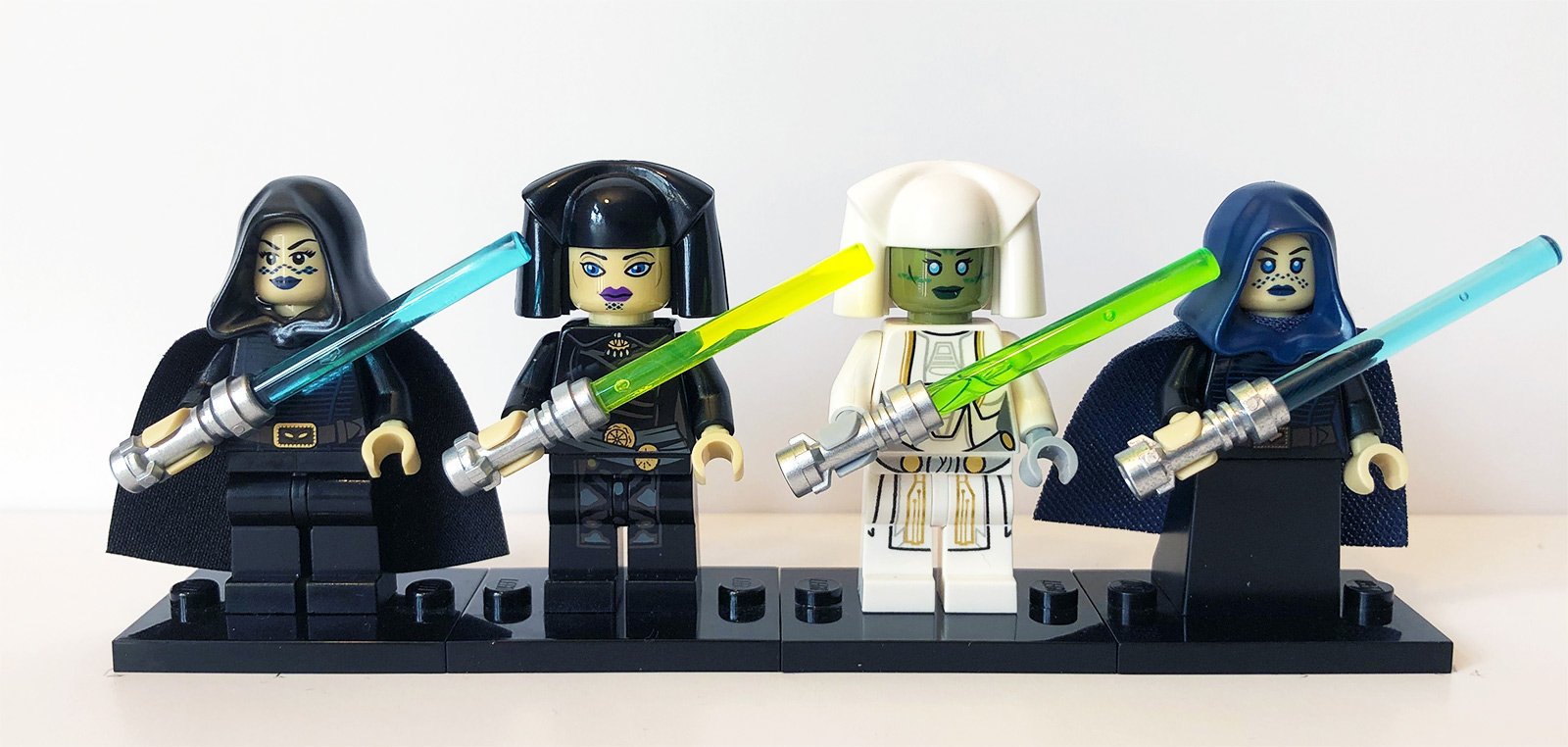
Mirialans were also introduced in the form of Jedi Master Luminara Unduli, but later we also saw her apprentice Barriss Offee and an unnamed Jedi Consular. Mirialans are very close to humans in appearance, but for their different range of skin colours and that they often tattoo their faces with a geometric pattern.
This species has the distinction of being the only one to be introduced as a light up lightsaber figure (I don’t own) where the facial tattoos were present and a new clothing element was introduced as an identifiable head garment (albeit stuck on). All future Mirialans up to 2018 have progressively introduced more detailed facial printing keeping the tattoos and sometimes reusing the ‘hat’ element as a further identifier of the species.
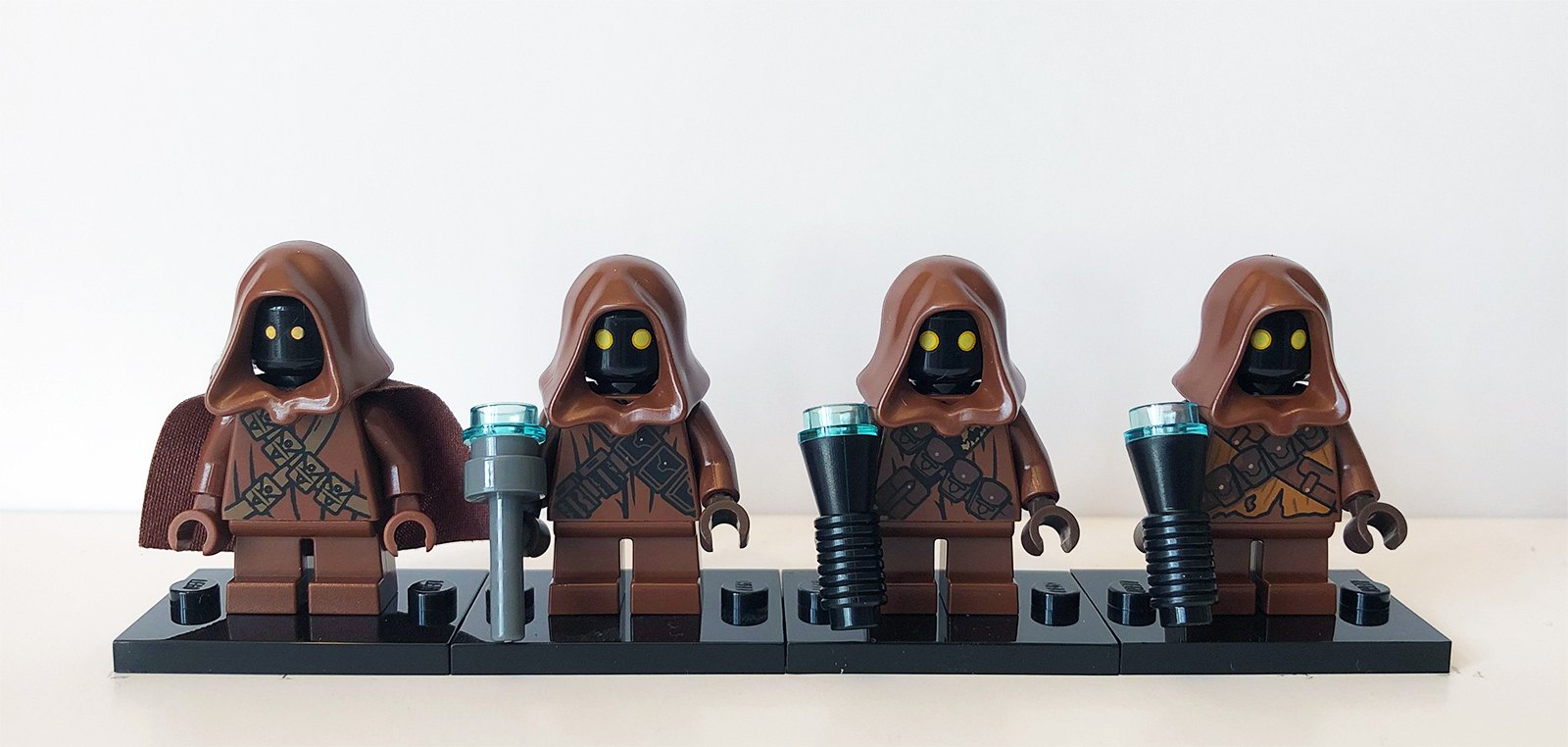
Jawas were also introduced in 2005, and they struck a very good likeness from the beginning. Little is known about what they look like beneath their robes and hoods, so we know them primarily for their tatty robes and bright yellow round eyes.
The original minifigs printed these eyes at a fairly small scale on a black head, which when combined with a hood and short legs for their small stature made them feel very accurate. Future versions from 2014 & 2018 removed the cape and also printed eyes that seem slightly too big in comparison (see above).

Read the article in full here.
Please support Jedi News by purchasing your LEGO here for the UK, USA and Canada.