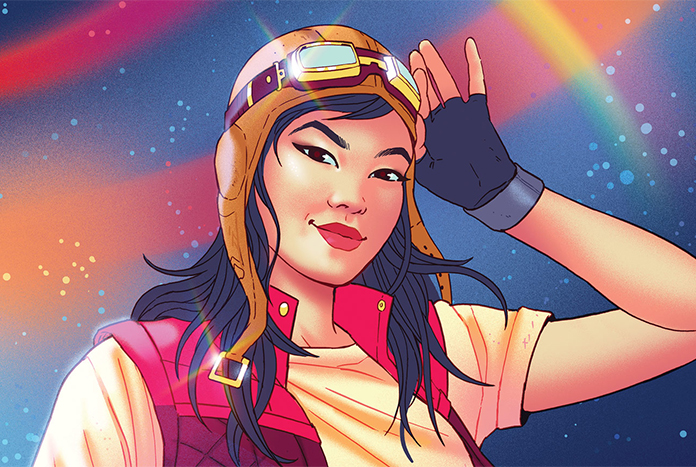
Pride Month may have ended, but that there’s always time to hear from Kieron Gillen and Alyssa Wong as they discuss the impact of Doctor Aphra, one of Star Wars’ most popular queer characters, as well as their own journeys at StarWars.com.
Here’s an extract from the interview conducted by Bria LaVorgna.
StarWars.com: Kieron, I know you just said you don’t really plan for the future, but when you first started writing Aphra, was the intent always that she was going to be a lesbian or is that something you sort of learned about her along the way as you kept writing?
Kieron Gillen: That’s what we learned. All I really knew about [Aphra’s] sexuality was, “She doesn’t want to sleep with Vader.” That isn’t what her relationship’s like. I know there’s a lot of people who like Aphra who may disagree with me, but that was the core thing. No, it’s not that kind of relationship. It’s just not, and that was the building block for me of her.
It was actually adjacent [to what] Alyssa was saying; it seems more real when someone else does something. I always feel like that about work for hire. When it’s just you writing a character, there’s a sense of unreality to it. It’s like, Aphra didn’t feel as real as Vader or Luke or Han or anyone else because I was writing them, but then Jason [Aaron] took her over for an arc [in the monthly Star Warsseries], “Rebel Jail,” and then she became more real because she had a life outside of me. It was Jason who said, “I want to hint on a past relationship with Sana,” and I said, “Great, go for it!” And then, and from that moment, I know she’s a lesbian. That was immediate for me.
Why did I lean a lesbian rather than bisexual? That’s partially because I just think I’ve made more bisexual [characters]. Maybe it was that simple. [Alyssa laughs.] There’s a bit in my brain as a creator, like, what have I done more of? [Laughs.] Speaking as somebody [who’s], you know, bisexual himself, obviously I’m very pro bisexual visibility. I’d be very self-defeating if I wasn’t, but it just seemed right, I guess. I quite like the fact that immediately means, “Oh, she’s not going to go into a romance with Luke or Han or any of those.” Her relationship is, by definition, defined to be different and that felt quite useful to take off the table. That was kind of subconscious and she just always seemed more of a lesbian. I don’t want to almost over-intellectualize it. She just seemed like a lesbian to me. That was just it.
StarWars.com: I think the phrase we used the last time we talked was she’s a total disaster lesbian.
Kieron Gillen: Oh, yeah, yeah, absolutely. [Laughs.]
StarWars.com: Nothing else fits her better than that. Alyssa, what did it mean to you on a personal level when you got to be the writer for the team relaunching Aphra in 2020?
Alyssa Wong: Marvel contacted me in 2019. I was still working in games at the time, and they were like, “Hey, do you want do this?” This is my first solo series, which was pretty wild. As a kid, my favorite character was Han, but I’ve always thought, “I like this dude. He’s fun, he’s a mess, but he’s also a little bit too clean for me.”
StarWars.com: [Laughs.] I don’t think anyone’s ever described Han as too clean before.
Kieron Gillen: He’s scruffy. Famously so.
Alyssa Wong: He’s scruffy! He’s canonically a scruffy nerf herder, but I don’t know. I feel like he cleans up nice. Also, my one Star Wars cosplay is a Han cosplay. But I was always like, I’m clearly someone dressed as Han, you know? I don’t look like Han. But I appreciate the bad vibes of Han. [Laughs.]
Getting to write Aphra was great because I was like, “Oh, this gets me everything that I want. I get my disaster queer folks. I get to write an Asian lead, which is dope.” Having Aphra as the main character opened a lot of doors for me because it meant that I didn’t have to ask for permission to have queer characters in a story, which has always been the case when I worked in other IPs and I’ve always hit a “no.” I was like, “Oh, this time I don’t have to ask.” Here’s my default. I’m building a group around this person and her exes, so this is perfect. When I write that team, everybody’s queer. In some ways, kind of by default. I’m just like… why not?
Kieron Gillen: It’s one of those things that just, immediately, you get to define like, the mathematics. Alyssa’s describing something slightly different, but the basic mathematics of writing a story are like, okay, I need a love interest. If our lead is a lesbian, it has to be a woman and that means she has to be queer as well, you know? And suddenly you’ve got two queer characters. And just the way everything — one decision of this is the lead character, everything goes out from that.
When we were doing Aphra and came up with love-interest Tolvan, I wanted to do Out of Sight. The slightly stern marshal with the charismatic criminal, but I want to do it lesbian, you know? And I was slightly jealous of Si [Spurrier], who got to write the kiss, because that was always the plan — the long, slow burn. But you know what I mean? Like, suddenly, “Oh no, I need a love interest and that means she must be interested in Aphra,” and it kind of [goes from there]. As Alyssa was saying, the second you’ve got one queer character, you’ve ultimately answered the question “Can you?” On Young Avengers, the opening scene is a character waking up from a one-night stand and it’s not a queer scene, but there’s lots of queerness in Young Avengers and it was, I’ll write the scene and if I get told, no, I’ll just quit the book and I won’t do it. It was explicitly me testing the wall. Can I get away with this? If not, I don’t want to do it. And I think occasionally that’s worthwhile as a creator.
Alyssa Wong: No, I super agree. I feel like I had a number of those kind of moments, too, where I thought, “This moment or character is really important to me. I’m going to put them in and we’ll see how this goes over. And based on that, I’ll find out how the team is going to treat me as a creator — and treat me as a person.”
I’m glad that Lucasfilm has been so willing to roll with my crazy ideas. I got to write a handsome, rogueish pansexual dude, which was fantastic, super fun. And he’s Southeast Asian! We just don’t really see that very often in mainstream American media. I got to write a trans nonbinary character who, obviously, is very important to me. I keep saying “I can’t believe people let me get away with this,” but really, I’m just happy that I’ve been so supported by everybody on the creative side.
StarWars.com: That’s awesome because one of the things I was going to ask, Kieron, is if there was any pushback. Because with my recollections of reading that Vader run, there was a little bit of a hint here, and then there was a more obvious moment, and there were lots of us who were like, “Oh, I see what you’re doing there.” I remember getting pushback about it from other fans and kept saying, “No, that’s an exes moment.” And we kept getting pushback up until we got to the moment where you guys had Papa Aphra being like, “Chelli, you got terrible taste in women.” [Laughs.]
Kieron Gillen: [Laughs.] Obviously, I didn’t write the “Rebel Jail” stories. We probably have to ask Jason what he was doing or whether there was any pushback around there, but not really. The bit I remember, particularly that scene, was that, “Oh, we just established they don’t really have homophobia in the same way in the Star Wars universe.” That’s literally what that scene establishes. Like, it’s just not the deal that it is on Earth. Of course, there’s so many things which are a deal in the same way in the Star Wars universe. [Laughs.] So that’s why conversations around representation always change a little. They become about just being part of the world rather than actually seeing yourself in this world, rather than, actually, an accurate map of your experiences. But at the same time, it’s very important that people can see themselves in the world.
Rewinding, no, I didn’t. They’re always really supportive. I can’t think of any time I really got pushed back. At the same time, like Alyssa was saying, a lot of it is trying to write to the boundaries. You don’t assume you can’t do something. I’d rather write something and be told no. I genuinely can’t think of a time I wrote beyond what Lucas[film] was comfortable with, but broadly, when there was a problem, you would be [told] yes, but; as in you can’t do this, but you can do that. That’s the grown-up, conversational way of doing things.
StarWars.com: You mentioned something I want to go back to, about how there’s not really homophobia in the Star Wars universe. And I think it’s fair to say in both of our countries right now…
Kieron Gillen: Not true on Earth, is it?
StarWars.com: It seems like there’s increased resurgence in hatred, in terms of both what people are saying and laws that are being passed against the LGBTQIA+ community. Is it freeing to be able to write queer people where you’re like, “No, they just get to be themselves”?
Alyssa Wong: Yeah, for sure. Writing Aphra feels like a celebration of queer people and our friendships and enmities and relationships of all kinds. It’s really refreshing. It’s been my happy place in a pretty dark time. When I write an Aphrascript, I want to share the immense feelings of love and support that I have for my friends, you know? It always makes me happy because, like I said, I’m working with an amazing team. It’s that incredible feeling of getting to create work with people who support you on a very deep level as a person and a creator. It’s a level of affirmation that I just don’t think I’ve ever had before. It just feels very special. I want to give back as much as I can in the stories that I make because I want other people to feel that level of support and affirmation, especially if they’re not getting it in other areas of their life. It’s a really stressful time.
StarWars.com: Little bit.
Kieron Gillen: There’s a difference between a queer story and a story featuring queer characters. In [the Star Wars] universe, it becomes stories about queer characters because you’re not really representing the realities of queerness in any way. Instead, it’s a story that speaks to the incredible power of seeing people like you doing cool stuff. Representation, that’s the one power.
And the second is actually, I think diversity, in the widest sense, is also powerful for other people than the group being represented. Because I remember growing up in Stafford. England’s still a really white country now and was moreso then, and Stafford especially so. Having seen people other than stereotypes in shows was incredibly powerful, and your hero figures being people unlike you, as well. I think it’s really important to have hero figures other than the people of the group you’re in, as well. Of course, this is what people in minority groups have always had to do. “Oh, I like this character,” because they’ve got no option. But like, people in other groups who have been more present in culture, it’s really good for you to have hero figures unlike yourself. Like, some random, straight boy goes, “I love Aphra!” Great! Your hero is now this Asian lesbian. I felt this with the sequel trilogy in terms of Rey. Forget what adults think — there’s going to be a generation of five- or six-year-olds who are going to love Rey, and then they grow up with a hero figure being this girl with a lightsaber, and that’s powerful. The idea that people other than you can be aspirational in all sorts of ways, both as yourself and as other people. And I’ve gone down about four holes here.
Alyssa Wong: I also love Rey.


Read the interview in full here.