



There are more than 10,000 available mental health apps nowadays. Only a few are of high quality and try to bring actual value to the users. We believe that choosing the right mental health app involves looking at the experiences of other users. And we want to contribute by reviewing Breeze Wellbeing.
The Breeze app has quickly gained attention and achieved 15 million downloads in just five years. While we see the results in rankings of an average of 4.0 across different platforms, how can we be sure that Breeze is one of those apps that can bring real value to the user? Let’s look at the features of Breeze Wellbeing and users’ feedback. We will also explain for whom this app may work and what it will cost.
Overview of Breeze Wellbeing’s Features
What we noticed about mental health apps is that they usually focus on one feature and try to perfect it. While this approach has its benefits, it means that if users want more than meditation or journaling, they should download multiple apps. This may be uncomfortable.
Breeze chose another strategy. Breeze Mental Health, at the moment, offers at least six features (what we counted):
- Self-discovery tests
- Journaling
- Mood tracker
- Mood analytics
- Meditation
- Relaxing Games
Let’s take a closer look at what each of them presents.
Journaling
Journaling has three types:
- Foster gratitude. Example questions:
- Who has brightened your day?
- What are 3 small joys that lifted your mood today?
- What did you achieve today that made you feel good about yourself?
- Calm anxiety. Questions, for example:
- I feel anxious when…
- How does your body feel at the moment?
- What immediate self-care steps can you take at the moment?
- Release worry. Common questions include:
- What was today’s top distressing moment?
- How did you handle today’s stressful situation?
- What is the one thing you will do today to unwind?
Expressive writing is often recommended by therapists as a way to release emotions and look at the situation from a different perspective. In the Breeze app, journaling has its advantages: it adjusts based on your entries and tracked mood. So, the questions are not random, and they can make a user feel seen.
Mood Tracker
The mood tracker lets you record emotions throughout the day. In the Breeze app, you can choose the overall mood of the day, how you can describe your feelings (you can choose from a list), what activities you have been up to (select from the list), and what photo describes your day (optional).
Using a mood tracker can be a helpful way to learn about yourself. However, in Breeze Wellbeing, it serves as an entry point to journaling. Since journaling may be overwhelming, a mood tracker is a simple version of it: you still reflect on your day, but with slight support from the app.
Mood Analytics
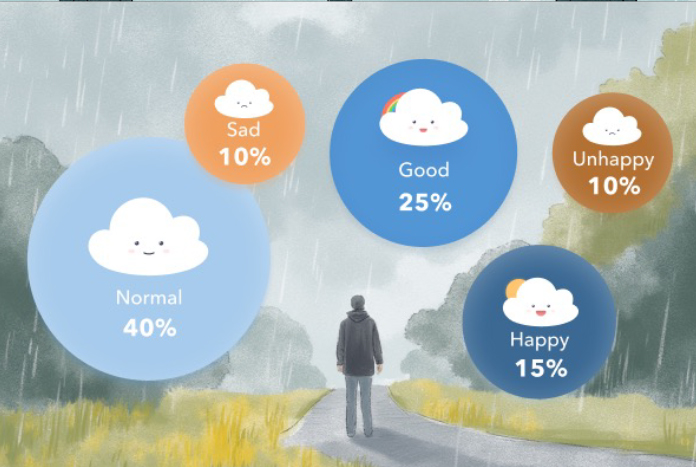
Mood analytics is a continuation of the mood tracker. The more a user fills out their mood tracker, the more accurate the data they will get in mood analytics. Mood analytics in Breeze Wellbeing shows long-term patterns, such as how many days you’ve been down or what you did on the days when you felt good.
What our editorial team finds most useful is that with mood analytics, you save memories. It’s easy to overlook certain emotions (some of them we try to forget on purpose). But if you save memories and have the possibility to review them, you learn from the past better. Eventually, it helps to make better decisions for your own sake.
Self-Discovery Tests
One of Breeze’s most unique offerings is its library of over 30 short, evidence-based self-discovery tests. We haven’t found a single app that competes with Breeze in both the quantity and quality of its tests.
The most popular choices are:
- Childhood experiences (based on the Adverse Childhood Experiences framework)
- Emotional intelligence (based on the Mayer-Salovey-Caruso Emotional Intelligence Test)
- Love languages (based on Gary Chapman’s theory)
- ADHD (based on The Adult ADHD Self-Reporting Scale)
- Neurodivergency (based on DSM-5 diagnostic criteria for Autism Spectrum Disorders, ADHD, and Highly Sensitive Person Scale)
Tests are visually engaging and take just 5-15 minutes. After completing them, you receive a breakdown of your results plus practical suggestions.
Relaxing Games
Adults were made to believe that video games are overstimulating and bad for mental health. Of course, it can be true, but refusing a whole spectrum of possibilities because of a few bad sheep is not the best approach. Relaxing games in the Breeze app are actually relaxing: not stimulating, but engaging.
All three of them are available on a free subscription and can also be used as a non-overwhelming background noise for when you work or try to concentrate.
Meditation and Relaxing Sounds
Meditation and relaxing sounds are part of Breeze’s relaxing games. Calming Waters offers background noises of water, with the possibility to play music as well.
The highlight for our editorial team was the Mindful Breathing feature. It navigates a user, even a beginner, through meditation. It shows when to breathe in and out, gives engaging visuals, and also plays an almost cosmic melody to relax to.
Breeze Wellbeing Reviews: Good and Bad
One of the best ways to decide whether to try an app is by listening to real users. Breeze Wellbeing has a mix of good feedback and constructive criticism. Read this before you commit to purchasing a paid subscription.
- User-friendly design.
What we noticed a lot in Breeze Wellbeing’s reviews is that people like the app’s design. They call it camling, good for beginners, consistent, and reactive. This review of Breeze Wellbeing’s user from the App Store:
“Just got this app, so far so good. The tests I’ve taken have been consistent with others — as they should be. Breeze has a very user-friendly setup and clear, quick testing, which is always a plus!”
- Breeze as a safe personal space.
Since the Breeze app values users’ privacy, they try to make their space as cozy and supportive as possible. The users notice this and feel so confident about the safety of their emotions there, they write reviews like this:
“Very helpful to have my own personal space for my thoughts and emotions.”
- Opening bottled-up emotions.
One green flag for mental health apps is when users share their fragility. One user shared a moving story of feeling distant from their emotions, but feeling the change after trying Breeze:
“I do find myself drawn to express my feelings and mentality. This caught my interest straight away, I love that finally I’m taking some steps to get to know more about myself and what this life journey has to offer to my inner soul and healing.”
- Subscription issues.
No app is perfect. The most frequent negative for Breeze Wellbeing is directed towards issues/misunderstandings of a subscription. As one person noted:
“A nice service with flexible and cheap payment! I did have a bit of a problem with the payment as did others, but the support team was super helpful and nice, refunding me almost immediately.”
As it turns out, the service team of the Breeze app is one of their benefits as well. Based on Trustpilot reviews, they quickly react to the requests, especially subscription-related. Here’s a user’s feedback to confirm that:
“Excellent customer service, which is rare these days. I accidentally activated a subscription, and they promptly refunded me and even followed up to make sure everything was okay. Friendly and professional.”
- Not enough depth for certain users.
Some users shared that Breeze’s features didn’t feel deep enough for them. We noticed such a complaint among people who claimed to be in a prolonged therapy, such as this one:
“Breeze isn’t too bad — but I’ll admit, I was probably expecting a bit more. Having been in therapy for over a decade, I find myself needing deeper, more advanced tools.”
This is not a surprise because advanced therapy users are familiar with a lot of features Breeze Wellbeing offers: insights from self-discovery, coping techniques, or relaxation.
- Costly subscription.
One common critique is the price. Money is always a topic of debate among people. But some reviews show that Breeze Wellbeing turned out to be more expensive than users expected:
“I actually really like the vibe of the app. But the subscription price feels too high for what you get. I’d probably stick around if there was a more affordable plan or one-time purchase option.”
You should always consider the price before trying Breeze. Although the free version does offer essential helpful features, the paid version offers a completely different, better experience. We will break the price down in the next section.
Cost of Breeze Wellbeing in Comparison
Common questions people ask before downloading a mental health app is anything price-related. Breeze Wellbeing costs on average $30 per month, but they also offer weekly and yearly subscription options. Let’s compare the prices of Breeze Wellbeing and other mental health apps (all prices are for monthly subscriptions):
- Breeze Wellbeing – $30, journaling, quizzes, mood tracker & analytics.
- Calm – $13, mostly focused on meditation and white noise for sleep.
- Headspace – $12, breathwork practices.
- WorryWatch – $3, only offers journaling.
- Moodlift – $30, limited to mood tracking.
As we can see, other mental health apps are indeed cheaper, but we should also consider what they offer. For $30, Breeze Wellbeing offers all the features of other apps combined. So, if you are interested in 2+ features and decide not to download multiple apps, you already save money by subscribing to Breeze.
Who Should Try Breeze
Breeze Wellbeing isn’t designed to replace therapy. But if you wonder if you should try Breeze, here’s who we think will benefit the most from this app:
- People who need extra support between therapy sessions.
- Those who can’t yet start therapy. Whether the reasons are costs, access, or if you’re not ready just yet.
- Anyone curious about self-discovery. If you feel like there’s something in you that you don’t understand or can’t explain, either journaling or quizzes can help you bring those topics from subconsciousness to consciousness.
- Busy people, overwhelmed by responsibilities. For those who need a healthy form of escapism.
- Individuals who want to take better care of themselves.
Who Should Not Try Breeze
No matter how inclusive every mental health app wants to be, there are always people who should carefully approach such mental health interventions. Yes, Breeze Wellbeing is very gentle, but certain groups of people should proceed with the app with caution:
- People experiencing persistent symptoms of depression, anxiety, dissociation, panic attacks, etc. It’s highly advisable to speak to a licensed professional, especially if symptoms don’t become lighter for a month or more.
- People who are already in treatment for diagnosed mental health conditions. The Breeze app can complement therapy, but any new self-help tool should be discussed with your clinician first.
- Children and teenagers without adult supervision.
- Those looking for clinical-level support. If you expect in-depth therapeutic techniques or crisis intervention, Breeze is not the way to go. It doesn’t take responsibility for your mental state.