



On Hoth, a snowspeeder brings down an AT-AT by wrapping a tow cable around its legs. In Star Wars: Fall of the Empire, that maneuver becomes a spiral-ramp shot. The ball follows a route through the machine, and the film supplies its meaning. Stern’s table turns recognizable moments from the original trilogy into objectives, giving players a physical action that stands for something happening in the story.
The Ball, the Target, and the Film Scene
Pinball has its own vocabulary before a film theme enters the picture. Bumpers change the ball’s direction, ramps carry it through the playfield, and targets provide objectives. Their shapes and positions give the player different places to aim. A movie adaptation can assign those elements a fictional purpose, linking the physical journey of the ball to an event beyond the cabinet.
That vocabulary also appears in pinball-inspired online arcade games, including the casino title Lucky Pinball 777. There, pinball elements provide a familiar presentation within a digital casino format, allowing players to engage with a much-loved game in a digital setting. Stern’s separate physical table develops the relationship between movement and theme through specific Star Wars scenes. Its ramp objectives connect the ball’s route to actions associated with a snowspeeder or the Millennium Falcon. The identity of the scene comes from the task assigned to the shot.
Hoth Becomes a Spiral Ramp
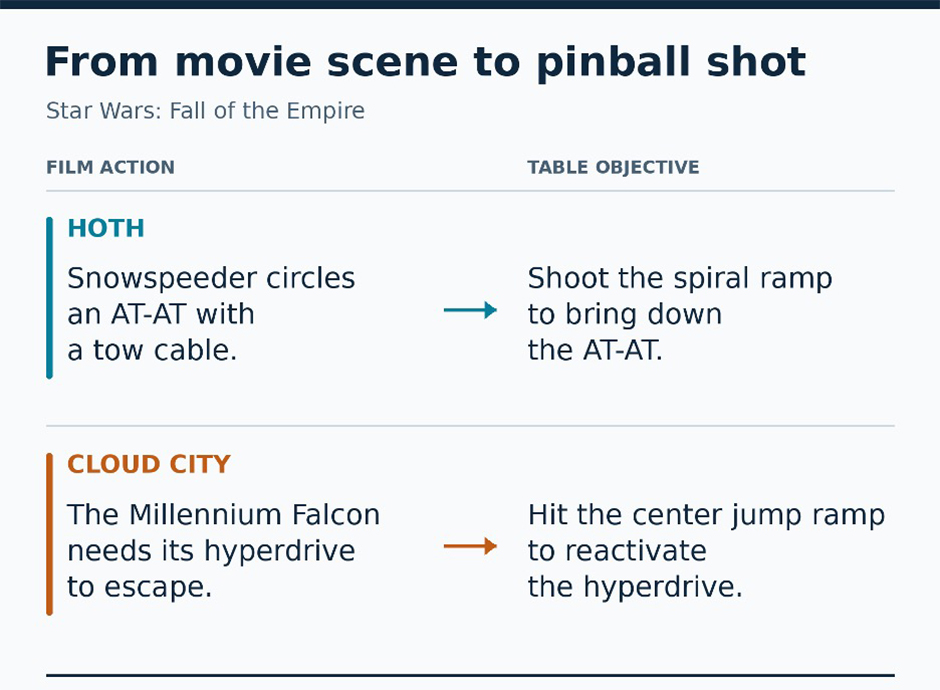
In its September 2025 announcement, Stern describes attaching the snowspeeder’s tow cable and shooting the spiral ramp to bring down the AT-AT. The curling path gives the objective a relationship to the movement it represents. The Empire Strikes Back supplies the maneuver; the machine gives it a route that can be reached with a ball.
The film follows an aircraft circling a much larger vehicle across an open battlefield. The table compresses that action into the dimensions of a playfield. It does not need to reproduce the relative sizes of the snowspeeder and walker for the correspondence to hold. The curve of the ramp carries the aircraft’s essential circling movement, while the named objective identifies why the player is making that shot.
Watching the scene and playing its adaptation also involve different kinds of participation. The film presents the maneuver through a fixed sequence of images. The table makes aiming at the associated route part of the player’s task.
Escape and Attack Need Different Objectives
Cloud City uses a different correspondence. Stern describes reactivating the Millennium Falcon’s hyperdrive by hitting the center jump ramp. Here, the shot represents the action that enables escape. The connection comes from what reaching the ramp accomplishes within the fiction, without requiring the ball to trace the Falcon’s complete flight.
That distinction leaves room for different kinds of adaptation on one table. Hoth provides a recognizable maneuver. Cloud City provides an objective associated with getting away. A ramp remains a physical route, but the event attached to it changes its purpose within the story.
Stern also gives the destruction of the second Death Star a separate treatment. During Death Star Multiball, lowering the battle station’s shields forms part of the objective. Multiball means having multiple balls in play simultaneously, so the battle is expressed through a particular playing condition as well as a named task. This connects Return of the Jedi to the table through the structure of an encounter, extending the approach beyond a single movement or escape shot.
When the Force Acts on the Ball
The physical adaptation can also affect the ball directly. In AIPT’s CES demonstration report, Gary Catig describes Yoda using the Force, represented by a magnet, to save a ball from entering the drain, the opening where it would leave play.
In this demonstration, a character’s power supplies the fictional explanation for a mechanical intervention. The relationship is immediately different from the ramp objectives: the ball’s rescue represents help arriving within the Star Wars world. The table uses Yoda’s identity to give that physical effect a story role, bringing a familiar idea into play without recreating an entire scene around it.
Designing for the Film and the Playfield
In the CES interview, Stern CEO Seth Davis describes designers combining their pinball knowledge with a close understanding of the franchise. He says the teams often begin as pop culture fans, then develop a deeper familiarity with the material while working on the game. His account connects the choice of a theme to the detailed work of understanding what its characters and stories can contribute to pinball.
Stern’s launch announcement also describes hand-drawn artwork, together with music from the films, and reports incorporating more than 1,000 film and audio assets. Those materials give the adaptation a connection to the films beyond the physical layout. The table combines material associated with the movies with elements created for the game, so recognition can come through its sound and visual presentation as well as its objectives.
C-3PO adds his voice to the action. In Catig’s CES report, the droid narrates the action through dialogue recorded for the game. Stern credits Chris Bartlett with the custom C-3PO callouts, the short spoken lines accompanying play. A familiar character is present through material created for this adaptation, alongside the film images and music. His narration connects the action on the table with the adventure it represents. Across the machine, Star Wars provides specific events and characters that acquire a playable purpose. A completed shot can stand for a recognizable achievement within the Star Wars world, allowing the player to take part through the ball’s movement around the playfield.