Before the dark times, before, well, everything! The late eighties and early nineties are referred to as the dark times for Star Wars fans. There were no movies, no television shows, nothing directly from Lucasfilm coming out for a galaxy far, far away. But that isn’t to say that there weren’t new stories, new experiences fans could have to widen their knowledge of the Star Wars universe. Books, comics and games all gave fans more of what they wanted and for one, loved every moment. The books really felt like Star Wars. Were they all good? Of course not, they were very hit and miss at times, as with all things, but the spirit of the films, of the characters was always there. There was this grand timeline that worked (mostly) together with all the different mediums that were releasing Star Wars. There was no need for alternate timelines because everything worked as one.
The books from this timeline are now known as ‘Legends’ and yet, there is something that is so special about these books, for me, they will always be my Star Wars. They are the books I read growing up, the Star Wars that helped me to celebrate my fandom and my gateway to escapism. The books might be called dated, but only because they were the ones to branch out the knowledge of what we know now. They were the pioneers of creating new lore which we just assume is well known thirty years later.
So why when reviewing a book am I taking a fond look back at the books that have been? At the start of May, a paperback book was released on Amazon using their print on demand service. A book that was a long, lost Star Wars book from the very early nineties, one that should have been released after the original Thrawn trilogy by Timothy Zahn. This book is The Heart of the Jedi by Kenneth C. Flint. It has actually been available to read for some years on www.starwarstimeline.net but this is the first time it had been published as a hard copy. Of course, the book was taken down quite quickly by Amazon, and is now selling for rather large sums on marketplace websites.

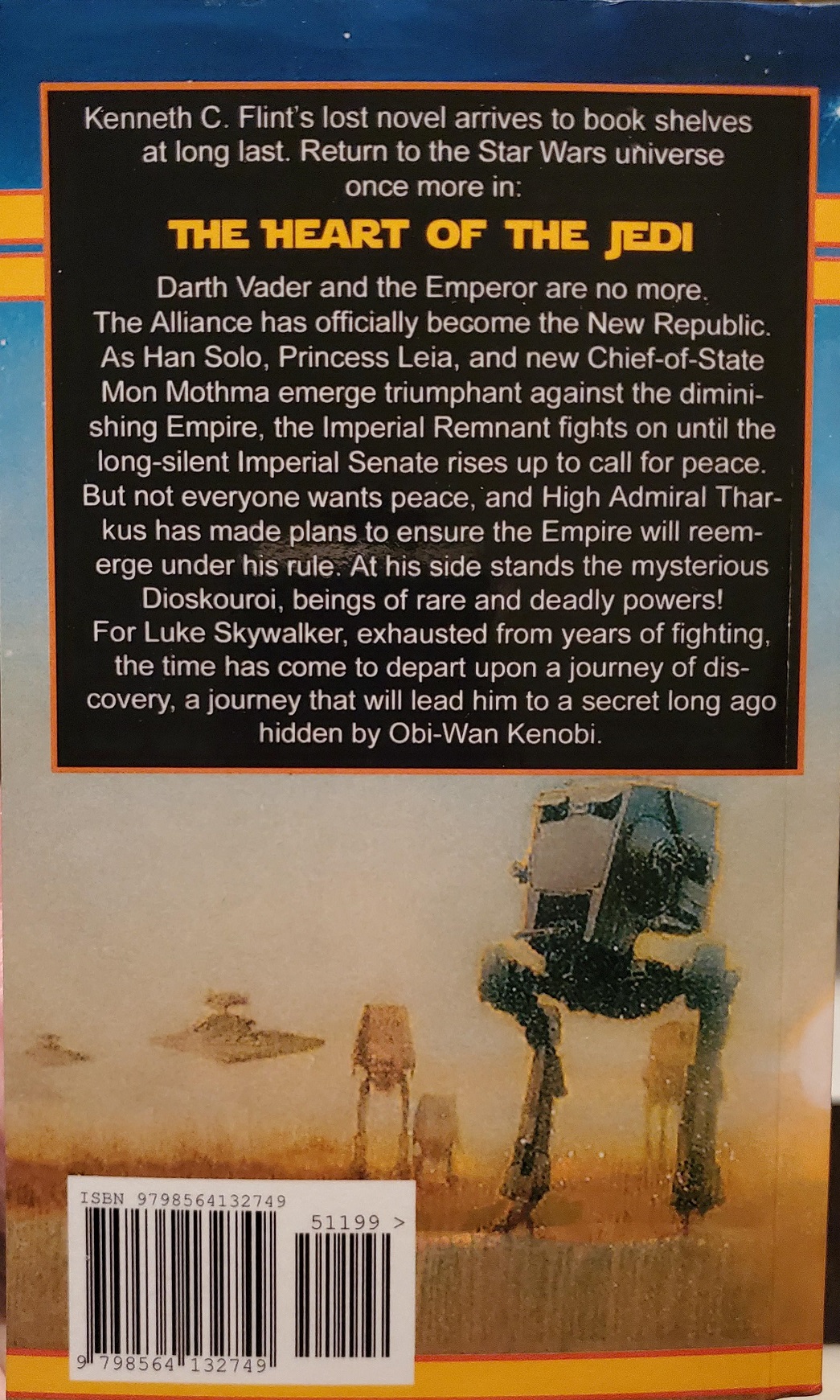
I was fortunate to obtain a copy from Amazon before it was taken down. I didn’t realise just how special this book would be. Before I look at the actual writing and story, I wanted to share the sheer joy that came over me when I received the book in the post. Upon opening, it was like being transported to my younger self. A paperback book that had travelled in time. This looked exactly like a Star Wars book from the nineties, from the spine, the layout, the design, it all fit in perfectly with my collection. It is hard to describe what that feels like so many years on, but it was a truly special moment. The pages aren’t of the old quality, feeling far superior, but I didn’t mind, that cover alone was worth the price of admission.
So, the book itself, is it worth the hype? The story takes a lot of what had come in the movies and turned it on its head. The opening scene is perfect example of this. Instead of the Imperials chasing a Rebel ship, we have the Imperials being chased by the Rebels in a Mon Calamari starship. Breaking through are our heroes who are having to play tidy up on the galaxy. From the first moments, it feels like Star Wars, but Flint has changed things to show the progress that has happened since Return of the Jedi.
The main focus of the story is Luke as he struggles to deal with his place in the galaxy. It is certainly the strongest and most compelling part of the story. Luke is not sure if he should be a Jedi, whether it is right for him to try and bring them back. This doubt follows Luke around as he tries to find clues to locate the ‘heart of the Jedi’ and sees Luke returning to Tatooine. In the old Legends, Tatooine, a planet of little fame, seemed to get mentioned far too much. Yet here, Flint utilises it perfectly, it’s there for Luke’s past. It doesn’t feel like it could be any other planet. Flint uses it to show us more of Luke’s past, of his upbringing. We get to actually see Luke’s bedroom; of the hardship it takes on a child living so far from civilisation. It is little details like this that really make the book an interesting read. The repetition of A New Hope is very noticeable, but Flint uses it as a way of showing us just how far Luke has grown since that first film. It doesn’t feel like a cheap move but one to make it very clear how far Luke has come from the optimistic youth who could change the galaxy.
The Tusken Raiders are expanded far more here, with Flint providing more depth and history. It makes them far more like Native Americans, the wronged party who are just trying to survive. Fans would be far more sympathetic to their plight reading this. There are also foundations placed here for further stories and part of me was a little disappointed that some of these threads would never get followed up.
Luke also meets up with an ewok captain at one point, a plot point that I think works really well. At first, I thought it be too far of a stretch, yet when thinking back on it, it was a pleasant experience to have an ewok in the galaxy. Why shouldn’t there be? It linked the book to the films quite nicely, particularly as they’re all but ignored in future books. This is something Flint does do well, the links of other parts of the franchise. When this was written, there wouldn’t be much, but reading it now, a lot of those links don’t usually crop up in other books. Mentions of Han’s exploits in the original Marvel series riding sea dragons, mentions of the Wizards of the Night Spirits from the Ewoks animation and Life Day from The Holiday Special can all be found in here. For newer fans, these references might completely bypass them, yet for older fans these little nods are wonderful to read.
One aspect that I have found very intriguing in Luke’s journey is when he encounters the Children of the Force. A group of pacifists trying to protect the environments of lost planets and cultures. They don’t want any part of the war. It’s contrasted well with Luke he starts to get pulled in by wanting to see the galaxy, by the material things in the galaxy, rather than the spiritual. If there is one message that is prevalent in the book it is this. What is more important, power or spiritual peace, material possessions or spiritual harmony? It reoccurs again and again, that even those who are trying to do right will get corrupted by power. Luke has to decide if sacrificing his freedom for his path as a Jedi is worth it. With the Children, it seems very topical of sacrificing material wealth for protecting the environment. Even thirty years on, this book still has relevance in our world.
As well as Luke, we have the journey of Han and Leia. This obvious split shows how Flint also follows the structure of The Empire Strikes Back. Our heroes start the book together, working to free the galaxy of the last vestiges of the Empire, but then Luke follows his path of the Force, and Leia and Han one that brings them up against the Empire. Again, this isn’t a bad thing, yes there are lots of echoes of the three original films, but particularly when this was written, this was not a bad strategy to have. I liked seeing those same beats but taking our heroes in a different direction. Although a scene directly from Indiana Jones and The Last Crusade might have been a step too far.
The Han and Leia part of the story I found a lot less engaging than Luke’s part. For me, the biggest reason for this was the main villain, Thrakus. He seems like a very typical Imperial who wants to reunite and rule the Empire. And this is perhaps the problem, he is very typical. Having now been thirty years, we have seen too many Imperials like this. Now when this was written, this wouldn’t have been the case, let alone, the era that this book is set, it is squabbling Imperials fighting for control. So, Flint doesn’t do anything wrong with writing a typical Imperial, in fact it should be. But now years later, there needs something more in a villain. It makes these parts of the book a little taxing at time.
Han and Leia are also back to their love/hate relationship, in fact, it feels frequently like that they don’t have a relationship. We know with The Courtship of Princess Leia that the two become distant, but this seems far too much, too soon. I think I’m right in saying that this takes place a year or two after Return of the Jedi and when originally written, was supposed to be in place of The Truce at Bakura. If that is the case, I can’t believe this couple would fall out of love quite so quickly. It makes reading their parts a little frustrating. There are glimmers here, particularly focusing on Han. Han is like Luke, trying to find his place in the galaxy. He wants to fit in for the benefit of Leia, yet he is worried how he measures up to others and how his past affects how people see him. It’s a very vulnerable side to Han that is good to see.
The other thing to note here is that the story in its current state does need an editor. There are quite a few mistakes in terms of spelling and grammar. As it was never past the draft stage, this is understandable and thankfully the mistakes are quite easy to rectify by the reader. Moving between different characters in scenes was also slightly disjointed and came without any warning. This took me out of the story a little as I had to try and work out whose point of view Flint was describing. The end of each chapter is also quite abrupt, every time finishing mid scene, which felt very formulaic at times. Yet the biggest issue for me, was the very abrupt ending to the story and the lack of detail in parts of the story. I wanted a lot more for the ending, I wanted to see more when our heroes reunited and compared notes, I wanted to see the emotional aftermath on our characters, and I wanted to see where the story would be heading in the next book (that obviously wasn’t written). Equally, some scenes needed more description and more detail. As an unfinished book, this could be for any number of reasons, I imagine the biggest being the page count, which as it currently is, matches the length of most Star Wars books of the time.
So, is the book worth the hype? It is very difficult to separate this book from the nostalgia that is tied with it. Because it has been so long since we’ve had a ‘new’ Legends book, because the physical book is so traditionally designed and because this still fits in with the older canon this ticks a lot of boxes other books won’t. This book does have it flaws. It needs more detail in parts (particularly the ending), a stronger villain and a good dose of editing. Yet for all those negatives, I can’t help but say how much I enjoyed reading this book. The journey Luke goes on is a fascinating read, to go back and see the memories Luke has is worth the price of admission alone (although you might want to fast forward past Artoo washing Luke’s back when having a bath, I don’t think I can unsee it). And yes, it did take me back to my younger days, to a version of the galaxy that I still prefer to the current one. Opening that package and seeing this capsule of time in my hands was so powerful that it makes me wish that we could have more moments like that as fans again. For newer fans, they might wonder why this book is getting so much attention, yet if you are a fan from the nineties like me, this book is worth your time, even if it’s just for taking one more stroll in the Legends timeline.