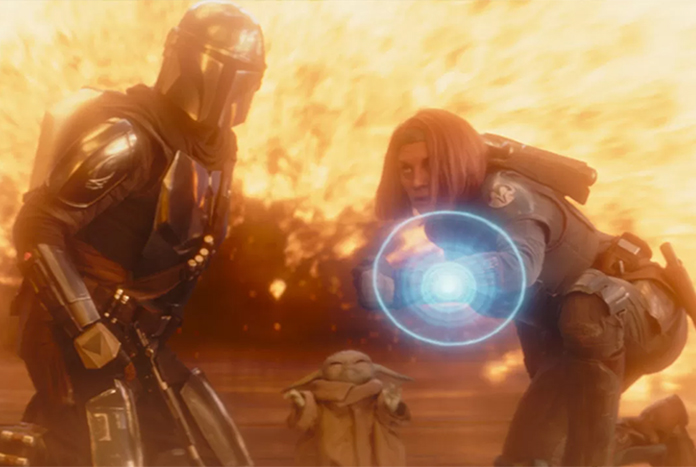
Grady Cofer, ILM Production VFX Supervisor, talks to Art of VFX about his return to Star Wars with the third season of The Mandalorian on Disney+.
What was your feeling to be back into this iconic universe?
This was my first season on the show. Richard Bluff was the production visual effects supervisor the first two seasons and did an amazing job. I feel quite lucky to have inherited this role on a show that does so many things right.
But though I am new to The Mandalorian, I am no stranger to Star Wars. I worked on Attack of the Clones and Revenge of the Sith for years in my early days at ILM. In fact, there are some environments this season that are direct callbacks to scenes I had contributed to in those prequels, like the Opera House on Coruscant.
To me, there’s really nothing like the Star Wars universe – its fantastic vistas and characters and grandness and depth. Like many in the VFX industry, Star Wars is the reason I do what I do. I saw that film as a child and knew I wanted a career in visual effects. So when I was asked to join the show, I jumped at the chance.
How was the collaboration with the showrunners and the directors?
Working with the creative team of Jon Favreau, Dave Filoni and Rick Fukuyama was a great experience. They have a crystal clear vision for the show. But they are also very receptive to your ideas and opinions. Often reviews felt more like being in a writer’s room, discussing character and tone.
Work is never shown in isolation. We would always watch shots in the context of the cut. And often the creative team was more interested in how well the new shots communicated an idea, or in how it would make the audience feel, versus the technical aspects of the shot.
That said, Jon has very high standards for visual effects and animation. He is a great partner in post, not only because he is a clever storyteller, and he keeps the work focused on supporting and enhancing that story experience, but also because he’s a bit of a fan of effects in general. He’s quite knowledgeable about various VFX techniques, and has great instincts about what works and what doesn’t.
Beyond collaborating with the showrunners, one of The Mandalorian’s many joys is the chance to work with a diverse slate of talented directors. Each of them comes with his or her own unique experience and aesthetic and point-of-view. I find working with creative artists, getting on their wavelength and helping them tell their stories, to be very rewarding.
What are the main changes they wanted to make since the previous season?
Perhaps the biggest change was the overall scope. This season was epic. The themes that Jon was exploring – redemption, rebirth, the unification of the entire Mandalorian family to retake their homeworld – these were big ideas, big stories. And they demanded that the visuals and the world building be taken to a new level.
The challenge was to do exactly that, while staying true to what makes The Mandalorian so special – pushing the visuals to new levels, while keeping it grounded. This is really the key to the show: aim for the highest level of computer graphics and animation, but then balance that with more traditional techniques – like practical creature effects, animatronics, model miniatures – all of those old-school tricks that add a bit of analogue into our digital world, and help the visuals feel more lived-in and handcrafted.
It’s great to be on a show that values both: cutting-edge technologies, as well as honoring the great effects traditions of the past.
How did you choose the various vendors?
We are lucky on this show: we get to work with a group of incredibly talented VFX houses, many of whom have been on the show since Season One. In addition, of course, to Industrial Light & Magic (ILM) who has led the visual effects on Star Wars for nearly half-a-century, we brought on Image Engine, Hybride, Important Looking Pirates (ILP), Ghost VFX, and many others that consistently delivered outstanding work year after year. And I feel like this season they went above and beyond.
Where were the various sequences of the series filmed?
We used a number of locations to help create this season’s diverse array of environments. The planet where we first find the Mandalorians in Episode One was based on Lake Powell. And the journey to rescue the Mandalorian boy from the Giant Eagle traveled over areas of Moab, Utah. We captured plates and stills from various areas to help build the enviros in 3D. Then the lakeside action was shot on our backlot.
For the dogfight over Kalevala, Andrew Jones, our great Production Designer, went to the Isle of Skye early on to scout it, and came back with these beautiful images. We knew immediately that this was the perfect backdrop for our scene.
We pre-vized the action, using Skye as our environment. Then we carefully broke down every shot into flight paths and created a detailed shot list. And then our aerial unit followed these paths in a helicopter, when that was feasible, or with camera drones, when the paths were too risky.
Shooting at this beautiful location, and capturing real vistas, helped elevate the action, while grounding it in reality.
Read the interview in full here, and watch the third season of The Mandalorian on Disney+ now.