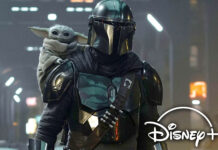
ILM’s VFX supervisor John Knoll has told IndieWire about how The Mandalorian and Grogu utilises practical and digital effects, along with computer-generated characters, such as Martin Scorsese as Ardennian Hugo Durant, alongside old-school techniques.
“‘Best tool for the job’ — that’s always been the credo for this show,” “Star Wars: The Mandalorian and Grogu” VFX supervisor John Knoll told IndieWire. “With the one twist being that [director] Jon [Favreau] really likes having a bit of a handcrafted look.” He’s worked on “Star Wars” movies as a visual effects supervisor dating back to “The Phantom Menace.”
The Favreau-directed sci-fi spectacle blends virtual production techniques with every trick in the Old-School Hollywood special-effects book. Knoll explained, “Jon’s philosophy is that it’s OK when you see a puppet, that you can tell it’s a puppet. When you have a character in a rubber mask, that’s OK. And if you’re looking at a miniature or a stop motion sequence, it’s OK that you can tell, because in Jon’s mind, that’s part of the charm.”
Knoll won an Emmy for his VFX work on Favreau’s “The Mandalorian” TV series, shot largely within a 110-foot-wide ellipsoid-shaped “LED Volume” in Manhattan Beach that generates digital environments by projecting high-resolution imagery onto wrap-around screens.
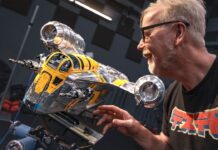
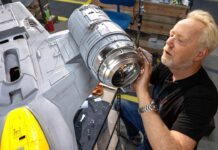
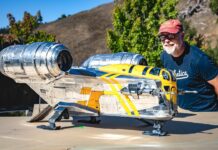
When Disney decided to expand the show as a standalone feature about intergalactic bounty hunter Din “Mando” Djarin (Pedro Pascal) and sidekick Grogu, aka Baby Yoda, Knoll went to work on their Razor Crest spaceship. He recalled, “From the beginning of the series, I’d wanted to have an LED volume for shooting miniatures in, so for this movie we built an 8-foot-by-8-foot LED cube, with one face open so we could get accurate reflections and realistic lighting on our characters and sets, in-camera. I had this gorgeous 48-inch model of the bare metal ship, so if we’re flying amongst clouds, we made sure that you’re seeing clouds reflected on the side of the ship. For the same reason, we would shoot Mando in the LED environment, instead of [in front of] blue screen, to get all those reflections on his highly polished armor.”
In collaboration with production animation supervisor Hal Hickel, who oversaw digital characters including Rotta the Hutt, and Legacy Effects puppeteers, in charge of Grogu, Knoll conjured a virtual travelogue of exotic planets that included the snow-capped mountains backdropping Mando and Grogu at the start of the film.
“We knew one thing: It’s mountainous with pine trees, so we did a bunch of scouting. Andrew Jones, our production designer, identified an area north of Vancouver called Mount Waddington as a real-world location we could base our environment on. My co-supervisor, Justin van der Lek, went up there and did a four-day helicopter scout-and-shoot, photographing thousands and thousands of stills. A lot of the imagery you see in that opening is Mount Waddington.”
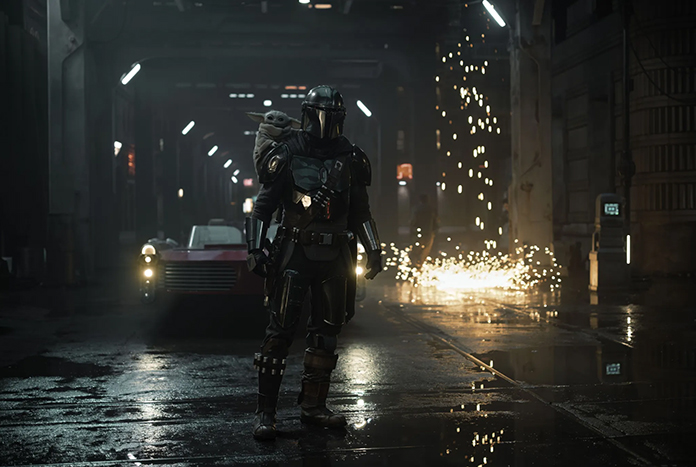
Other environments were built as massive physical sets, including the “Blade Runner”-like cityscape Shakari. “We found this big industrial warehouse in downtown LA and built the main drag there,” Knoll said. “We can see way off miles into the distance, and rather than put a blue screen at the end of that street for the [digital] extension, we built LED screens at both ends of that street, put in motion tracking cameras, and generated the extension of the street that way. It was a nice use [of LED volume] where it’s not a 110-foot diameter round set.”
In Shakari, Mando and Grogu meet the gregarious Hugo, a four-armed food truck vendor voiced by Martin Scorsese. Hugo was ultimately computer-generated, but during production, Knoll wanted a real actor to temporarily perform the role.
“When you’re doing synthetic characters, Hal and I strongly believe you should cast an actor to play that role on set if at all possible. It helps camera operators frame up, it helps the other actors to have somebody they can play against, and it helps the editors cut the scene. So we had Misty Rosas, who’s a little person, performing the Hugo role. We didn’t know that Marty was gonna do the voice until the whole scene had been shot and Jon did the deal. God bless him — Marty did a hilariously great performance with all that hemming and hawing. We had a camera on Marty while he was doing the voice, so our guys were able to incorporate some of his gestures and facial expressions.”
Read the article in full here, and see Star Wars: The Mandalorian and Grogu in cinemas and IMAX now.