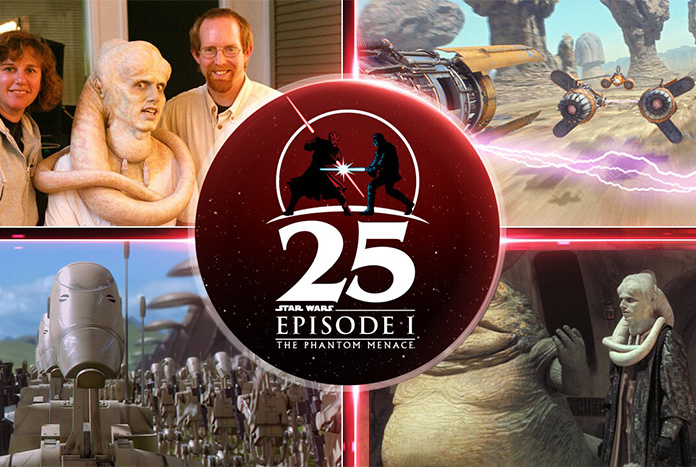
To celebrate the 25th anniversary of Star Wars: The Phantom Menace, StarWars.com presents “Phantom at 25,” a special series of interviews and editorials, with this entry talking to Skywalker Sound’s Matthew Wood on why this was his favorite movie to work on.
The first person to watch the initial assembly of Star Wars: The Phantom Menace (1999) wasn’t director George Lucas. It was then-25-year-old Matthew Wood of Skywalker Sound. As he tells StarWars.com, picture editors Ben Burtt and Paul Martin Smith had spent weeks with Lucas at Skywalker Ranch compiling the first rough version of Episode I. Hours long and far from the refined cut that audiences would see, it was up to Wood to review it and make notes about voices that needed recording.
“Paul and Ben ran out their sequences on video tapes for me,” Wood recalls, “and as I walked into their office, they were all stacked up really high on the table. George Lucas said, ‘Well, here you go, Matt. You’re the first person that’s going to watch the whole movie from beginning to end.’” George was obviously watching everything between the two editing rooms, but they hadn’t screened the movie in its entirety yet. This was the first output of the movie, and I had it in my hands. The Ranch has these bikes so we can ride between the buildings, and I put all the tapes in the front basket and rode back to the Tech Building.
“I got paranoid about security, not that anything could actually happen,” Wood continues, “but I sort of put something to block the door. This was the first time that someone had watched a new Star Wars movie since 1983, and I actually did call my mother and tell her what I was doing! It was several hours long with a lot of temp material. Even though I’d seen the designs and read the script, just seeing it was different. Everything was so new in this film. There was a lot to take in. There was no John Williams music and bluescreen everywhere. The movie was this new way of doing Star Wars, for sound and everything. I understood how big the project was and it lit a fire under me.”
By the time he began work on The Phantom Menace, Wood had already been with Lucasfilm for seven years, first as a tester with Lucasfilm Games when he was still a teenager, and then with Skywalker Sound. His interest in computer technology made him an ideal candidate for the team working on the SoundDroid, one of the first non-linear digital sound editing tools, which had been developed at Lucasfilm. The SoundDroid saw heavy use on the television series The Adventures of Young Indiana Jones (1992-96) and by the time of Lucasfilm’s feature production, Radioland Murders (1994), Skywalker Sound was beginning to use ProTools, another digital editor that remains an industry standard to this day.
ProTools would be used to cut sound for the new sequences in the Star Wars Special Edition, released in early 1997. It was during this period that Wood began to introduce Lucasfilm’s original sound designer, Ben Burtt, to the new digital workflow. “Film sound had been done the same way for decades, and any sort of adjustment would take a while for people to get used to,” Wood explains. “I tried to maintain that human component in teaching artists — who at that point might not have known how to use a computer at all — all of the basic steps to help them do their art with the new tools. We needed that blend. It wasn’t about just bringing a bunch of new computer people in. Ben was so eager to learn new things, and I think that’s why he took me under his wing. We had a great relationship of sharing technology and the creative process, and combining those things together.”
Initially, Burtt tasked Wood with digitizing the former’s original library of Star Wars sounds for use with a Synclavier, a digital synthesizer commonly used at the time. Burtt was not only the sound designer for The Phantom Menace, but a picture editor as well, and during that early stage he was busily shooting and cutting material for rough animatics of sequences like the podrace. Wood soon found himself fully enmeshed in the Star Wars production. “I was just pulled onto the project. There was no formal process. Once you were able to work with George and be a part of the team, you were set.
“One of the great things about developing at Skywalker Sound was that you weren’t pigeon-holed into one job,” Wood continues. “I had to know engineering, know timecode and video sync, computer programming, microphone technique, and so many other things. I learned a lot of that on the job, being in an environment where people are sharing information. Ben wore a ton of hats, and I just followed that. There was never an indication that I shouldn’t try doing new things.
“It was an absolute dream. It felt incredible to be a part of that process, but I never felt intimidated by it in the sense of ‘You shouldn’t be here.’ It was such a welcoming environment. George was a big part of that. He trusted everyone and showed his support where he could. That extended into the way we built out the team. The mindset was that we were working on an independent movie.” As Wood notes, it wasn’t until merchandise arrived from venues like Pizza Hat and Taco Bell that they remembered the global scale of the film they were working on. “You kind of lose sight of how big the movie is out in the world because you’re basically working on this independent movie with your friends. Skywalker Ranch made it feel that way. That was a funny reminder that this was going to be a big thing.”
Wood led the effort to organize Burtt’s massive collection of original sound recordings into a digital database that could be accessed at the click of a mouse, a level of access that was unusual if not unprecedented for the time. He also busied himself gathering new recordings for that very database. As Burtt had done years before, Wood took microphones into the field to capture cars, boats, planes, and animals.
“I went up to a racetrack here in Northern California,” Wood says. “It was this kind of place where you could just sign a release, no matter what kind of car you had, and go out there and race. They gave me full access, and I got so many amazing vehicles that became parts of Anakin and Sebulba’s pods, among others. There were so many different kinds of mufflers and engines.”
Bringing his recordings back to the Ranch, he’d then catalog them for Burtt, who applied his skills at manipulating them into unique sound designs. “I was really surprised by his ability to create something with a sound that I had thought wasn’t a successful recording,” Wood recalls. “He’d make something really cool out of a piece of it. I’d sit and watch him design and layer things together. He always brought in a touch of the old Star Wars patina from the original sounds. I learned that sound is really a subconscious glue in Star Wars. Even though it looked like a completely new era, you still had lasers, ships, and lightsabers that brought you back to what you remembered Star Wars was.
“Ben gave me a great pointer when he explained that because these scenes were being cut very quickly, you only had time with your sound to establish a change point, going from one state to another,” Wood continues. “He advised me to try and find a place in the track where they’re doing something that requires a gear shift, like slowing down and speeding back up again. Try to record the vehicles at that point where you have multiple pieces to the sound. That’s what will register to the viewer. If you watch the podrace, a lot of what you’re hearing are the transitional sounds between two gears. It’s a high energy sound that happens in a very short amount of time. A steady sound doesn’t usually do that, unless it’s something like that intimidating scene when Sebulba is right behind Anakin.”
During the first year of their work on The Phantom Menace, in concurrence with the movie’s principal photography, Wood and Burtt were the only Skywalker Sound crew members on the project. As new artists joined the team, Wood remained at the heart of the project as what Burtt would call its “digital architect.”
“Tom Belfort, who was one of the supervisors on Young Indiana Jones, came on to handle the ADR spotting,” Wood explains. “Chris Scarabosio was the lead effects editor. Terry Eckton, who’d been an editor on some of the original movies, came in as an editor who primarily specialized in the droids. Gwen Whittle was editing the dialogue, and she continues to be an amazing force in the industry. Kevin Sellers was an assistant, and like me, he’d come from a technical background. He was involved in the prototypes of a lot of the programs that are standard now. Ben was the lead designer and it was very much his show.”
Among Wood’s later responsibilities on the film was capturing automated dialogue replacement (ADR) with the cast in order to refine performances in specific scenes. A one-man operation, Wood had his hands full.

Read the article in full at StarWars.com.