“The Digital Road to The Phantom Menace” is a Lucasfilm.com series that explores ILM’s work in pioneering digital visual effects for the first of the prequel films, with this entry looking at the group formed by John Knoll to craft shots entirely on their own.
During the 1990s at Industrial Light & Magic (ILM), computer graphics visual effects were increasingly in demand from client productions. The emerging methods, however, remained prohibitively expensive. As a visual effects supervisor at the time, ILM’s current executive creative director John Knoll was admittedly frustrated by the experience of bidding a show with effects that to his mind should be accomplished with computer graphics, but lacked a “super-high-end” quality, as he puts it, that could justify the expense. One instance was on Star Trek Generations (1994), where, as Knoll recounts, “we had a shot when the Starship Enterprise goes into warp drive. I thought the right way to do this was with computer graphics. We had this beautiful six-foot model that we used for most of the shots but I needed a CG model for just the one shot. You have to remember these were still early days and the numbers I got back were so high, I didn’t even feel like I could turn them into Paramount.”
Initially working from home, Knoll began to devise an “alternate pipeline” to use “simple tools for simple jobs,” as he explains. “There’s going to be lots of cases where we needed simple computer graphics and it couldn’t be that expensive.” Knoll made friends with developers of the over-the-counter software Electric Image, and after preparing the tool, decided he would try to create the entire warp drive shot himself. It was a success, and he created elements for an additional five or six shots. “I was really pleased with the workflow, and scaled it up on the next project, Mission Impossible [1996].” Following that show, he formally established a new department for Star Trek: First Contact (1996) using desktop tools to provide more computer graphics bandwidth both affordably and efficiently.
Inspired both by the Rebel Alliance in Star Wars and the fact of their distinction from the standard effects pipeline, the group was known as the “Rebel Unit,” or sometimes the “Rebel Mac Unit.” They worked primarily on Macintosh computers, as opposed to the usual high-powered Silicon Graphics machines of the day, and featured a small cadre of generalists, each assigned shots in their entirety and tasked with every step including modeling, animating, lighting, compositing, and rendering. After the group’s successful work on shows like First Contact and Men in Black (1997), the effort was scaled up for Star Wars: The Phantom Menace (1999) and later Star Wars: Attack of the Clones (2002).
Among the Rebel Unit crew was Billy Brooks, who remembers the experience as “pretty awesome because I was there with artists like Stuart Maschwitz, Jonathan Rothbart, Colie Wertz, Andrew Hardaway, Erich Ippen, and [department coordinator] Marianne Heath, just a great group of people. As a generalist you can do a lot of different things, instead of being a specialist which is also a good thing, but a lot of times a generalist can be a lot faster. If I’m modeling a house that I’m going to be using for a specific shot, I know I’m never going to see the back of it, so I’m not going to model the back because I’m the person doing the whole shot. If I’m a modeler, I would have to do it from every angle because I’m isolated and not sure how it’s going to be used later in a shot.”
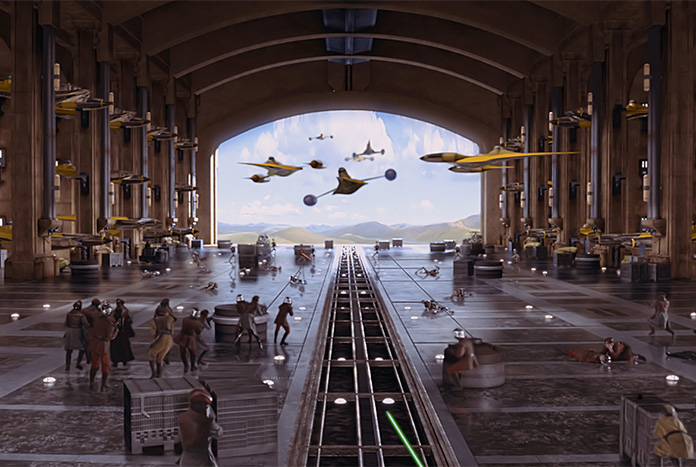
The Phantom Menace was the most ambitious visual effects project ever undertaken at that time, and the first of its kind to cross the 2,000-shot mark. Any opportunity to streamline production time proved essential as the Rebel Unit helped create a slew of elements in the movie, including shots of Queen Amidala’s royal starship in flight, elements of the Coruscant skyline and vehicle traffic, and Naboo starfighters in flight out of the Theed hangar. Led by sequence supervisor Stu Maschwitz, they also played a significant role in the creation of the climactic space battle over Naboo, animating many of the dogfights between the Naboo starfighters and Trade Federation droids. Their generalist work was directly integrated with practical miniature elements and other CG effects.
“We worked hard but we had so much fun,” Heath continues. “It was a new thing. We still felt that we were a part of the ILM’s CG department, but we were kind of in our own little world.” As Brooks explains, it was a “very collaborative environment” with “everybody just helping each other out. There were maybe 14 or 15 people in the whole group, very small. We were lucky enough to share a wall with the Model Shop.”
Read the entry in full at Lucasfilm.com.