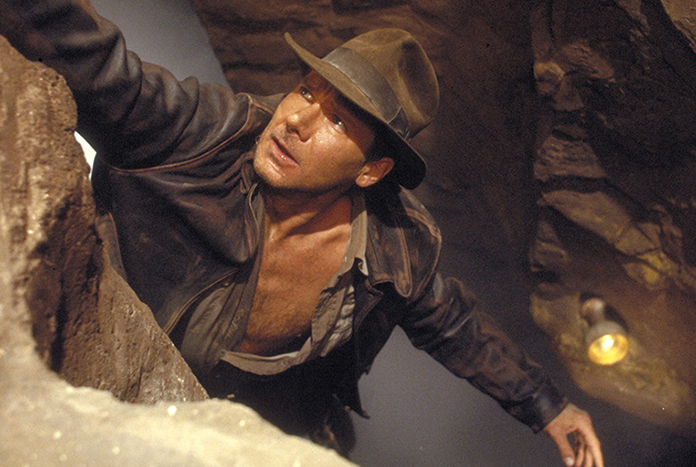
“The Real Indiana Jones” is a series at Lucasfilm.com that explores the man behind the fedora, and in this instalment they take a look at how some of Indy’s fears are on the surface whilst others run much deeper.
Any discussion about Indiana Jones’ fears must begin with his aversion to snakes. All of us can be stopped in our tracks by seemingly innocuous things. A fear of snakes isn’t entirely irrational, of course, especially if you happen to meet a venomous cobra in an Egyptian tomb. But Indy more easily overcomes equally scary or deadly obstacles (think insects, rats, and so forth). Nothing can stop Indiana Jones – boulders, tanks, hordes of soldiers – but show him a friendly, nonpoisonous snake and he’s a goner.
As we see in the opening of Indiana Jones and the Last Crusade, a teenaged-Indy idly moves a snake aside as if it weren’t a nuisance at all. Only moments later aboard a circus train, he falls into a tub full of the slithering reptiles and is henceforth afflicted with this all-too-human foible (though never used in the series, the clinical term is “ophidiophobia”). Over the course of our lives, we pick up psychological baggage that we each carry in a unique assortment. Indy’s fear of snakes is a poignant, humorous element that stretches back decades to his adolescence. Other fears and insecurities go back even further and motivate the hero in much deeper ways.
Image: Fleeing from a band of grave robbers, a teenaged Indy develops his fear of snakes.
It’s no secret that Indy’s relationship with his father was complicated from the start. During their world travels as seen in The Adventures of Young Indiana Jones, the pair struggle to connect in a meaningful way and often get on each other’s nerves. Henry Jones, Sr. seems not entirely comfortable with fatherhood and struggles to balance his academic passions with his investment in his son’s life. From his youthful days, Indy can make friends with almost anyone in any place. By contrast he is intimidated by his father, who provides few openings for emotional connection.
During their trip to Russia, Indy and Henry reach a boiling point as the former repeatedly gets himself into trouble, much to the embarrassment of the latter. As tensions run high, Indy decides he’s had enough and runs away. Though he safely makes it back to his family after a harrowing adventure (including a run-in with famed writer Leo Tolstoy), this becomes a common decision for Indy in the years to come.
When faced with an insurmountable problem – not one involving booby traps, historical mysteries, or nefarious antagonists, but rather those involving human relationships and psychological trauma – he skips town. He might retreat back to the quietness of his academic work or race out into the world in pursuit of treasure. Perhaps the most heart-wrenching example is his relationship with Marion Ravenwood. Though never explicitly detailed, it’s implied that Indy ran away from a commitment to the love of his life on more than one occasion, what Marion piercingly describes as his “leaving behind a trail of human wreckage” in Indiana Jones and the Kingdom of the Crystal Skull.

Read more at Lucasfilm.com, and watch Indy’s past adventures, the original four films and The Adventures of Young Indiana Jones TV series, now on Disney+.
Indiana Jones and the Dial of Destiny is released on June 28th in the UK and Ireland, and June 30th in the rest of the world.