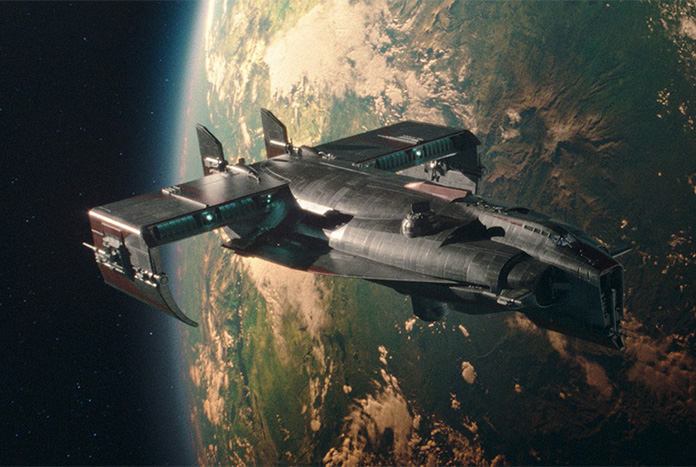
Julian Foddy, longtime ILM London artist, shares his insights into creating the many worlds of The Acolyte from both the surface and outer space.
The Acolyte’s production visual effects supervisor Julian Foddy used a favorite book to help realize many views of outer space in the Lucasfilm series. While aboard the International Space Station, British astronaut Tim Peake took high-resolution photographs of Earth and its atmosphere, which were subsequently published. “I wouldn’t say I was obsessed with the book,” Foddy notes with a smile, “but I was very keen to make sure that the atmospheres that you see around the edges of the planets were all physically realistic.
Peake took incredible images of the edge of the Earth at various conditions and angles to the sun,” he continues. “It’s amazing how differently the light plays and refracts and wraps around the Earth when you’re going around to the dark side of the planet that’s in night. We put a lot of effort into replicating those looks and playing around with how thick the atmosphere would be based on the planet’s size and so forth. It’s not just copying Earth. Hopefully, it adds a bit of physical reality to all those atmospheres.”
The conditions of light in space were used to a mesmerizing effect in a chase sequence from The Acolyte’s finale episode, where the Jedi Sol (Lee Jung-jae) and Mae (Amandla Stenberg) race through an asteroid belt that forms the rings of Brendok’s moons. As Foddy explains, the concept arrived relatively late in development as a means to separate the two characters. “Asteroid belts provide a lot of obstacles and things to interact with in space, of which there are not many,” he says. “We’ve seen asteroids a lot in Star Wars before, so [production designer] Kevin [Jenkins] had the idea of using the moon’s rings that have an unusual coloration with blue and turquoise. There’s an aqua-marine feeling to the crystals, as if they’re made of ice or minerals.”
Foddy explains what he calls “the pseudo-science” behind their approach to the crystals and their separation: “If these rings are being held in place by gravity and they’re made from some sort of crystal, maybe the different bands of gravity are pushing the crystals together at different densities that refract light in different ways, which is why the colors and light change. We have amazing shafts of sunlight, bits of crystal floating for volume and atmosphere, and you could get these god-rays, as we call them. Then we enter the dark side of the moon and we go into shadow, which allows a dramatic reemergence back into the light.” The result is a beautiful sequence to watch, with multi-colored layers of rock and crystal that feel almost like the iconic slit-scan effects seen in films like 2001: A Space Odyssey (1968).
Mixing Skillsets
After nearly a decade with Industrial Light & Magic’s (ILM) London studio, Julian Foddy stepped into a new kind of role for The Acolyte. As the overall visual effects supervisor, he was based with the show’s own production team, and coordinated the efforts of not just ILM’s work, but the six vendor studios around the world. English-born, Foddy actually began his career in music, working as a DJ and recording producer before switching careers and entering visual effects, first in a long stint with Double Negative.
“As a creative skillset, music stays with me in terms of the marriage of art and technology,” Foddy says. “Being a record producer is learning to use technology in a creative way. There’s a certain amount of that in computer graphics in general, the ability to be both technical and artistic.
“But where my career in music and being a DJ has done me the most favors is in my sense of confidence and ability to interact with people,” Foddy continues. “I was quite shy as a teenager, and when I took up being a DJ, I found myself performing in front of hundreds if not thousands of people. That made me more self-confident in general, and when I got into visual effects, that helped me become a leader and learn to interact with directors and actors and things like that.”
A Childhood Dream
Joining ILM London within its first year of operation, Foddy had a particular motivation. “To be honest, the move to ILM was always motivated by Star Wars,” he admits. “As a lifelong Star Wars fan, the fact that ILM had opened up in London and there was a possibility of visual effects work on Star Wars was one of the few things that would’ve tempted me away from that previous job.” He didn’t have to wait long, joining the production of Rogue One: A Star Wars Story (2016) as it neared completion. “The seven-year-old boy within me was reawakened,” Foddy says. “The first day on set, I was in the base on Scarif which looked a lot like being inside the Death Star.” He’d later work on both Solo: A Star Wars Story (2018) and the second season of The Mandalorian (2020).
“What was great about doing Solo is that I actually worked quite closely with [ILM’s executive creative director] John Knoll in post-production,” Foddy notes, “so it was an opportunity to learn a lot of the little unwritten rules of the visual effects of Star Wars. There are quite a lot of things that perhaps you wouldn’t pick up on, but once they’re pointed out to you by a master such as John, they become imprinted in your mind. Those visual lessons have carried forward onto this project.”
Those lessons can be simple or involve very specific elements, but together they add up to the unique storytelling world that is the Star Wars galaxy. “When you’re lighting ships for space, the Star Wars look that everyone’s familiar with was based on miniatures being shot,” as Foddy explains one example. “When you’re shooting miniatures, you’re using spotlights that aren’t an infinite distance away like the sun is, and so they cast shadows in a different way than an actual sun would. So when you’re doing a scene in CG and there’s a temptation to have a sun that’s millions of miles away causing parallel rays with parallel shadows, it doesn’t look like the way the miniatures were shot. If you replicate the miniature style, the shadows will very subtly fan out, and doing that helps the audience tie the visual language of digital Star Wars back to analog Star Wars.”
Organizing the Production
The Acolyte’s production involved many elements that harkened back to earlier Star Wars films, including extensive set construction at Shinfield Studios in England and location shooting in multiple countries including Wales and Madeira (an Atlantic archipelago off the coast of Africa and a region of Portugal). Foddy joined the team organized by showrunner Leslye Headland in the summer of 2022. Filming began that autumn, extending through May of 2023. The visual effects work during post-production continued through the late winter of 2024.
All told, nearly 3,000 shots were created across the series’ eight episodes. ILM’s studios in London and Vancouver, Canada led the effort, with additional contributions from the newer office in Mumbai, India — The Acolyte shots were, in fact, among the studio’s first completed work. Smaller vendors contributed shots and assets from locales as diverse as Adelaide, Australia (Rising Sun Pictures), Montreal, Canada (Hybride), Los Angeles, California (Luma Pictures), London (Outpost Visual Effects), and Vancouver (beloFX).
With plenty of experience as an onset visual effects supervisor on feature films, Foddy initially expected to take the same role day-to-day for The Acolyte. That changed, however, with the varied demands of an episodic series. “In episodic, it’s more of a broken-down process where the shoot happens in blocks with different directors,” he explains. “Earlier blocks are turning over while later blocks are still shooting. It very quickly became a realization that I couldn’t spread myself so thin. If I was onset the whole time, I was constantly trying to run away to do turnover meetings. So, for the second half of the shoot, I adopted more of an overseeing role and deferred to my associate visual effects supervisor Kyle Goodsell and also our amazing second unit set supervisor Dan Pearson and trust them to run the units down on the set whilst I was up in the office turning over the earlier blocks and getting things like pre-viz and post-viz going as well.”
Foddy still managed to keep a hands-on approach, often building out the initial post-viz for shots in space on his own. “I come from a generalist background before I became a CG supervisor and then a visual effects supervisor,” he says. “As the edits came up, and we’d get an edit with a card that said ‘Space Establishing Shot of Brendok’ or something, and I’d jump on that. When I got home, after my family had gone to bed, I’d log onto the ILM network and fire up Maya and mash out a version of the shots. Sometimes, if you’ve got an idea in your mind of what you want, and you are capable of doing it yourself, it reduces the iteration time and makes it smoother for everybody involved. Not only is great to be creative, but it’s also just savvy for the project sometimes.”


Read the article in full here, and watch the full season of The Acolyte, streaming exclusively on Disney+.