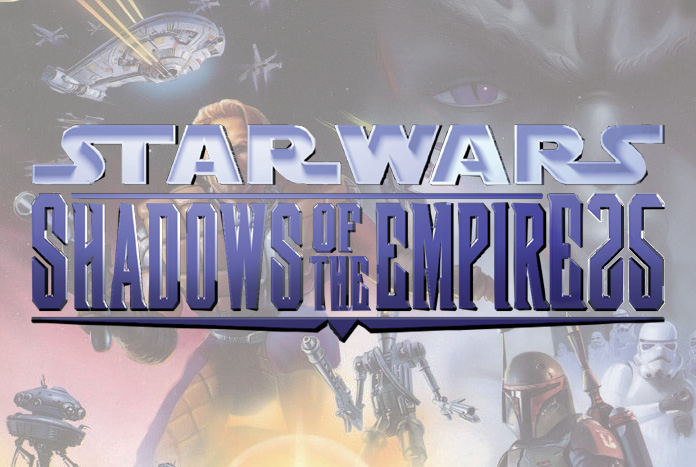
Now, Jon Knoles isn’t necessarily a household name to many Star Wars fans, but if you have played many of the LucasArts games produced through the 90’s and 00’s, it’s more than likely he had a major involvement their development and design.
Knoles joined LucasArts in 1990 and was hired as an artist/animator in 1990 and moved up to become a Project Leader in 1995 during the Shadows of the Empire game development. After the success of Shadows and other releases he had probably one the best job titles you could ever have, “Director” until he left for pastures new in 2004.
As well as helping pioneer new game development for the Nintendo N64 and other gaming platforms, it is alleged that Knoles was the model for Dash Rendar, the lead character in the game for Shadows of the Empire. So, is there any truth in that?
Now, that is a question we needed the ask, isn’t it?
Jedi News – Hello there Jon, welcome to Jedi News! How are you?
Jon Knoles – Great, thanks, all things considered in a COVID-19 world, working from home, and also working on long-overdue home improvements!


Let’s go back to the start by asking about the early part of your career and how you became involved in the world of computers and eventually, video game development?
JK – I went to a commercial art school directly after graduating from high school in 1987, interested in becoming an illustrator or product designer. Dreamed of designing cars, or concept artist for films like some of my art heroes Syd Mead, Joe Johnston, and Ralph McQuarrie. Computer graphics were only just starting to emerge at the time. Most of the art I created in those days was by hand, with a little exposure to graphic design and painting programs of the day. A few months after graduating art school, I landed my first game development job at Taito Software Inc., working on Indiana Jones and the Last Crusade for the 8-bit Nintendo system.
My own personal introduction to computers was via a Sinclair ZX-80 that was purchased for me by my grandmother back in 1981. There is a story of Mark Haigh-Hutchinson placing one these 8-bit devices on top of the Silicon Graphics Onyx 256-bit machine in the office as a reminder of where things started. Do you still own any and use retro gaming devices?
JK – I might have one or two buried in a box in the garage somewhere if I didn’t give them away years ago. Never was much of a collector of game consoles. Had most of the major consoles over the years, and a few gaming PCs along the way. Nowadays I’m pretty much just playing my Xbox Series X.
Where and how did your own personal journey with Star Wars start?
JK – For my 8th birthday in May 1977, my Dad took my friends and I to see Star Wars when it first came out. That was mind-blowing for us and made a pretty huge impact on me personally. I drew a lot of pictures as a kid, mostly hot rod cars and spaceships that looked like traditional rockets. Star Wars showed me that spaceships could look like anything you imagined. Before Star Wars, a friend and I used to turn over big animal posters we’d earn from selling scholastic book club subscriptions after school and draw western gun battles on the back, cowboys shooting at each other, falling out of windows and such. After Star Wars, it was all space battles on the backs of those posters.
What do you remember from the initial meetings about developing Shadows?
JK – I recall landing pretty quickly on the timeframe – between Empire and Jedi – something I pitched as this was to me the most interesting and least explored time period. I also wanted to focus on the criminal underworld and Boba Fett’s challenges delivering the frozen Han Solo to Jabba the Hutt with every other bounty hunter in the galaxy trying to steal his prize. The original concept would have the player take on the role of Boba Fett within that story construct.
What did you know about the Nintendo N64 before starting the project?
JK – We had very early access to the N64 technology, or what Nintendo called “Project Reality” at the time, and the emulator that ran it, a Silicon Graphics “Onyx” machine, which was about the size of a dishwasher. It was hard to believe Nintendo was building a small game console that had the same graphics power as that monster! We also had early access to their top-secret controller, the first with an analogue joystick. We weren’t allowed to show anyone. Had to keep it in a box with holes cut in both sides to put your hands through without seeing it.
With Shadows being launched on N64 and PC, what technical differences are there developing for these 2 different platforms?
JK – At the time, the N64 was actually much more capable than PCs at real time 3D rendering. It wasn’t until the advent of early 3D accelerator cards that we committed to building a PC version. It also afforded us the opportunity to create new FMV (Full Motion Video) cinematic sequences instead of 2D cinematics used on the N64 version.
Developing for a new gaming system must have been empowering and daunting at the same time. Were there any technical breakthroughs made or pitfalls you experienced while developing Shadows?
JK – Shadows was a showcase of both technical breakthroughs and pitfalls. We did a lot of things few developers had attempted at the time. Too much, in hindsight. 1st and 3rd person shooter, low-altitude flight, speeder bike, gun turret gameplay, full 3D spaceflight, riding on a moving train. That’s like 6 games in one, fraught with development pitfalls. The takeaway after Shadows was to do one thing and do it well. My team’s next game, Episode I Racer, was all about eye-peeling speed, nothing else. The result was a much more focused, polished and fun experience.
How much input did you have into the storyline and artwork used in the game?
JK – There was an overall story arc coming together, mostly driven by Steve Perry’s novel. As with the comic book series, which had its own spin, we had a lot of freedom to make the game’s plot work for the gameplay we wanted to create. For example, we knew we wanted to let players take part in the Battle of Hoth from the start, even though that didn’t fit neatly into the novel’s story. There were other elements like that which weren’t in lockstep with the novel. As for the artwork in the game, that was pretty much entirely driven by the game team, apart from Dash Rendar’s appearance, which was a collaboration between game, novel, comic, and action figure teams.
Were there any ideas put forward to you that would like to have included, but even though the N64 platform was so advanced, the ideas had to be shelved as it was a step too far?
JK – I’m sure there were some of those – flying Dash Rendar’s ship the Outrider through an asteroid field, for example (we ended up changing that to gun turret gameplay with the ship on a pre-set path), but honestly, we were already doing too much. If anything, we should have shelved more.
It is well documented that Dash Rendar was created to look like you, and I love the fact that video game and comic book creators can do this so freely and sometimes very surreptitiously. Are there any other team members in the Shadows game or other games you yourself appear in?
JK – I’m not sure how that rumor started, lol. Dash’s facial appearance in the game was more closely based on a model our storyboard artist hired to pose for his drawings whose name was Zeb (a great Star Wars name by the way!). I had to age him up a bit because Zeb was a lot younger than Dash, but his face on the cover (which I did the artwork for as well), is pretty much what Zeb would look like if a bit older, more muscles and with longer, redder hair.
What can you remember from the launch of Shadows?
JK – Mainly relief that we got it done before the holidays, having missed our planned release date in November by about a month. As it was also my first game as lead designer, I was also hopeful and anxious about critical reaction. When mixed reviews started coming in, I was disappointed, but the game’s success was undeniable and was well received by players. It was a learning experience for the me, the team, and the entire company, being our first real time 3D console game. It also left a powerful legacy. The vehicle technology we developed led directly to the Rogue Squadron series, and the character tech helped the Dark Forces 2: Jedi Knight team get up and running in full 3D.
The Nintendo N64 was ground-breaking at the time like GoldenEye 007 and The Legend of Zelda: Ocarina of Time. Similar to Shadows, they have a huge fanbase to this day, why do you think that is?
JK – Those were terrific games that truly showcased the power of the console. GoldenEye’s 4 player split-screen in particular (which was a late add by the development team), in my opinion became a watershed moment in console gaming. Ocarina of Time’s epic scale and sense of adventure was its signature, as was its perfectly realized main character. It set the early bar high for every open world game to follow.
How aware were you of the impact Shadows had on so many fans of Star Wars?
JK – It took me a while to recognize it. Over the past few years as streaming and retro gaming have become more popular, I’ve come to realize many adult gamers out there today who were kids when Shadows came out – for many it was among their first games – have a pretty deep nostalgia for it. For all its faults, it did have a lasting impact on many.
Which part of the Shadows experience created a lasting memory for you?
JK – I’d say it was probably similar to one of the lasting memories most players had at the start of the game, the first time I piloted a rebel snowspeeder though an Imperial walker’s legs, fired my tow cable, successfully hobbling and toppling it. That was something no one had ever seen in real time 3D on a home video game console.
You had quite an illustrious career with LucasArts and worked on many Star Wars projects, how did Shadows rate amongst those projects?
JK – Shadows will always occupy a special place for me. It was something like my tenth game at that point as an artist an animator, but my first as lead game designer and co-project leader as well. It was a huge learning experience too. I learned not to do too many jobs at the same time. I learned not to design too many disparate gameplay styles in one game. It was difficult to make, but not the most difficult by any means. It was a tight development schedule, but not the tightest either. It also turned out well in spite of all those challenges; I’ve worked on better games, and I’ve worked on worse games. I’m still proud of what we accomplished and pleased that a lot of gamers remember it fondly.
If asked, could you be tempted to redevelop Shadows for one of the current day consoles or even consider working on a different Star Wars project in the future?
JK – I’m not sure remaking Shadows would be appealing to me personally. It was a moment in time, the right kind of game at the right time. If I were to revisit it, I’d do everything differently, which might result in something completely at odds with what made it unique or memorable at the time. Hard to say. As for a different Star Wars project, I’d never say never. I made Star Wars games almost exclusively for 14 years, but I’ve been away from it for even longer, and I’ve learned a great deal about how and how not to develop games. I wanted to make a follow up to Star Wars: Bounty Hunter that would feature Boba Fett’s rise to infamy. It even involved a bonus mission where you were hired to capture Dash Rendar, dead or alive.
Oh, wow! I know I’d be up for buying that.
You no longer work for LucasArts, so what are you up to these days?
JK – I’ve been a design director at Turn 10 Studios since 2010, working on the Forza Motorsport and Forza Horizon series (the latter developed by Playground Games in the UK). It’s fun to have a job working with another childhood passion – cars – and to work on great games for a franchise that’s been growing exponentially in popularity over the years.
Jon, it has been absolute honour and pleasure to speak to you and we would like to extend a huge Jedi News thank you to you for being part of our Shadows of the Empire 25th Anniversary celebration.
JK – Thank you for having me. It’s fun to take the trip down memory lane. Wait – 25 years? How did that happen?!
Jon Knoles is still busy working on new gaming projects for Turn 10 Studios as Design Director and you keep up to date with what he is up to by follow him on Twitter.
The team at Jedi News would like to say a big thank you to Jon for taking the time to talk to us.