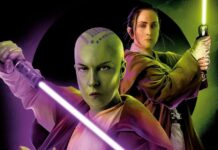
Published: June 23, 2020 (US) June 25, 2020 (UK); Paperback February 23, 2021 (US) February 25, 2021 (UK)
Author: Alexander Freed
Cover Artist: Jeff Langevin
Publisher: Del Rey
Formats: Hardback (393 pages), eBook (396 pages), Audiobook ( 887 minutes)
Timeline: 5 ABY
The synopsis;
Alphabet Squadron’s hunt for the deadliest TIE fighters in the galaxy continues in this Star Wars adventure!
News of the New Republic’s victory still reverberates through the galaxy. In its wake, the capital ships of the newly legitimized galactic government journey to the farthest stars, seeking out and crushing the remnants of imperial tyranny. But some old ghosts are harder to banish than others. And none are more dangerous than Shadow Wing.
Yrica Quell’s ragtag Alphabet Squadron still leads the search for Shadow Wing, but they’re no closer to their goal—and the pressure to find their quarry before it’s too late has begun to shake them apart. Determined, Quell works with New Republic Intelligence’s contentious Caern Adan and the legendary General Hera Syndulla to prepare the riskiest gambit of her starfighting career—a trap for Shadow Wing that could finish the chase once and for all.
But in the darkness, their enemy has evolved. Soran Keize, last of the Imperial aces, has stepped into the power vacuum at the head of Shadow Wing, reinvigorating the faltering unit in their hour of need. Once adrift in the aftershocks of the war, Keize has found meaning again, leading the lost soldiers of his unit through to safety. The only thing standing in his way? The most mismatched squadron in the New Republic Navy, led by his former mentee: the traitor Yrica Quell.
The review;
 Let me be honest. During this pandemic, I have been so filled with anxiety for my family, my students, my community, and my species– I really hadn’t had room to add new individuals to my sphere of anxiety. The Handmandians of Queens Peril, Doctor Aphra and her chaotic love life, and even cute little Grogu and his uncertain fate: I had no room for any of them in my Death Star of Lockdown Gloom. Instead, I retreated to the company of old friends; Shug Nix and Val of Dark Empire, Corran Horn and Wedge Antillies of Rogue Squadron, and the feisty ladies living out their old age together in the Floridian condo of The Golden Girls. I truly only indulged in two new works of fiction during the past 10 months and both of them featured rather unlikeable characters; the Canadian sitcom Schitt’s Creek, and Alexander Freed’s second book in the Alphabet Squadron saga Star Wars: Shadow Fall.
Some readers found Shadow Fall to be a quick read. I obviously did not. The text can be dense and sometimes bleak. Yet, the reader is rewarded by prose rich with meaning. Space battles are brilliantly told from the perspective of those who fight them; and the psychological battles that never cease to end in the minds of his characters are where Freed really shines. Freed’s prose often rises to poetry. This passage particularly struck me;
“One vessel was missing the solar collectors on its port wing, leaving its naked side albino white. Another lacked its cockpit viewport, as if someone had gouged out its eye. A third TIE had had both wings amputated altogether.”
Freed’s use of metaphor (star fighters as damaged and mangled people) echoes the theme of the book; that the pilots who fly the star fighters are damaged as well. Freed creates lyric poetry in the form of soldier ballads too, something he did in prior works like Battlefront: Twilight Company (the 61st Mobile Infantry make an appearance in this book also). Even his chapter subtitles evoke poetics, with titles like “The Joyous Togetherness of Shared Suffering,” “Six Trillion Suns and None,” and “That Which You Take With You.” The latter being an obvious reference to Luke’s mystical experience in the Dagobah cave, appropriate as that chapter title precedes Yrica’s mystical experience in an abandoned Sith temple.
What Freed says about these Star Warriors, he may be saying about us too. Freed cements himself as one of the most brilliant writers in the Star Wars literary stable. In my review of this first book, Alphabet Squadron, I remarked that this was not the Rogue Squadron of the Legends books of the 90s. The contrast is even more stark in Shadow Fall: so much so I wonder if this is a conscious decision of Freed’s. One can view Shadow Fall as a deconstruction of the fighter pilot as hero mythos in much the same way that The Last Jedi was a deconstruction of the Luke Skywalker mythology. Rian Johnson used flashbacks to explain the context of Luke’s self-exile in the film’s present. In Shadow Fall we learn how the past of the pilots of Alphabet squadron shaped their present as well. Hurt people, to Freed, hurt people.
It is revealed in Shadow Fall that Aden, Kairos, and IT-O managed to escape from a brutal Imperial concentration camp leaving them with PTSD from that experience. We do not learn much of Kairos’s mental health beyond IT-O’s cryptic snap to Yrica that “Kairos has her own challenges. They are classified…” however the absence of Kairos’s point of view is telling in its own right. Aden has survivor’s guilt over leaving friends and fellow collaborators behind. The Balosar spymaster is especially tortured over betraying his ally Ver Iflan, the one who reprogramed IT-O and planned the escape from Imperial captivity. Adan tries to redeem that act by saving those around him. Saving people like Kairos and even Yrica. But, in these actions he finds no solace, continuing to self-flagellate himself with guilt and with whiskey. “My conscience bothers me just the same,” he tells Yrica before adding. “why else… do you think I kept a torture droid around?”
The hotshot pilot that is a hot mess herself, Yrica Quell, we learn, has had issues with abandonment. Her father, deep in bottles of brandy, was absent in her life; so she tried to fill that void with a string of doomed romances. When she is to abandon the Empire with her girlfriend for the Rebellion, she is once again abandoned. Left alone. Again. She stayed in the Imperial Navy—in an Empire she had grown up to hate.
She lies about her past, about her role in Operation Cinder and the death of the planet Nacronis, to her therapist, the former torture droid turned psychologist, IT-O. Not just to escape any retribution from Aden or the New Republic, but to shield herself from the truth of her past. Yrica doesn’t view herself as someone worthy of love, as her past relationships show her. So, then, why would she be worthy of friends, or a home, or a squadron? Or the respect shown to her by General Syndulla, whom we know from Rebels to have always been able to see the potential of those around her. Hyra Syndulla places her faith in Yrica by giving her a squadron, trusting the wisdom of her battle plans, and offers her a true home aboard the Lodestar. Yet, to Yrica, that faith is misplaced. Like an unshielded exhaust port right below a main reactor, Yrica’s lack of self-worth is her true character flaw that—like the flaws in a Shakespearian drama—explains her past mistakes as well as the huge mistakes she makes in this novel.
“Truth is a Poison,” thinks Yrica. Yrica sees the truth, her truth, as a Sword of Damocles ready to fall and bring with it more abandonment and heartache. Freed provides a sword metaphor thus: “Quell’s relationship with the lot of them was over, all ties severed by the blade that had hovered at her throat since Traitor’s Remorse.” Yrica fulfils her own prophecy.
Chass na Chadic’s story proves to be one of the most interesting in the book. Like Yrica, she too came from a broken home. Unlike Yrica, she filled that void not with girlfriends (well, there is that too) but with the religion of a tyrannical cult. Religiosity is not new to Star Wars. Indeed, the religion of the Jedi and the Sith are central to the saga. But, a look into the religious life of the common, every day, non-force sensitive, galactic citizen has been rare thus far in Star Wars narrative fiction. Rogue One: A Star Wars Story and tie in media like Greg Rucka’s Guardians of the Whills provided one look at religious sects prosecuted by the Empire. J.J. Abrams’s The Force Awakens shows us Lor San Tekka’s Church of the Force—a sect persecuted by the First Order. Freed gives us the highly armed Children of the Empty Son—a sect that persecutes their own members to consolidate power amid the power vacuum that exists in the wake of the fall of the Empire. Chass’s past experience with cults certainly colors her time with this cult in the present, and most certainly will affect her future.
Wyl and Naith are also shaped by their past. Well, Naith hides from it—but Wyl wants to run to his. Wyl daydreams of leaving the New Republic, going AWOL and returning to his planet, the aptly named Home. When the squad needs true leadership, Naith (the most veteran of the fighter pilots) abdicates and Wyl is thrust into a position of responsibility. Naith did not delegate authority to young Wyl as a way for paving the way for a younger generation of leaders (like General Organa did with Poe Dameron), but as a way to avoid that responsibility himself. Naith regularly rebuffed Wyl’s requests for help and guidance. As a result, the reader sees Wyl grow as a person and blossom as a leader. Wyl leads the ragtag squadron of starfighters and airspeeders, with pilots with great names like Gorgeous Su (flying a Scooty-Puff JR like HoverCat into battle), with compassion and resourcefulness. Wyl remains the light of hope in this book. The one character who is likeable. Yet, like Chass using her grief at the loss of Fadime and Yeprexi and Quaysail and Hound Squadron and the Cavern Angels to keep the others at bay; the reader is at this point hesitant to fully embrace Wyl Lark as well. The book is full of tragedy and grief. We, like Alphabet Squadron, are damaged as well and cannot take more heartbreak.
Villains are a victim of history as well. Soren Keize, we learn, is an Imperial with no fealty to the dead Emperor Palpatine or his New Order. His loyalty is to himself (as only in Imperial service is he free of prosecution from the New Republic), and to a lesser extent to his subordinates (how a colonel and not an admiral leads an Imperial flotilla is never addressed). Those subordinates are trapped in the past as well, as Freed illustrated in a most eerie and creepy fashion. A shrine to the late Emperor is fashioned by Soren’s pilots at the feet of a lifeless Messenger Droid. The droid, swathed in a blood red cloak, once projected the face and voice of the late Palpatine. Soren Keize witnesses a pilot religiously drawing a drop of his own blood as an offering to the droid, as the young man prays to his dead Emperor for guidance in the battle to come.
I listened to the audiobook version of Shadow Fall as well, and once again Random House Audio delivers a fantastic reading experience. Carol Monda does a great job reading the voices of the characters, and it is good to have a female voice actress provide the narration for a female dominated text. I would have liked to have heard music cues taken from the DJ Rex Playlist as can be heard at Star Wars Galaxy’s Edge (or at a streaming service near you if you, like me, have never been out of this solar system) when the novel refers to the music Chass plays in her cockpit, and not the generic electronica used in the audiobook. I never heard Corellian Folk, Cryptosymphonic House, Scatterbob, or Weequay Power Ballads, but I would like to…I think.
Both Schitt’s Creek and Shadow Fall feature a cast of characters that are unlikeable; and yet they are the characters I allowed onto my Death Star of Pandemic Anxiety. Over my binge watch, I saw the Rose family learn to love and accept each other a little bit more each episode. By the wedding episode, I was in tears; overcome with the warmth and tenderness the Roses had shown to one another. A show with an unfortunate name featuring unlikeable people at the start, had ended with one of the most heartwarming episodes of all of television. Alexander Freed will conclude the tale of Alphabet Squadron this month, when Star Wars: Victory’s Price hits bookstore shelves this week. Will Yrica, Chass, Wyll, Naith, and Kairos have a heartwarming final episode of their own? Or will their past, and their past actions over the course of the last two books, be a prologue of the hurt to come? I hope it is the former. If not, it is a good thing I still have my Netflix account. I just may have a wedding to go to. Again.
Availability;
Star Wars: Shadow Fall by Alexander Freed is published by Del Rey. It was released on June 23, 2021 in hardback in the US, and June 25 in the UK. The paperback edition was released on February 23, 2021 in the US, and February 25 in the UK. It is available in hardback, eBook and audiobook formats from all good high street bookstores and online, including Amazon UK and Amazon US.