Published: December 1, 2020
Publisher: Abrams Books
Author: Phil Szostak
Foreword: Doug Chiang
Format: Hardback ( pages)
RRP: £30 (UK), $40 (US), $50 (Canada)
The synopsis;
This official behind-the-scenes companion to the Disney+ Star Wars series The Mandalorian features exclusive concept art, character and costume sketches, and vehicle and creature designs.
The Art of Star Wars: The Mandalorian takes fans behind the scenes of the first ever live-action Star Wars television series. Filled with concept art, sketches, and interviews with key cast, crew, and creatives, including executive producer/showrunner/writer Jon Favreau and executive producer/director Dave Filoni, The Art of Star Wars: The Mandalorian will provide readers with an exclusive look at a whole new universe of Star Wars characters, locations, and vehicles.
Premiering in November 2019 as a key launch title for Disney+, The Mandalorian follows the adventures of galactic gunslinger Din Djarin and the Child as they traverse the outer systems of the Star Wars galaxy. Readers will encounter early visual and conceptual ideas for these new characters and unexplored frontiers, filled with crime syndicates, bounty hunters, and smugglers. The gritty, lived-in cantinas and spaceports are populated by a talented cast that includes Pedro Pascal (Game of Thrones), Werner Herzog (Fitzcarraldo, Grizzly Man), Nick Nolte (48 Hours), Gina Carano (Haywire, Deadpool), Giancarlo Esposito (Breaking Bad), and Carl Weathers (Rocky).
The review;
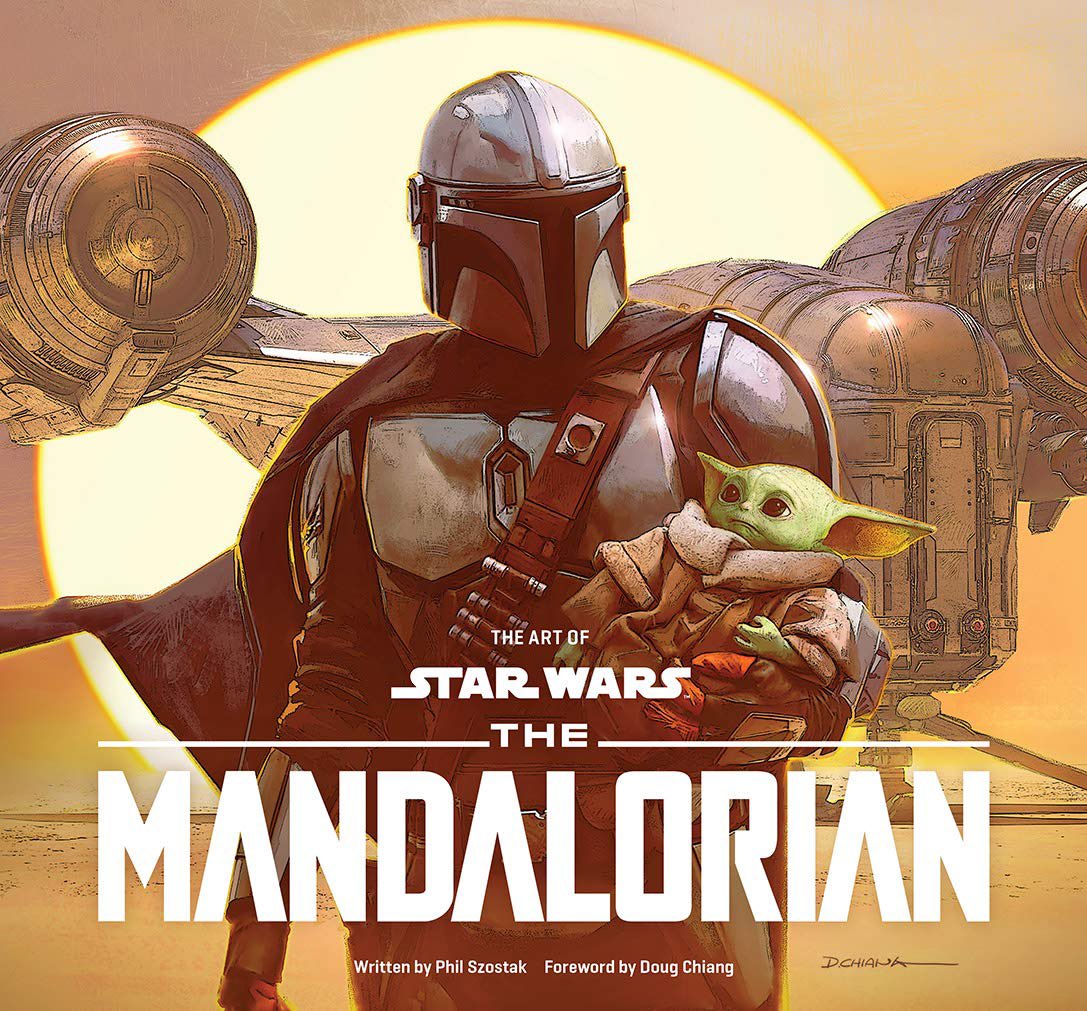 The Art of Star Wars: The Mandalorian by Phil Szostak was probably one of the most anticipated books to be released in 2020. Unfortunately, the COVID-19 global pandemic resulted in varying supply chain issues, which meant that copies were hard to come by at the time of its release. Now there is a but and a very big but at that point… BUT… it was well worth waiting for!
On the front cover of the dust jacket, we are treated to a now well-known image of Din Djarin carrying a slightly worried looking Grogu in front of the Razor Crest. A striking image from the legendary Doug Chiang that in my eyes is now becoming iconic. On the rear cover we have an image of Moff Gideon and flanked by Death troopers which to me is simply perfect. This is by Brian Matyas and has Gideon’s landed TIE Fighter in the background. The mood and atmosphere jump off the cover. Then as with any ‘The Art of…’ book, when you take off the dust jacket we are treated to another illustration. This time it is of IG-11 careening over the lava fields of Nevarro on an Imperial speeder bike. This is a collaboration between Chiang and Nick Gindraux and I must admit I’d love a print of this image framed and hung on my study wall.
If you have one of the many ‘The Art of…’ books in your collection already you will know that they stick to a tried and tested format. Why fix something that isn’t broken? But there is something slightly different about this one. This is the first to tie into a live action Star Wars TV series, so the chapter structure is adapted to fit each chapter of season one.
The foreword from Doug Chiang highlights the differences experienced from creating a TV series rather than a movie, but with its core values still set to stay true to George Lucas’s original ideologies and ambience.
The ‘Who’s Who’ page always makes me marvel at how many people are actually involved behind the scenes just on the concept and development side. It always makes me smile when I see the names of George Lucas and Ralph McQuarrie included on this page. Without them both Star Wars wouldn’t be as iconic as it is, but their involvement is there to be seen in the sandbox they have left for the likes of Chiang, Church, Matyas, Filoni and Favreau to play in.
Then we get into the actual main core of the book. The talent within the concept team on display is phenomenal! The artwork is simply remarkable, at times utilising unused McQuarrie concepts as guides and bases for their ideas really does show how those original values are central to the development of ideas. This is driven by Favreau and Filoni and that is reinforced by the sketches from Filoni showing his ideas.
On screen we saw Imperial Remnant Stormtroopers, which were the usual trooper we know, but with dirty and yellowed armour. The concepts in the book for the original ideas were quite different. It makes the Imperial force look more like a guerrilla militia, almost rag tag and cobbled together rather than a regimented, although beleaguered force that we see in the final TV series. The clinical lines of Palpatine’s forces long destroyed by the victory of the New Republic. I can understand why this idea wasn’t used. The Imperial machine runs on discipline and a certain uniformity meaning that downtrodden look, although awesome, does not quite fit their demeanour.
If I need to be picky and point to something that I would like to see changed, I will have to say that I would like to have seen larger versions of the maps of the different extended sets. There is a complex map of Nevarro showing all the routes within the town and it’s surrounding areas that would benefit from being full page. I have a personal love for maps in their paper form, and this goes back to map reading with my grandad many years ago. Although they do not have a real-world function, I have learned to use them to help me better comprehend a story or scenario.
Each time I read one of these books I learn so much about what it takes to bring together what we see on screen. That can be in the form of taking an idea into concept and then developing it so it can become an important part of the story and a lasting memory for the viewer of the final product. I find it pretty remarkable how quickly these concepts can escalate and become iconic with fans in such a short space. That is something that has happened with so many that have been developed for The Mandalorian.
Szostak has smashed it out of the park yet again. It is littered with stunning artwork, anecdotal quotes from those involved and facts from behind the scenes that I crave. Combine all that with the quality of production from Abrams Books and it makes me feel that these books are a must have in anyone’s collection, and not just if you are a Star Wars fan.
Now that’s the book for season one out of the way, now we wait in trepidation for the book for season two!
Availability;
The Art of Star Wars: The Mandalorian by Phil Szostak was published on December 1, 2020 by Abrams Books. It is available from all good high street bookstores and from online retailers, including Amazon UK and US.